Dorset · England
Shallow-mount security bollard installation in Poole
Shallow-mount bollards supplied and fitted in Poole, Dorset: surveyed, scanned for services, set in proper foundations and finished to match the ground.
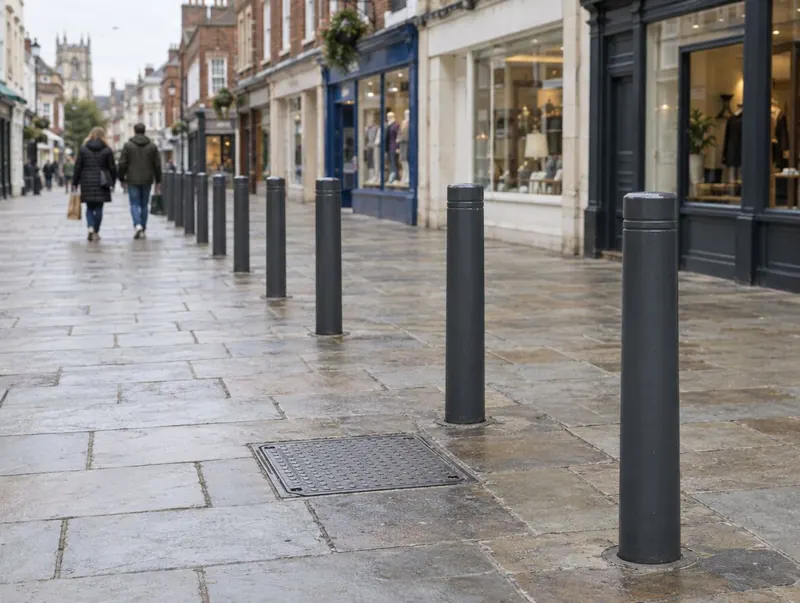 Computer-generated image
Shallow-mount bollards in Poole
From retail parks, town-centre streets and leisure centres, Poole has plenty of places where shallow-mount bollards earn their keep. Like any rated product, its performance applies only to the configuration and foundation that were tested.
We cover the BH15, BH14, BH17, BH13, BH12 and BH18 postcode districts in Poole. Nearby, we also work in Bournemouth (4.6 miles), Christchurch (9 miles), New Milton (14.2 miles) and Weymouth (21.9 miles), measured as the crow flies. It sits roughly 29 miles from Southampton as the crow flies.
Poole at a glance
- Area
- Dorset, England
- Highway authority
- Bournemouth, Christchurch and Poole Council (local roads)
- Planning authority
- Bournemouth, Christchurch and Poole Council
- Postcodes
- BH15, BH14, BH17, BH13, BH12 and BH18
- Guide price
- Typically £1,995–£8,995 per bollard + VAT; minimum job £4,995
- Survey
- Free, with a fixed written quote
- Nearby
- Bournemouth (4.6 mi), Christchurch (9 mi), New Milton (14.2 mi), Weymouth (21.9 mi)
Guide prices for Poole
| Specification | Guide price | Includes |
|---|---|---|
| Standard | £1,995–£4,945 + VAT | Rated for a 7.5 t vehicle at 30 mph (48 km/h), tested foundation |
| Upgraded | £4,095–£7,045 + VAT | Rated for 7.5 t at 40 mph (64 km/h), tested foundation |
| Premium | £6,195–£8,995 + VAT | Rated for 7.5 t at 50 mph (80 km/h), or a specialist foundation |
Per bollard position, supplied and installed; no regional adjustment. Guide only — the fixed price follows a survey.
Shallow-mount bollards in Poole: common uses
Around Poole, shallow-mount bollards usually solve one of these:
- Retrofits outside occupied buildings with tight programmes
- Bridges and structures where excavation depth is limited
- Listed or historic streets where deep digging is unwelcome
What we check first in Poole
In Poole, work on adopted pavements and verges needs consent from Bournemouth, Christchurch and Poole Council, the local highway authority. Car parks, forecourts and other private land only need the owner's permission.
If your site in Poole is listed or inside a conservation area, check with the local planning authority (Bournemouth, Christchurch and Poole Council) before choosing a finish — heritage settings often favour cast iron or painted steel over stainless.
Paving is often natural stone in the streets where these systems are used, so careful lifting, storage and relaying is part of the job. On decks and roofs, the waterproofing and drainage layers must be protected or rebuilt, and fixings must not puncture membranes unless the structural and waterproofing designers have agreed a detail.
- Get written confirmation from a structural engineer before installing on slabs, decks, basements or over voids.
- Check gaps work for wheelchair users and buggies while still stopping vehicles, referring to Inclusive Mobility guidance.
What happens on site
Confirm the system with the manufacturer
The survey findings go back to the manufacturer and the client's adviser to confirm the system, its layout and any end details. A fixed written quote follows the free site survey.
Cut and excavate the trench
Paving is lifted and kept for reuse where possible, and a shallow trench is excavated by hand near known services. Where a service sits higher than expected, work stops and the detail is referred back.
Record and hand over
As-built drawings show the frame position relative to services, which matters for anyone digging nearby later. Product certificates and photographs go to the client's adviser.
Options to consider
| Option | Detail |
|---|---|
| Removable posts within a run | Some systems include removable or retractable positions for maintenance or emergency access. Check how these affect the rating. |
| Modular cassette sections | Pre-made sections joined on site, allowing short runs and changes of direction within the manufacturer's tested limits. |
| Surface-mounted rated units | Some tested products sit on or very close to the surface with minimal digging. These are often used for temporary or semi-permanent protection and need careful checking of the surface they bear on. |
Pricing shallow-mount bollards in Poole
When we price shallow-mount bollards in Poole, these make the biggest difference:
- Amount of hand digging needed around live services
- Restricted working hours in busy streets or occupied sites
- Changes of direction, end details and removable positions
Looking after them
Once cured, a shallow-mount line needs much the same care as any static rated barrier: periodic visual checks, cleaning of covers and renewal of visibility bands. If one post is struck, the frame may have transmitted load to its neighbours, so the whole run near the impact should be checked with the manufacturer rather than replacing a single post in isolation.
For damaged or loose posts in Poole, repairs and replacements are priced in writing first.
Shallow-mount bollards in Poole: FAQs
Which parts of Poole do you cover for shallow-mount bollards?
We cover all of Poole (BH15, BH14, BH17, BH13, BH12 and BH18) and the rest of Dorset. We also work in Bournemouth, Christchurch and New Milton.
Do I need consent for shallow-mount bollards on a public footway in Poole?
In Poole, work on adopted pavements and verges needs consent from Bournemouth, Christchurch and Poole Council, the local highway authority. Car parks, forecourts and other private land only need the owner's permission.
What's a typical price for shallow-mount bollards in Poole?
In Poole, typically £1,995–£8,995 per bollard position, supplied and installed, plus VAT, with a minimum job of £4,995 plus VAT, using our South West guide prices. The fixed figure comes in writing after we've seen the site.
How much shallower is a shallow-mount bollard foundation?
Often a fraction of the depth of a conventional rated foundation, commonly a few hundred millimetres. The exact depth depends on the system and rating chosen. What you gain in depth is usually traded for width, because the load is spread along a linked frame.
What if a service turns out to be higher than the records show?
Work stops at that position and the finding goes back to the manufacturer and your adviser. Sometimes the frame can be adjusted within tested limits; sometimes the utility has to be lowered or the line moved. We do not improvise a change to a rated foundation on site.