Mid Ulster · Northern Ireland
Crash-rated bollard installation in Dungannon
Planning crash-rated bollards in Dungannon? We check ownership, consents and buried services first, then quote a fixed price.
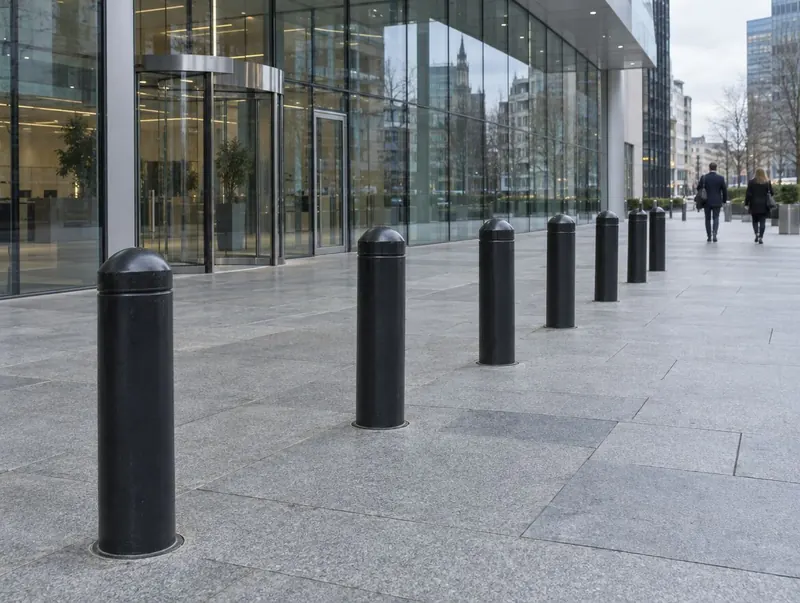 Computer-generated image
Dungannon crash-rated bollards
We supply and fit crash-rated bollards throughout Dungannon, typically for sites such as town-centre squares, schools and filling-station forecourts. The rating only holds when the bollard is installed to the same foundation design that was tested.
We cover every part of Dungannon in the BT71 and BT70 postcode districts. Jobs in Dungannon can be combined with work in Cookstown (9.7 miles), Armagh (11.3 miles), Portadown (14.1 miles) and Craigavon (15.8 miles) (straight-line distances). Belfast is around 34 miles away.
Dungannon at a glance
- Area
- Mid Ulster, Northern Ireland
- Roads authority
- the Department for Infrastructure (DfI Roads)
- Planning authority
- Mid Ulster District Council
- Postcodes
- BT71 and BT70
- Guide price
- Typically £1,945–£9,795 per bollard + VAT; minimum job £3,895
- Survey
- Free, with a fixed written quote
What Dungannon sites use crash-rated bollards for
Typical reasons Dungannon sites choose crash-rated bollards:
- Transport interchanges, taxi ranks and drop-off zones
- Sites where a vehicle dynamics assessment shows a long straight run-up
- Glazed frontages on corporate and public buildings
Dungannon: typical crash-rated bollard prices
| Specification | Guide price | Includes |
|---|---|---|
| Standard | £1,945–£5,245 + VAT | Rated for a 7.5 t vehicle at 30 mph (48 km/h), tested foundation |
| Upgraded | £4,295–£7,595 + VAT | Rated for 7.5 t at 40 mph (64 km/h), tested foundation |
| Premium | £6,645–£9,795 + VAT | Rated for 7.5 t at 50 mph (80 km/h), or a specialist foundation |
Per bollard, supplied and installed on a standard tested foundation; -2% for Northern Ireland. Guide only — the fixed price follows a survey.
Consents, ground and services in Dungannon
Kerbside work in Dungannon is a DfI Roads question: the Department for Infrastructure is the roads authority for Northern Ireland, and its permission is needed for anything placed in the public road or footway.
Planning in Northern Ireland sits with the councils, so for a listed building or conservation area in Dungannon the planning team at Mid Ulster District Council is the one to ask before posts go in.
Utility records, radar scanning and hand-dug trial holes come before any machine work, and service diversions can take longer than the bollard installation itself. Rated foundations are large, and excavation is often where projects run into trouble.
- Balance the gaps: narrow enough to stop a vehicle, typically no more than about 1,200 mm, but wide enough for wheelchair users and buggies — check against Inclusive Mobility guidance.
- Ask the local planning authority whether consent is needed, particularly in conservation areas or near listed buildings.
What happens on site
Set out and excavate
Positions are set out to the drawing and excavated to the tested depth and width, with shoring where the ground needs it. Spoil is removed as work progresses.
Fix reinforcement and set the posts
The reinforcement cage is built to the drawing and the bollards are held to line and level in templates. Concrete is poured to the specified grade, with samples taken for testing if the specification calls for them.
Hand over a build record
You receive photographs of the reinforcement and excavation before each pour, concrete delivery tickets, as-built positions and the manufacturer's product certification, ready for your adviser and insurers.
Specification choices
| Option | Detail |
|---|---|
| Finishes and visibility bands | Galvanised and powder-coated finishes in RAL colours, with contrasting or reflective bands near the top so the posts are visible to pedestrians and drivers. |
| Static rated bollards | Fixed posts for permanent lines where vehicles never need to pass. They are a straightforward rated option to install and maintain. |
| Deep or standard foundation designs | Deep foundations suit open ground where excavation is unrestricted. Where services or slabs get in the way, shallow-mount tested designs may be a better fit. |
What moves the price in Dungannon
Our Northern Ireland guide prices are a starting point; the survey in Dungannon firms them up. What tends to move them:
- Depth and volume of excavation, reinforcement and concrete
- Number of posts and whether a linked beam system is needed
- Buried services, diversions and ground investigation
Looking after them
Movable rated bollards need a planned servicing schedule. Keep inspection records with the original test certificate so the line's condition can be shown to insurers or a security adviser.
For damaged or loose posts in Dungannon, repairs and replacements are priced in writing first.
Common questions
Can you install crash-rated bollards anywhere in Dungannon?
We cover all of Dungannon (BT71 and BT70) and the rest of Mid Ulster. We also work in Cookstown, Armagh and Portadown.
Who gives permission for bollards on the pavement in Dungannon?
Across Northern Ireland the Department for Infrastructure's DfI Roads is the roads authority, so crash-rated bollards on a public footway or road in Dungannon need its agreement before anything is dug. Posts on your own land do not.
How much do crash-rated bollards cost in Dungannon?
In Dungannon, typically £1,945–£9,795 per bollard, supplied and installed on a standard tested foundation, plus VAT, with a minimum job of £3,895 plus VAT, using our Northern Ireland guide prices. The fixed figure comes in writing after we've seen the site.
What does a crash rating code actually tell me?
It tells you the vehicle used in the test, how fast it was travelling, the angle it hit at and how far it got past the bollard line. Your security adviser compares those figures with the vehicle and speed achievable on your approach. A rating that does not match the site's real risk is either more than you need or not enough.
Will you design our HVM layout?
No. Scheme design and threat assessment belong with your security adviser, a specialist consultant or the manufacturer's technical team. We install the products they specify, to the tested foundation, and work alongside them on site so the build matches the design.