North Ayrshire · Scotland
Crash-rated bollard installation in Kilwinning
Crash-rated bollards supplied and fitted in Kilwinning, North Ayrshire: surveyed, scanned for services, set in proper foundations and finished to match the ground.
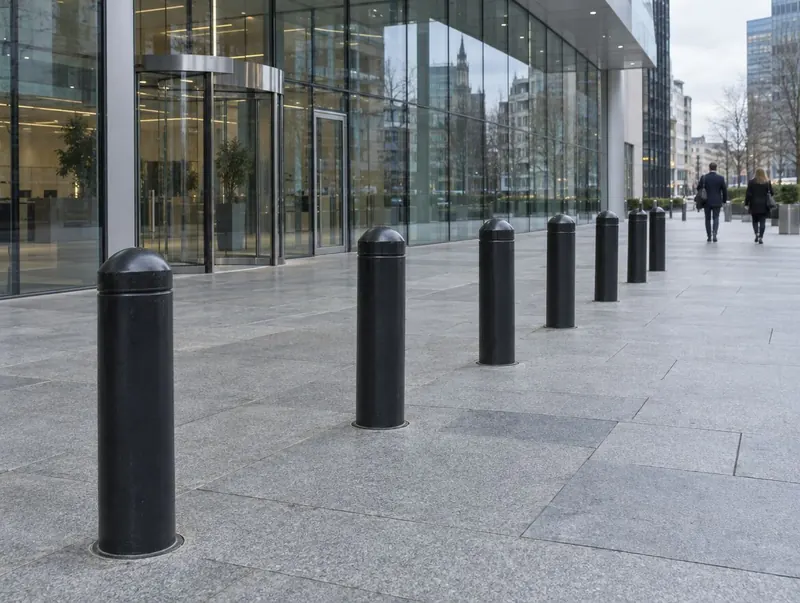 Computer-generated image
Kilwinning crash-rated bollards
Across Kilwinning, typical sites for crash-rated bollards include filling-station forecourts, community car parks and small industrial units. The rating only holds when the bollard is installed to the same foundation design that was tested.
We cover Kilwinning's KA13 and KA24 postcode districts, including places such as Benslie and Dalry. We also cover neighbouring Irvine (3.1 miles), Saltcoats (3.3 miles), Ardrossan (3.9 miles) and Troon (7.8 miles) — distances are straight-line. Kilwinning is about 23 miles from Glasgow.
Kilwinning at a glance
- Area
- North Ayrshire, Scotland
- Roads authority
- North Ayrshire Council (local roads)
- Planning authority
- North Ayrshire Council
- Postcodes
- KA13 and KA24
- Guide price
- Typically £1,995–£9,995 per bollard + VAT; minimum job £3,995
- Survey
- Free, with a fixed written quote
Crash-rated bollards in Kilwinning: common uses
Around Kilwinning, crash-rated bollards usually solve one of these:
- Transport interchanges, taxi ranks and drop-off zones
- Glazed frontages on corporate and public buildings
- Data centres, utilities and critical infrastructure perimeters
What crash-rated bollards cost in Kilwinning
| Specification | Guide price | Includes |
|---|---|---|
| Standard | £1,995–£5,345 + VAT | Rated for a 7.5 t vehicle at 30 mph (48 km/h), tested foundation |
| Upgraded | £4,395–£7,745 + VAT | Rated for 7.5 t at 40 mph (64 km/h), tested foundation |
| Premium | £6,795–£9,995 + VAT | Rated for 7.5 t at 50 mph (80 km/h), or a specialist foundation |
Per bollard, supplied and installed on a standard tested foundation; no regional adjustment. Guide only — the fixed price follows a survey.
What we check first in Kilwinning
Kilwinning falls under North Ayrshire Council as roads authority. If the line of posts crosses onto adopted road or pavement, permission comes before excavation; on private land it does not.
Bollards on private land often need no planning application, but listed buildings and conservation areas are different; the planning service at North Ayrshire Council can confirm before anything is ordered.
Reinstatement matches paving, tactile surfaces and kerbs. Footways and forecourts in towns are usually crowded with cables, gas mains, water pipes and old drainage, and a single unexpected duct can stop a bollard position.
- Ask the local planning authority whether consent is needed, particularly in conservation areas or near listed buildings.
- Check that the test certificate matches the exact model, configuration and foundation being installed, and keep it with the site records.
Installation, step by step
Free site survey and ground checks
A free site survey looks at access, surfaces and likely services, followed by utility searches, radar scanning and trial holes where needed. You then receive a fixed written quote based on what the survey found.
Set out and excavate
Positions are set out to the drawing and excavated to the tested depth and width, with shoring where the ground needs it. Spoil is removed as work progresses.
Hand over a build record
You receive photographs of the reinforcement and excavation before each pour, concrete delivery tickets, as-built positions and the manufacturer's product certification, ready for your adviser and insurers.
Specification choices
| Option | Detail |
|---|---|
| Static rated bollards | Fixed posts for permanent lines where vehicles never need to pass. They are a straightforward rated option to install and maintain. |
| Finishes and visibility bands | Galvanised and powder-coated finishes in RAL colours, with contrasting or reflective bands near the top so the posts are visible to pedestrians and drivers. |
| Heights and diameters | Exposed heights are commonly around 800 to 1,000 mm, with core diameters varying by model and rating. Larger diameters are not always needed to achieve a given rating. |
What moves the price in Kilwinning
Two Kilwinning jobs with the same number of posts can price quite differently. The usual reasons:
- Depth and volume of excavation, reinforcement and concrete
- Traffic management, restricted working hours or night work in occupied sites
- Covers, finishes and any integrated lighting
Keeping them working
Static rated bollards need little routine work, but they should be inspected periodically and always after any impact. Keep inspection records with the original test certificate so the line's condition can be shown to insurers or a security adviser.
We can also service, repair or replace existing posts anywhere in Kilwinning.
Common questions
Can you install crash-rated bollards anywhere in Kilwinning?
We cover all of Kilwinning (KA13 and KA24) and the rest of North Ayrshire. We also work in Irvine, Saltcoats and Ardrossan.
Who gives permission for bollards on the pavement in Kilwinning?
Kilwinning falls under North Ayrshire Council as roads authority. If the line of posts crosses onto adopted road or pavement, permission comes before excavation; on private land it does not.
How much do crash-rated bollards cost in Kilwinning?
In Kilwinning, typically £1,995–£9,995 per bollard, supplied and installed on a standard tested foundation, plus VAT, with a minimum job of £3,995 plus VAT, using our Scotland guide prices. The fixed figure comes in writing after we've seen the site.
Is a heavy unrated steel post good enough instead?
Not where the risk is a deliberate vehicle attack. An unrated post may look solid, but nobody can say what it will stop because it has never been tested with its foundation. Unrated steel suits nuisance parking and low-speed knocks, not crowds or buildings flagged in a security assessment.
Will you design our HVM layout?
No. Scheme design and threat assessment belong with your security adviser, a specialist consultant or the manufacturer's technical team. We install the products they specify, to the tested foundation, and work alongside them on site so the build matches the design.