North Ayrshire · Scotland
Steel security bollard installation in Kilwinning
Planning steel security bollards in Kilwinning? We check ownership, consents and buried services first, then quote a fixed price.
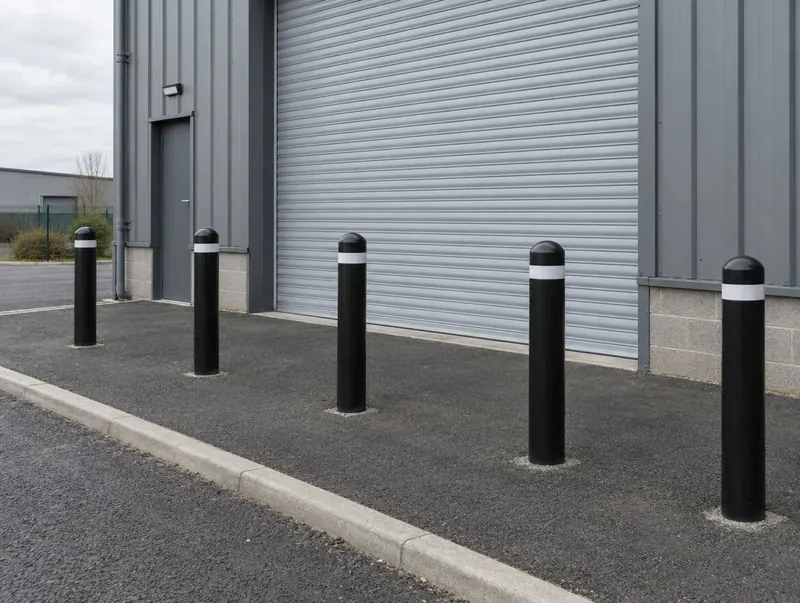 Computer-generated image
Steel security bollards in Kilwinning
Across Kilwinning, typical sites for steel security bollards include high street shopfronts, small industrial units and filling-station forecourts. Concrete-filled steel bollards, root-fixed or base-plated, for car parks, forecourts, boundaries and nuisance vehicle control.
Coverage in Kilwinning takes in the KA13 and KA24 postcode districts and nearby places like Benslie and Dalry. Jobs in Kilwinning can be combined with work in Irvine (3.1 miles), Saltcoats (3.3 miles), Ardrossan (3.9 miles) and Troon (7.8 miles) (straight-line distances). Glasgow is around 23 miles away.
Key facts for this area
- Area
- North Ayrshire, Scotland
- Roads authority
- North Ayrshire Council (local roads)
- Planning authority
- North Ayrshire Council
- Postcodes
- KA13 and KA24
- Guide price
- Typically £195–£895 per bollard + VAT (£225–£1,045 inc VAT for homes); minimum job £595
- Survey
- Free, with a fixed written quote
What steel security bollards cost in Kilwinning
| Specification | Guide price | Includes |
|---|---|---|
| Standard | £195–£485 + VAT · £225–£575 inc VAT | Standard post, foundation, reinstatement |
| Upgraded | £405–£695 + VAT · £485–£825 inc VAT | Upgraded finish or fittings, reflective band, matched keys |
| Premium | £615–£895 + VAT · £735–£1,045 inc VAT | Heavy-duty or architectural spec, premium finish |
Per bollard, supplied and installed; no regional adjustment. Guide only — the fixed price follows a survey.
Where steel security bollards go in around Kilwinning
Around Kilwinning, steel security bollards usually solve one of these:
- Stopping cut-through traffic on private roads and estates
- Car park perimeters, end-of-bay protection and walkway edges
- Protecting meter boxes, gas kiosks, pillars and corners
Permissions and groundwork in Kilwinning
Kilwinning falls under North Ayrshire Council as roads authority. If the line of posts crosses onto adopted road or pavement, permission comes before excavation; on private land it does not.
Bollards on private land often need no planning application, but listed buildings and conservation areas are different; the planning service at North Ayrshire Council can confirm before anything is ordered.
Base plates must sit on a slab thick and sound enough to hold resin anchors; cracked or thin concrete will let the anchors pull out on the first knock. Verges are often softer than they look, and the edges of car parks may be thin tarmac over hardcore, so the foundation is sized to the ground found.
- Keep clear gaps of typically at least 1,000–1,200 mm where pedestrians, wheelchair users or buggies pass between posts.
- Avoid linking posts with chains across pedestrian routes, which can be a trip hazard for blind and partially sighted people.
Installation, step by step
Set the posts
Posts are set plumb and to a consistent height along the line, and concreted in. Base-plated posts are drilled, anchored with resin and torqued once cured.
Fill and cap
Where specified, posts are filled with concrete and capped so water cannot collect inside the tube.
Reinstate and finish
The surface around each post is made good to match, and reflective bands are fitted. Damaged galvanising from handling is touched up.
Choosing the right spec
| Option | Detail |
|---|---|
| Root-fixed | Cast into a concrete foundation, typically with several hundred millimetres of post below ground. The usual choice where digging is possible. |
| Concrete infill | Adds mass and stiffness and makes the post harder to cut or dent. Usually specified for security and impact positions. |
| Finishes | Hot-dip galvanised, then powder-coated in a RAL colour if wanted. Black, grey, yellow and green are common. |
What affects the quote
Our Scotland guide prices are a starting point; the survey in Kilwinning firms them up. What tends to move them:
- Surface reinstatement such as block paving or tarmac
- Finish: galvanised only or powder-coated
- Ground conditions and buried services
After installation
A post that leans after a knock usually means the foundation has moved or cracked; it should be re-bedded or replaced rather than left as a trip or snag hazard. Galvanised steel posts need little attention for years at a time.
We can also service, repair or replace existing posts anywhere in Kilwinning.
Common questions
Which parts of Kilwinning do you cover for steel security bollards?
We cover all of Kilwinning (KA13 and KA24) and the rest of North Ayrshire. We also work in Irvine, Saltcoats and Ardrossan.
Who gives permission for bollards on the pavement in Kilwinning?
For anything on the public footway in Kilwinning we check with the roads authority first — North Ayrshire Council for local roads, Transport Scotland on trunk routes. Private ground such as a car park or forecourt only needs the owner's go-ahead.
What's a typical price for steel security bollards in Kilwinning?
In Kilwinning, typically £195–£895 per bollard, supplied and installed, plus VAT (£225–£1,045 including VAT for homeowners), with a minimum job of £595 plus VAT, using our Scotland guide prices. The fixed figure comes in writing after we've seen the site.
What diameter of steel bollard do I need?
Match it to the job. Around 114 mm suits car park walkways and verges; 168 or 219 mm with a heavier wall suits service yards and corners that lorries pass. The survey looks at what is likely to hit the posts.
Should I choose root-fixed or base-plated steel bollards?
Root-fixed where you can dig and want the stronger post; base-plated where there is a sound slab and you want quick installation or the option to remove posts later. Base plates are limited by the slab and anchors, so they are not the right choice where vehicles hit hard.