East Ayrshire · Scotland
Steel security bollard installation in Kilmarnock
Local installation of steel security bollards in Kilmarnock — free survey, fixed written price, and posts set to the right spacing for people and vehicles.
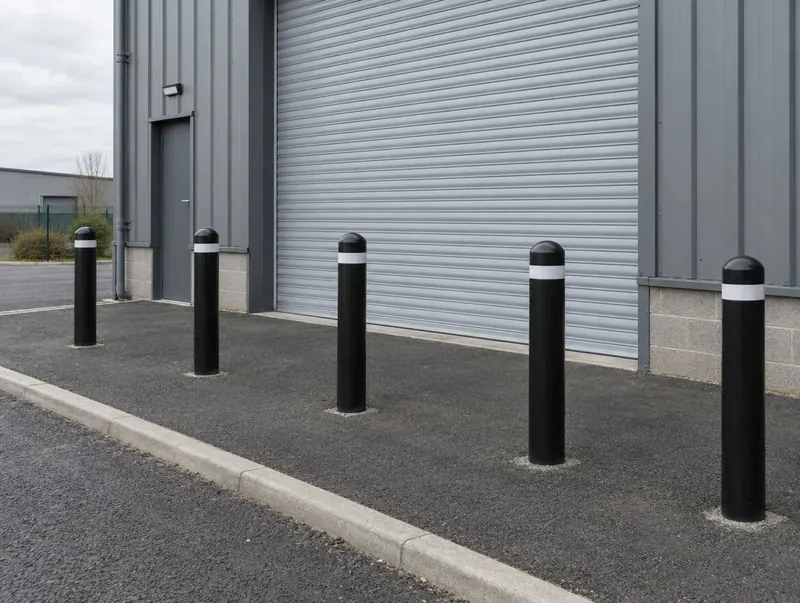 Computer-generated image
Steel security bollards in Kilmarnock
Across Kilmarnock, typical sites for steel security bollards include high street shopfronts, small industrial units and town-centre squares. Unrated steel bollards have not been crash-tested, so they deter vehicles and stop low-speed knocks and casual misuse rather than a determined attack.
We cover Kilmarnock's KA1, KA3 and KA4 postcode districts, including places such as Hurlford, Symington, Craigie and Stewarton. Jobs in Kilmarnock can be combined with work in Irvine (6.2 miles), Troon (8.1 miles), Kilwinning (8.7 miles) and Prestwick (10 miles) (straight-line distances). Kilmarnock is about 20 miles from Glasgow.
Kilmarnock at a glance
- Area
- East Ayrshire, Scotland
- Roads authority
- East Ayrshire Council (local roads)
- Planning authority
- East Ayrshire Council
- Postcodes
- KA1, KA3 and KA4
- Guide price
- Typically £195–£895 per bollard + VAT (£225–£1,045 inc VAT for homes); minimum job £595
- Survey
- Free, with a fixed written quote
- Nearby
- Irvine (6.2 mi), Troon (8.1 mi), Kilwinning (8.7 mi), Prestwick (10 mi)
What Kilmarnock sites use steel security bollards for
Common uses in a place like Kilmarnock:
- Stopping cut-through traffic on private roads and estates
- Car park perimeters, end-of-bay protection and walkway edges
- Protecting meter boxes, gas kiosks, pillars and corners
What steel security bollards cost in Kilmarnock
| Specification | Guide price | Includes |
|---|---|---|
| Standard | £195–£485 + VAT · £225–£575 inc VAT | Standard post, foundation, reinstatement |
| Upgraded | £405–£695 + VAT · £485–£825 inc VAT | Upgraded finish or fittings, reflective band, matched keys |
| Premium | £615–£895 + VAT · £735–£1,045 inc VAT | Heavy-duty or architectural spec, premium finish |
Per bollard, supplied and installed; no regional adjustment. Guide only — the fixed price follows a survey.
What we check first in Kilmarnock
Kilmarnock falls under East Ayrshire Council as roads authority. If the line of posts crosses onto adopted road or pavement, permission comes before excavation; on private land it does not.
Many private-land installations in Kilmarnock need no planning application, but the rules don't clearly cover bollards, so listed buildings, conservation areas and prominent frontages are worth raising with the planning team at East Ayrshire Council before posts go in.
Base plates must sit on a slab thick and sound enough to hold resin anchors; cracked or thin concrete will let the anchors pull out on the first knock. Root-fixed posts need firm ground and enough depth to carry the post's root plus a concrete surround.
- Fit contrasting or reflective bands near the top so posts are visible, as Inclusive Mobility guidance recommends.
- Keep clear gaps of typically at least 1,000–1,200 mm where pedestrians, wheelchair users or buggies pass between posts.
Installation, step by step
Survey and set out
A free site survey confirms positions, surfaces, buried services and whether root-fixing or base plates suit the ground. You receive a fixed written quote listing post size, finish and fixing.
Set the posts
Posts are set plumb and to a consistent height along the line, and concreted in. Base-plated posts are drilled, anchored with resin and torqued once cured.
Reinstate and finish
The surface around each post is made good to match, and reflective bands are fitted. Damaged galvanising from handling is touched up.
Options to consider
| Option | Detail |
|---|---|
| Concrete infill | Adds mass and stiffness and makes the post harder to cut or dent. Usually specified for security and impact positions. |
| Visibility bands | Reflective or contrasting bands near the top for drivers at night and for partially sighted pedestrians. |
| Tube size and wall thickness | Common diameters include 76, 114, 140, 168 and 219 mm, with heavier walls for service yards and vehicle routes. |
Pricing steel security bollards in Kilmarnock
When we price steel security bollards in Kilmarnock, these make the biggest difference:
- Number of posts and length of the line
- Ground conditions and buried services
- Root-fixed or base-plated installation
Looking after them
Galvanised steel posts need little attention for years at a time. Reflective bands fade and peel and are easy to renew.
If posts in Kilmarnock are later hit or damaged, we can repair or replace them — see bollard repairs.
Questions about steel security bollards in Kilmarnock
Can you install steel security bollards anywhere in Kilmarnock?
We cover all of Kilmarnock (KA1, KA3 and KA4) and the rest of East Ayrshire. We also work in Irvine, Troon and Kilwinning.
Do I need consent for steel security bollards on a public footway in Kilmarnock?
For anything on the public footway in Kilmarnock we check with the roads authority first — East Ayrshire Council for local roads, Transport Scotland on trunk routes. Private ground such as a car park or forecourt only needs the owner's go-ahead.
How much do steel security bollards cost in Kilmarnock?
In Kilmarnock, typically £195–£895 per bollard, supplied and installed, plus VAT (£225–£1,045 including VAT for homeowners), with a minimum job of £595 plus VAT, using our Scotland guide prices. The fixed figure comes in writing after we've seen the site.
What diameter of steel bollard do I need?
Match it to the job. Around 114 mm suits car park walkways and verges; 168 or 219 mm with a heavier wall suits service yards and corners that lorries pass. The survey looks at what is likely to hit the posts.
Why fill a steel bollard with concrete?
Concrete infill adds weight and stiffness, so the post dents less and is harder to cut. It also stops water collecting inside a hollow tube. It is usual for security and impact positions.