Scottish Borders · Scotland
Crash-rated bollard installation in Galashiels
Crash-rated bollards for sites across Galashiels and the rest of Scottish Borders, from the first measurement to the last relaid paving block.
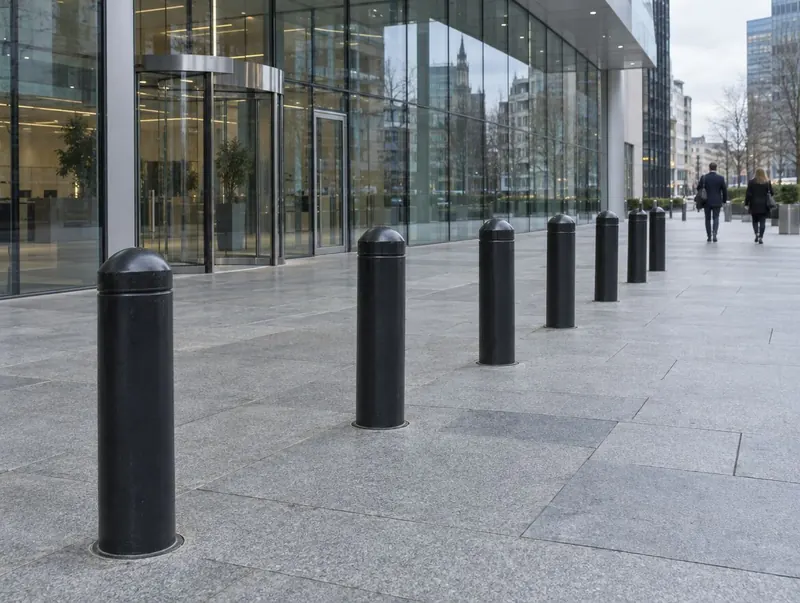 Computer-generated image
Crash-rated bollards in Galashiels
Crash-rated bollards suit plenty of Galashiels sites, town-centre squares, community car parks and filling-station forecourts among them. The rating only holds when the bollard is installed to the same foundation design that was tested.
Coverage in Galashiels takes in the TD1, TD6, TD4 and TD7 postcode districts and nearby places like Clovenfords, Fountainhall, Killochyett and Nether Blainslie. We also cover neighbouring Hawick (13.3 miles), Bonnyrigg (21.3 miles) and Dalkeith (21.8 miles) — distances are straight-line. Galashiels is about 28 miles from Edinburgh.
Galashiels at a glance
- Area
- Scottish Borders, Scotland
- Roads authority
- Scottish Borders Council (local roads)
- Planning authority
- Scottish Borders Council
- Postcodes
- TD1, TD6, TD4 and TD7
- Guide price
- Typically £1,995–£9,995 per bollard + VAT; minimum job £3,995
- Survey
- Free, with a fixed written quote
Guide prices for Galashiels
| Specification | Guide price | Includes |
|---|---|---|
| Standard | £1,995–£5,345 + VAT | Rated for a 7.5 t vehicle at 30 mph (48 km/h), tested foundation |
| Upgraded | £4,395–£7,745 + VAT | Rated for 7.5 t at 40 mph (64 km/h), tested foundation |
| Premium | £6,795–£9,995 + VAT | Rated for 7.5 t at 50 mph (80 km/h), or a specialist foundation |
Per bollard, supplied and installed on a standard tested foundation; no regional adjustment. Guide only — the fixed price follows a survey.
Crash-rated bollards in Galashiels: common uses
Common uses in a place like Galashiels:
- Stadiums, arenas and event venues with predictable crowd flows
- Pedestrianised streets, plazas and crowded public spaces
- Sites where a vehicle dynamics assessment shows a long straight run-up
Consents, ground and services in Galashiels
Galashiels falls under Scottish Borders Council as roads authority. If the line of posts crosses onto adopted road or pavement, permission comes before excavation; on private land it does not.
If your site in Galashiels is listed or inside a conservation area, check with the local planning authority (Scottish Borders Council) before choosing a finish — heritage settings often favour cast iron or painted steel over stainless.
Reinstatement matches paving, tactile surfaces and kerbs. Footways and forecourts in towns are usually crowded with cables, gas mains, water pipes and old drainage, and a single unexpected duct can stop a bollard position.
- Check that the test certificate matches the exact model, configuration and foundation being installed, and keep it with the site records.
- Balance the gaps: narrow enough to stop a vehicle, typically no more than about 1,200 mm, but wide enough for wheelchair users and buggies — check against Inclusive Mobility guidance.
Installation, step by step
Set out and excavate
Positions are set out to the drawing and excavated to the tested depth and width, with shoring where the ground needs it. Spoil is removed as work progresses.
Fix reinforcement and set the posts
The reinforcement cage is built to the drawing and the bollards are held to line and level in templates. Concrete is poured to the specified grade, with samples taken for testing if the specification calls for them.
Hand over a build record
You receive photographs of the reinforcement and excavation before each pour, concrete delivery tickets, as-built positions and the manufacturer's product certification, ready for your adviser and insurers.
Choosing the right spec
| Option | Detail |
|---|---|
| Heights and diameters | Exposed heights are commonly around 800 to 1,000 mm, with core diameters varying by model and rating. Larger diameters are not always needed to achieve a given rating. |
| Finishes and visibility bands | Galvanised and powder-coated finishes in RAL colours, with contrasting or reflective bands near the top so the posts are visible to pedestrians and drivers. |
| Rated removable or automatic posts | Where an entrance must open for deliveries or emergency vehicles, rated removable, retractable or automatic models are available. Check that the rating stated is for the exact model and position you are buying. |
What moves the price in Galashiels
When we price crash-rated bollards in Galashiels, these make the biggest difference:
- Reinstatement of natural stone, tactile paving or specialist surfaces
- Covers, finishes and any integrated lighting
- Depth and volume of excavation, reinforcement and concrete
Keeping them working
Look for cracked surfacing at the base, movement, damaged covers and faded bands. Movable rated bollards need a planned servicing schedule.
We can also service, repair or replace existing posts anywhere in Galashiels.
Common questions
Which parts of Galashiels do you cover for crash-rated bollards?
We cover all of Galashiels (TD1, TD6, TD4 and TD7) and the rest of Scottish Borders. We also work in Hawick, Bonnyrigg and Dalkeith.
Do I need consent for crash-rated bollards on a public footway in Galashiels?
Galashiels falls under Scottish Borders Council as roads authority. If the line of posts crosses onto adopted road or pavement, permission comes before excavation; on private land it does not.
How much do crash-rated bollards cost in Galashiels?
In Galashiels, typically £1,995–£9,995 per bollard, supplied and installed on a standard tested foundation, plus VAT, with a minimum job of £3,995 plus VAT, using our Scotland guide prices. The fixed figure comes in writing after we've seen the site.
What does a crash rating code actually tell me?
It tells you the vehicle used in the test, how fast it was travelling, the angle it hit at and how far it got past the bollard line. Your security adviser compares those figures with the vehicle and speed achievable on your approach. A rating that does not match the site's real risk is either more than you need or not enough.
When can we rely on the new bollards?
Only once the concrete has reached the strength set in the specification. The posts are physically in place as soon as the pour is finished, but the rated performance depends on the foundation, and full design strength is commonly taken at around 28 days. Your adviser may arrange temporary measures to cover the gap.