Somerset · England
Crash-rated bollard installation in Yeovil
Crash-rated bollards supplied and fitted in Yeovil, Somerset: surveyed, scanned for services, set in proper foundations and finished to match the ground.
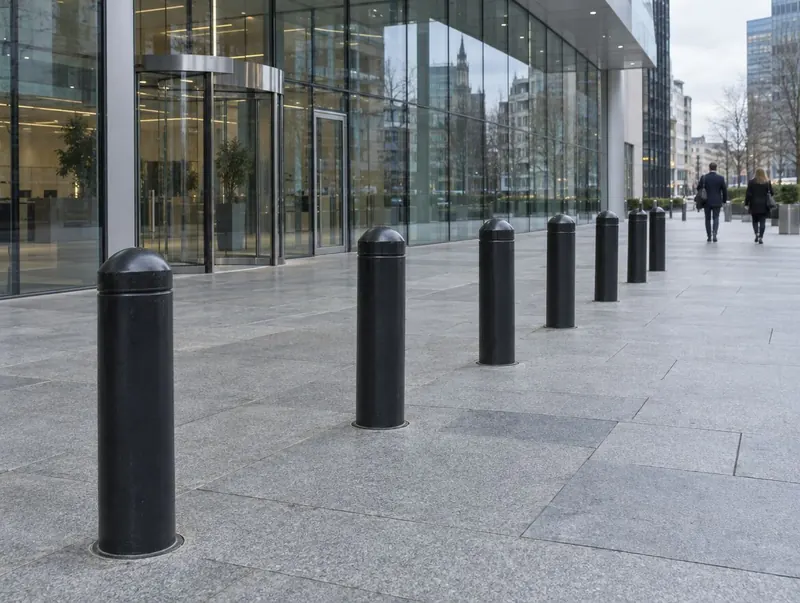 Computer-generated image
Crash-rated bollards in Yeovil
Crash-rated bollards suit plenty of Yeovil sites, town-centre squares, filling-station forecourts and high street shopfronts among them. The rating only holds when the bollard is installed to the same foundation design that was tested.
Coverage in Yeovil takes in the BA20, BA21, BA22, TA15 and TA14 postcode districts and nearby places like Mudford Sock, Mudford, Coppits Hill and Lower Vagg. Jobs in Yeovil can be combined with work in Bridgwater (20.7 miles) and Taunton (21.1 miles) (straight-line distances). It sits roughly 36 miles from Bristol as the crow flies.
Yeovil at a glance
- Area
- Somerset, England
- Highway authority
- Somerset Council (local roads)
- Planning authority
- Somerset Council
- Postcodes
- BA20, BA21, BA22, TA15 and TA14
- Guide price
- Typically £1,995–£9,995 per bollard + VAT; minimum job £3,995
- Survey
- Free, with a fixed written quote
- Nearby
- Bridgwater (20.7 mi), Taunton (21.1 mi)
Crash-rated bollard prices in Yeovil
| Specification | Guide price | Includes |
|---|---|---|
| Standard | £1,995–£5,345 + VAT | Rated for a 7.5 t vehicle at 30 mph (48 km/h), tested foundation |
| Upgraded | £4,395–£7,745 + VAT | Rated for 7.5 t at 40 mph (64 km/h), tested foundation |
| Premium | £6,795–£9,995 + VAT | Rated for 7.5 t at 50 mph (80 km/h), or a specialist foundation |
Per bollard, supplied and installed on a standard tested foundation; no regional adjustment. Guide only — the fixed price follows a survey.
Where crash-rated bollards go in around Yeovil
Around Yeovil, crash-rated bollards usually solve one of these:
- Pedestrianised streets, plazas and crowded public spaces
- Data centres, utilities and critical infrastructure perimeters
- Transport interchanges, taxi ranks and drop-off zones
Consents, ground and services in Yeovil
Somerset Council is the highway authority covering Yeovil's local roads. If any post would stand on adopted highway rather than your land, that consent is the first thing we sort out.
Bollards on private land often don't need planning permission, but it depends on the council's view, the height and the location; in a conservation area, next to a listed building or under an Article 4 direction, ask the local planning authority (Somerset Council) first — we flag this at survey.
Footways and forecourts in towns are usually crowded with cables, gas mains, water pipes and old drainage, and a single unexpected duct can stop a bollard position. Utility records, radar scanning and hand-dug trial holes come before any machine work, and service diversions can take longer than the bollard installation itself.
- Agree how emergency vehicles will get through, and refer to guidance on selecting and installing vehicle security barriers such as PAS 69 or ISO 22343-2.
- Confirm who owns the land: works on public highway usually need the highway authority's agreement, and permanent street furniture there may need a licence.
How the job runs
Start from the specification
We work from the specification issued by your security adviser or the manufacturer: product, rating, positions and foundation drawing. If no specification exists yet, we can put you in touch with the manufacturer's technical team, but we do not set the threat level ourselves.
Set out and excavate
Positions are set out to the drawing and excavated to the tested depth and width, with shoring where the ground needs it. Spoil is removed as work progresses.
Hand over a build record
You receive photographs of the reinforcement and excavation before each pour, concrete delivery tickets, as-built positions and the manufacturer's product certification, ready for your adviser and insurers.
Choosing the right spec
| Option | Detail |
|---|---|
| Static rated bollards | Fixed posts for permanent lines where vehicles never need to pass. They are a straightforward rated option to install and maintain. |
| Decorative covers | Stainless steel, cast or polymer sleeves can be fitted over the steel core to suit a streetscape. Use covers supplied or approved by the manufacturer so the tested product is not altered. |
| Heights and diameters | Exposed heights are commonly around 800 to 1,000 mm, with core diameters varying by model and rating. Larger diameters are not always needed to achieve a given rating. |
What moves the price in Yeovil
Two Yeovil jobs with the same number of posts can price quite differently. The usual reasons:
- Depth and volume of excavation, reinforcement and concrete
- Number of posts and whether a linked beam system is needed
- Buried services, diversions and ground investigation
After installation
A rated bollard that has stopped a vehicle has done its job and should be assessed with the manufacturer; in most cases the post, and sometimes the foundation insert, is replaced rather than straightened. Static rated bollards need little routine work, but they should be inspected periodically and always after any impact.
We can also service, repair or replace existing posts anywhere in Yeovil.
Common questions
Which parts of Yeovil do you cover for crash-rated bollards?
We cover all of Yeovil (BA20, BA21, BA22, TA15 and TA14) and the rest of Somerset. We also work in Bridgwater and Taunton.
Do I need consent for crash-rated bollards on a public footway in Yeovil?
The highway authority for local roads in Yeovil is Somerset Council; motorways and trunk roads sit with National Highways. Crash-rated bollards on the adopted footway are a matter for the highway authority, so we only install there with its written agreement.
How much do crash-rated bollards cost in Yeovil?
In Yeovil, typically £1,995–£9,995 per bollard, supplied and installed on a standard tested foundation, plus VAT, with a minimum job of £3,995 plus VAT, using our South West guide prices. The fixed figure comes in writing after we've seen the site.
Will you design our HVM layout?
No. Scheme design and threat assessment belong with your security adviser, a specialist consultant or the manufacturer's technical team. We install the products they specify, to the tested foundation, and work alongside them on site so the build matches the design.
When can we rely on the new bollards?
Only once the concrete has reached the strength set in the specification. The posts are physically in place as soon as the pour is finished, but the rated performance depends on the foundation, and full design strength is commonly taken at around 28 days. Your adviser may arrange temporary measures to cover the gap.