Carmarthenshire · Wales
Flexible bollard installation in Carmarthen
Flexible bollards for sites across Carmarthen and the rest of Carmarthenshire, from the first measurement to the last relaid paving block.
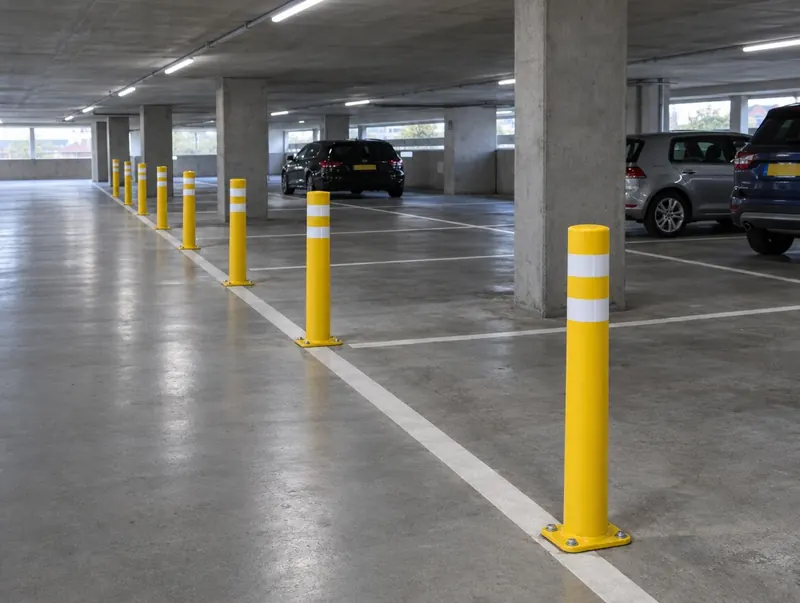 Computer-generated image
About flexible bollards in Carmarthen
Polyurethane and spring-based bollards that bend when hit and return upright, for car parks, depots and lane separation. In Carmarthen, that tends to mean sites such as local parades, community car parks and community buildings.
We work across SA31 and SA33 — Carmarthen itself and places including Abergwili, Trevaughan, Cwmffrwd and Llanllwch. Jobs in Carmarthen can be combined with work in Llanelli (13.5 miles), Ammanford (14.2 miles), Gorseinon (17.1 miles) and Clydach (21 miles) (straight-line distances). It sits roughly 22 miles from Swansea as the crow flies.
Local details
- Area
- Carmarthenshire, Wales
- Highway authority
- Carmarthenshire County Council (local roads)
- Planning authority
- Carmarthenshire County Council
- Postcodes
- SA31 and SA33
- Guide price
- Typically £185–£575 per bollard + VAT; minimum job £425
- Survey
- Free, with a fixed written quote
Flexible bollards in Carmarthen: common uses
Around Carmarthen, flexible bollards usually solve one of these:
- Approaches to barriers, pay stations and ticket machines
- Bus stations and coach parks
- Temporary or trial layouts before permanent kerbs
Carmarthen: typical flexible bollard prices
| Specification | Guide price | Includes |
|---|---|---|
| Standard | £185–£355 + VAT | Standard post, foundation, reinstatement |
| Upgraded | £305–£465 + VAT | Upgraded finish or fittings, reflective band, matched keys |
| Premium | £425–£575 + VAT | Heavy-duty or architectural spec, premium finish |
Per bollard, supplied and fixed; -3% for Wales. Guide only — the fixed price follows a survey.
What we check first in Carmarthen
Local roads and pavements in Carmarthen are the responsibility of Carmarthenshire County Council as highway authority, with the Welsh Government's trunk road agents handling trunk roads. Posts on the public highway need that authority's consent; private land does not.
If your site in Carmarthen is listed or inside a conservation area, check with the local planning authority (Carmarthenshire County Council) before choosing a finish — heritage settings often favour cast iron or painted steel over stainless.
Anchors therefore need sound concrete with enough edge distance; anchoring into thin, cracked or weak surfaces means the base works loose within weeks. Flexible bollards put repeated load on their fixings, because every knock rocks the base.
- Do not use flexible bollards where a physical barrier is needed to protect people or buildings; they guide rather than stop.
- Check drilling into car park decks or podium slabs with the building owner before fixing.
What happens on site
Check the surface
Slabs and decks are checked for thickness, reinforcement and waterproofing before drilling. Weak tarmac may need a concrete pad or socket base.
Fit posts and test
Posts are fitted and bent by hand to confirm they return upright, and reflective sleeves are applied.
Hand over spares and records
Post and base details are recorded so replacements match, and spare posts can be left on site for busy locations. Staff are shown how a post is swapped on its base.
Options to consider
| Option | Detail |
|---|---|
| Low-profile deck bases | Shallow fixings for multi-storey decks where deep drilling is not permitted. |
| Heights and diameters | Commonly 750–1,000 mm high and around 80–200 mm diameter, with slimmer wand-style posts for lane lines. |
| Sprung-base bollards | A rigid post on a heavy spring or elastomer base that tilts and returns. Looks like a conventional bollard. |
Pricing flexible bollards in Carmarthen
Two Carmarthen jobs with the same number of posts can price quite differently. The usual reasons:
- Bolt-down or socket base
- Number of posts and length of line
- Surface condition and need for concrete pads
Looking after them
Keep a few spare posts on site where knocks are frequent, so a damaged one can be swapped before the line develops a gap. Clean reflective sleeves so they stay visible, and replace them when they fade or peel.
If posts in Carmarthen are later hit or damaged, we can repair or replace them — see bollard repairs.
Common questions
Do you install flexible bollards in Carmarthen?
We cover all of Carmarthen (SA31 and SA33) and the rest of Carmarthenshire. We also work in Llanelli, Ammanford and Gorseinon.
Do I need consent for flexible bollards on a public footway in Carmarthen?
Before digging near the kerb in Carmarthen we establish who owns the ground: adopted footways are Carmarthenshire County Council's responsibility, trunk roads the Welsh Government's, and everything else belongs to the site owner.
How much do flexible bollards cost in Carmarthen?
In Carmarthen, typically £185–£575 per bollard, supplied and fixed, plus VAT, with a minimum job of £425 plus VAT, using our Wales guide prices. The fixed figure comes in writing after we've seen the site.
Can flexible bollards go in a multi-storey car park?
Yes, often with low-profile bases. The deck has to be checked first, as some slabs contain tendons or waterproofing that must not be drilled. The building owner usually needs to agree the fixing method.
Will a flexible bollard stop a car?
No. It is designed to bend and recover, so a car can push past it. It marks the line and discourages drivers from crossing it. Where a vehicle must be physically stopped, use a rigid bollard.