Swansea · Wales
Flexible bollard installation in Clydach
Local installation of flexible bollards in Clydach — free survey, fixed written price, and posts set to the right spacing for people and vehicles.
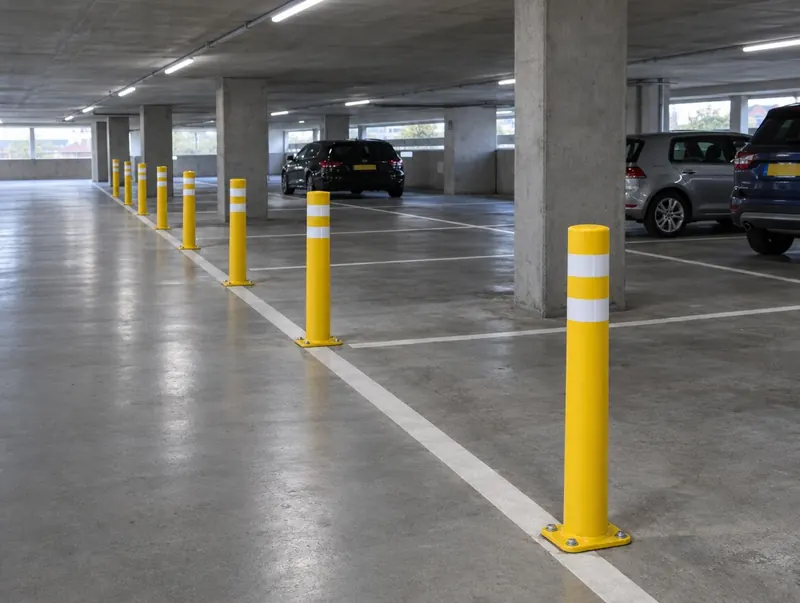 Computer-generated image
Flexible bollards in Clydach
Across Clydach, typical sites for flexible bollards include high street shopfronts, small industrial units and schools. Flexible bollards are traffic management products, not barriers, and will not stop a vehicle that is driven at them.
Coverage in Clydach takes in the SA6 postcode district and nearby places like Craig-cefn-parc and Rhyd-y-gwin. We also cover neighbouring Neath (4.3 miles), Swansea (4.7 miles), Gorseinon (6.1 miles) and Port Talbot (7.7 miles) — distances are straight-line. Swansea is around 5 miles away.
Local details
- Area
- Swansea, Wales
- Highway authority
- Swansea Council (local roads)
- Planning authority
- Swansea Council
- Postcodes
- SA6
- Guide price
- Typically £185–£575 per bollard + VAT; minimum job £425
- Survey
- Free, with a fixed written quote
- Nearby
- Neath (4.3 mi), Swansea (4.7 mi), Gorseinon (6.1 mi), Port Talbot (7.7 mi)
What flexible bollards cost in Clydach
| Specification | Guide price | Includes |
|---|---|---|
| Standard | £185–£355 + VAT | Standard post, foundation, reinstatement |
| Upgraded | £305–£465 + VAT | Upgraded finish or fittings, reflective band, matched keys |
| Premium | £425–£575 + VAT | Heavy-duty or architectural spec, premium finish |
Per bollard, supplied and fixed; -3% for Wales. Guide only — the fixed price follows a survey.
Where flexible bollards go in around Clydach
Around Clydach, flexible bollards usually solve one of these:
- Marking pedestrian routes inside multi-storey car parks
- Bus stations and coach parks
- Depot and yard routes where vehicles knock posts daily
What we check first in Clydach
Local roads and pavements in Clydach are the responsibility of Swansea Council as highway authority, with the Welsh Government's trunk road agents handling trunk roads. Posts on the public highway need that authority's consent; private land does not.
Many private-land installations in Clydach need no planning application, but the rules don't clearly cover bollards, so listed buildings, conservation areas and prominent frontages are worth raising with the planning team at Swansea Council before posts go in.
Multi-storey and rooftop decks are a special case: slabs may be post-tensioned or carry waterproofing and heating, so drilling depth and positions are agreed with the building owner and scanned first. Flexible bollards put repeated load on their fixings, because every knock rocks the base.
- Do not use flexible bollards where a physical barrier is needed to protect people or buildings; they guide rather than stop.
- Keep pedestrian gaps and routes clear, referring to Inclusive Mobility guidance where people walk through the line.
From survey to handover
Survey traffic movements
The free site survey looks at vehicle sizes, turning paths and where drivers currently clip posts or kerbs. You receive a fixed written quote with post type and fixing.
Check the surface
Slabs and decks are checked for thickness, reinforcement and waterproofing before drilling. Weak tarmac may need a concrete pad or socket base.
Fix the bases
Holes are drilled and cleaned, resin anchors or bolts are set and the bases fixed and torqued once cured. Socket bases are set flush in concrete.
Options to consider
| Option | Detail |
|---|---|
| Sprung-base bollards | A rigid post on a heavy spring or elastomer base that tilts and returns. Looks like a conventional bollard. |
| Low-profile deck bases | Shallow fixings for multi-storey decks where deep drilling is not permitted. |
| Colours and reflective sleeves | Yellow, black, red, white or orange, with reflective sleeves for visibility in low light. |
Pricing flexible bollards in Clydach
Two Clydach jobs with the same number of posts can price quite differently. The usual reasons:
- Polymer posts or sprung-base bollards
- Surface condition and need for concrete pads
- Out-of-hours working in busy car parks
Looking after them
Posts exposed to strong sunlight slowly lose flexibility and colour, and eventually crack; replacing the post on its existing base is usually quick. Keep a few spare posts on site where knocks are frequent, so a damaged one can be swapped before the line develops a gap.
For damaged or loose posts in Clydach, repairs and replacements are priced in writing first.
Questions about flexible bollards in Clydach
Do you install flexible bollards in Clydach?
We cover all of Clydach (SA6) and the rest of Swansea. We also work in Neath, Swansea and Gorseinon.
Who gives permission for bollards on the pavement in Clydach?
Local roads and pavements in Clydach are the responsibility of Swansea Council as highway authority, with the Welsh Government's trunk road agents handling trunk roads. Posts on the public highway need that authority's consent; private land does not.
How much do flexible bollards cost in Clydach?
In Clydach, typically £185–£575 per bollard, supplied and fixed, plus VAT, with a minimum job of £425 plus VAT, using our Wales guide prices. The fixed figure comes in writing after we've seen the site.
Do flexible bollards damage vehicles?
Typically very little in a low-speed knock, which is a large part of their appeal. They may leave a scuff on paintwork. A rigid post in the same position would usually dent the vehicle and bend itself.
Do flexible bollards work in cold weather?
They do, but polymers become stiffer in cold conditions and recover more slowly after a knock. Sprung-base designs are less affected. Neither type is damaged by normal UK winter temperatures.
Flexible bollards near Clydach
- Neath (4.3 mi)
- Swansea (4.7 mi)
- Gorseinon (6.1 mi)
- Port Talbot (7.7 mi)
- Ystalyfera (7.7 mi)
- Ammanford (8.5 mi)