Swansea · Wales
Steel security bollard installation in Clydach
Steel security bollards supplied and fitted in Clydach, Swansea: surveyed, scanned for services, set in proper foundations and finished to match the ground.
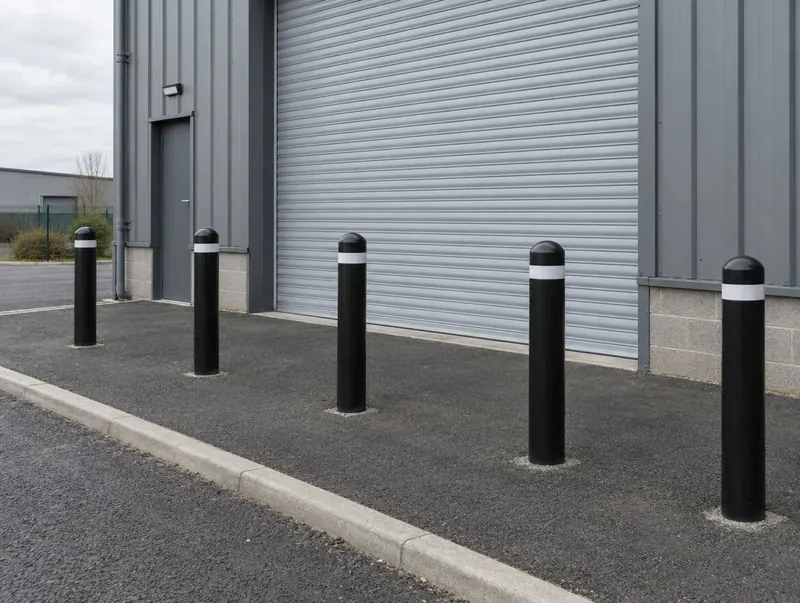 Computer-generated image
Clydach steel security bollards
Steel security bollards suit plenty of Clydach sites, schools, small industrial units and filling-station forecourts among them. Unrated steel bollards have not been crash-tested, so they deter vehicles and stop low-speed knocks and casual misuse rather than a determined attack.
Coverage in Clydach takes in the SA6 postcode district and nearby places like Craig-cefn-parc and Rhyd-y-gwin. We also cover neighbouring Neath (4.3 miles), Swansea (4.7 miles), Gorseinon (6.1 miles) and Port Talbot (7.7 miles) — distances are straight-line. Swansea is around 5 miles away.
Clydach at a glance
- Area
- Swansea, Wales
- Highway authority
- Swansea Council (local roads)
- Planning authority
- Swansea Council
- Postcodes
- SA6
- Guide price
- Typically £185–£865 per bollard + VAT (£215–£1,045 inc VAT for homes); minimum job £575
- Survey
- Free, with a fixed written quote
- Nearby
- Neath (4.3 mi), Swansea (4.7 mi), Gorseinon (6.1 mi), Port Talbot (7.7 mi)
Guide prices for Clydach
| Specification | Guide price | Includes |
|---|---|---|
| Standard | £185–£475 + VAT · £215–£565 inc VAT | Standard post, foundation, reinstatement |
| Upgraded | £395–£675 + VAT · £465–£805 inc VAT | Upgraded finish or fittings, reflective band, matched keys |
| Premium | £595–£865 + VAT · £705–£1,045 inc VAT | Heavy-duty or architectural spec, premium finish |
Per bollard, supplied and installed; -3% for Wales. Guide only — the fixed price follows a survey.
Typical steel security bollards jobs in Clydach
Common uses in a place like Clydach:
- Grass verges and landscaped areas that vans keep driving over
- Social housing estates with nuisance parking
- Protecting meter boxes, gas kiosks, pillars and corners
Permissions and groundwork in Clydach
Before digging near the kerb in Clydach we establish who owns the ground: adopted footways are Swansea Council's responsibility, trunk roads the Welsh Government's, and everything else belongs to the site owner.
Bollards on private land often don't need planning permission, but it depends on the council's view, the height and the location; in a conservation area, next to a listed building or under an Article 4 direction, ask the local planning authority (Swansea Council) first — we flag this at survey.
Verges are often softer than they look, and the edges of car parks may be thin tarmac over hardcore, so the foundation is sized to the ground found. Base plates must sit on a slab thick and sound enough to hold resin anchors; cracked or thin concrete will let the anchors pull out on the first knock.
- Keep clear gaps of typically at least 1,000–1,200 mm where pedestrians, wheelchair users or buggies pass between posts.
- Fit contrasting or reflective bands near the top so posts are visible, as Inclusive Mobility guidance recommends.
How the job runs
Break out and excavate
For root-fixed posts, the surface is cut neatly and each hole is dug to depth, by hand near known services. For base plates, the slab is checked for thickness and soundness.
Set the posts
Posts are set plumb and to a consistent height along the line, and concreted in. Base-plated posts are drilled, anchored with resin and torqued once cured.
Reinstate and finish
The surface around each post is made good to match, and reflective bands are fitted. Damaged galvanising from handling is touched up.
Options to consider
| Option | Detail |
|---|---|
| Caps and heads | Dome, flat, chamfered or ball tops, with welded caps to keep water out of hollow posts. |
| Visibility bands | Reflective or contrasting bands near the top for drivers at night and for partially sighted pedestrians. |
| Root-fixed | Cast into a concrete foundation, typically with several hundred millimetres of post below ground. The usual choice where digging is possible. |
What moves the price in Clydach
Our Wales guide prices are a starting point; the survey in Clydach firms them up. What tends to move them:
- Surface reinstatement such as block paving or tarmac
- Tube diameter, wall thickness and concrete infill
- Finish: galvanised only or powder-coated
After installation
Reflective bands fade and peel and are easy to renew. Check periodically for impact damage, loose base plates and cracked surfacing around the root.
If posts in Clydach are later hit or damaged, we can repair or replace them — see bollard repairs.
Questions about steel security bollards in Clydach
Which parts of Clydach do you cover for steel security bollards?
We cover all of Clydach (SA6) and the rest of Swansea. We also work in Neath, Swansea and Gorseinon.
Do I need consent for steel security bollards on a public footway in Clydach?
Before digging near the kerb in Clydach we establish who owns the ground: adopted footways are Swansea Council's responsibility, trunk roads the Welsh Government's, and everything else belongs to the site owner.
How much do steel security bollards cost in Clydach?
In Clydach, typically £185–£865 per bollard, supplied and installed, plus VAT (£215–£1,045 including VAT for homeowners), with a minimum job of £575 plus VAT, using our Wales guide prices. The fixed figure comes in writing after we've seen the site.
Why fill a steel bollard with concrete?
Concrete infill adds weight and stiffness, so the post dents less and is harder to cut. It also stops water collecting inside a hollow tube. It is usual for security and impact positions.
Are unrated steel bollards anti-ram?
No. They have not been crash-tested, so their performance against a deliberate vehicle attack is unknown. They are suited to nuisance parking and low-speed knocks; tested products are needed where an attack is the concern.
Steel security bollards near Clydach
- Neath (4.3 mi)
- Swansea (4.7 mi)
- Gorseinon (6.1 mi)
- Port Talbot (7.7 mi)
- Ystalyfera (7.7 mi)
- Ammanford (8.5 mi)