Fife · Scotland
Flexible bollard installation in Dunfermline
Planning flexible bollards in Dunfermline? We check ownership, consents and buried services first, then quote a fixed price.
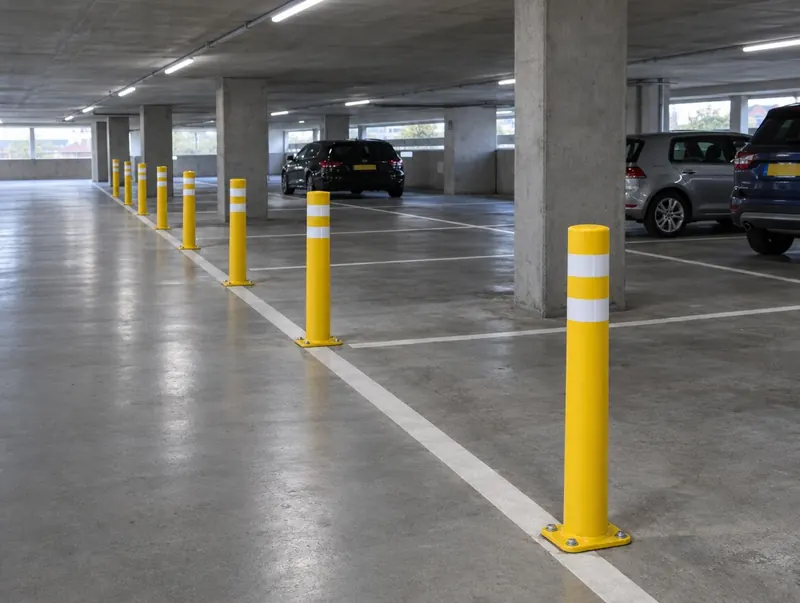 Computer-generated image
Dunfermline flexible bollards
Whether it's filling-station forecourts, high street shopfronts and local parades, flexible bollards in Dunfermline are planned around who needs to get through and who doesn't. Polyurethane and spring-based bollards that bend when hit and return upright, for car parks, depots and lane separation.
Coverage in Dunfermline takes in the KY12 and KY11 postcode districts and nearby places like Cairneyhill, Saline, High Valleyfield and Torryburn. Nearby, we also work in Rosyth (2.5 miles), Cowdenbeath (5.2 miles), Kirkcaldy (11.9 miles) and Alloa (13.1 miles), measured as the crow flies.
Local details
- Area
- Fife, Scotland
- Roads authority
- Fife Council (local roads)
- Planning authority
- Fife Council
- Postcodes
- KY12 and KY11
- Guide price
- Typically £195–£595 per bollard + VAT; minimum job £445
- Survey
- Free, with a fixed written quote
- Nearby
- Rosyth (2.5 mi), Cowdenbeath (5.2 mi), Kirkcaldy (11.9 mi), Alloa (13.1 mi)
Flexible bollards in Dunfermline: common uses
Typical reasons Dunfermline sites choose flexible bollards:
- Marking pedestrian routes inside multi-storey car parks
- Bus stations and coach parks
- Drive-thru lanes and fuel forecourts
What flexible bollards cost in Dunfermline
| Specification | Guide price | Includes |
|---|---|---|
| Standard | £195–£365 + VAT | Standard post, foundation, reinstatement |
| Upgraded | £315–£485 + VAT | Upgraded finish or fittings, reflective band, matched keys |
| Premium | £435–£595 + VAT | Heavy-duty or architectural spec, premium finish |
Per bollard, supplied and fixed; no regional adjustment. Guide only — the fixed price follows a survey.
Permissions and groundwork in Dunfermline
For anything on the public footway in Dunfermline we check with the roads authority first — Fife Council for local roads, Transport Scotland on trunk routes. Private ground such as a car park or forecourt only needs the owner's go-ahead.
Many private-land installations in Dunfermline need no planning application, but the rules don't clearly cover bollards, so listed buildings, conservation areas and prominent frontages are worth raising with the planning team at Fife Council before posts go in.
Anchors therefore need sound concrete with enough edge distance; anchoring into thin, cracked or weak surfaces means the base works loose within weeks. On tarmac, a small concrete pad or a socket base cast in concrete is the reliable option.
- On public highway, including cycle lane segregation, the roads authority's agreement and specification are needed.
- Keep pedestrian gaps and routes clear, referring to Inclusive Mobility guidance where people walk through the line.
Installation, step by step
Survey traffic movements
The free site survey looks at vehicle sizes, turning paths and where drivers currently clip posts or kerbs. You receive a fixed written quote with post type and fixing.
Check the surface
Slabs and decks are checked for thickness, reinforcement and waterproofing before drilling. Weak tarmac may need a concrete pad or socket base.
Fix the bases
Holes are drilled and cleaned, resin anchors or bolts are set and the bases fixed and torqued once cured. Socket bases are set flush in concrete.
Choosing the right spec
| Option | Detail |
|---|---|
| Low-profile deck bases | Shallow fixings for multi-storey decks where deep drilling is not permitted. |
| Bolt-down or socket bases | Bolt-down for existing slabs; socket bases allow posts to be replaced without new fixings. |
| Polyurethane posts | Flex along their length and return to shape. Gentle on vehicles and common in car parks and on forecourts. |
What moves the price in Dunfermline
Our Scotland guide prices are a starting point; the survey in Dunfermline firms them up. What tends to move them:
- Out-of-hours working in busy car parks
- Surface condition and need for concrete pads
- Bolt-down or socket base
Keeping them working
After resurfacing or line repainting, check that the bases were not disturbed or painted over, and that posts still line up with the new markings. Keep a few spare posts on site where knocks are frequent, so a damaged one can be swapped before the line develops a gap.
For damaged or loose posts in Dunfermline, repairs and replacements are priced in writing first.
Flexible bollards in Dunfermline: FAQs
Do you install flexible bollards in Dunfermline?
We cover all of Dunfermline (KY12 and KY11) and the rest of Fife. We also work in Rosyth, Cowdenbeath and Kirkcaldy.
Who gives permission for bollards on the pavement in Dunfermline?
Dunfermline falls under Fife Council as roads authority. If the line of posts crosses onto adopted road or pavement, permission comes before excavation; on private land it does not.
What's a typical price for flexible bollards in Dunfermline?
In Dunfermline, typically £195–£595 per bollard, supplied and fixed, plus VAT, with a minimum job of £445 plus VAT, using our Scotland guide prices. The fixed figure comes in writing after we've seen the site.
Will a flexible bollard stop a car?
No. It is designed to bend and recover, so a car can push past it. It marks the line and discourages drivers from crossing it. Where a vehicle must be physically stopped, use a rigid bollard.
How many times can a flexible bollard be hit?
Many times in normal use, as long as the impacts are the low-speed bumps it is designed for. A heavy vehicle running right over it, or a high-speed strike, can tear it. Manufacturers give guidance for their products.
Flexible bollards near Dunfermline
- Rosyth (2.5 mi)
- Cowdenbeath (5.2 mi)
- Kirkcaldy (11.9 mi)
- Alloa (13.1 mi)
- Glenrothes (13.9 mi)
- Tullibody (15.2 mi)