Fife · Scotland
Steel security bollard installation in Dunfermline
Local installation of steel security bollards in Dunfermline — free survey, fixed written price, and posts set to the right spacing for people and vehicles.
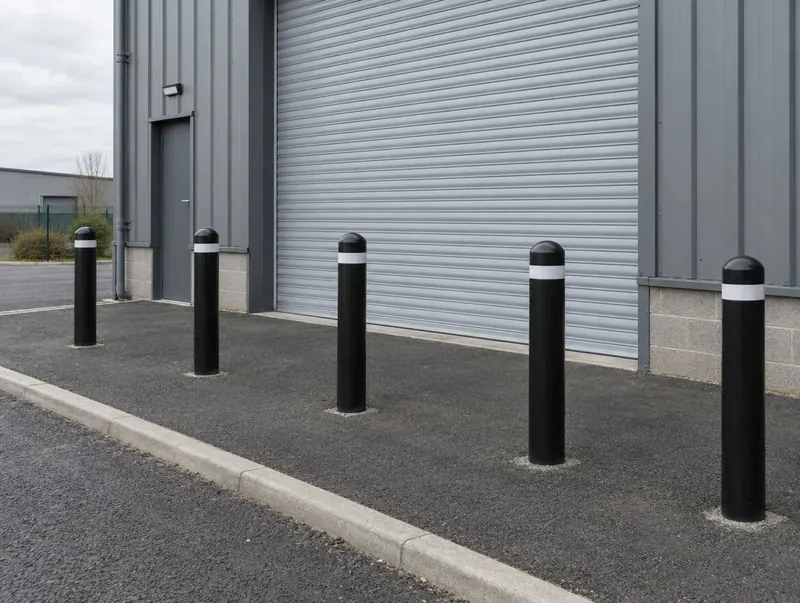 Computer-generated image
Dunfermline steel security bollards
Across Dunfermline, typical sites for steel security bollards include schools, town-centre squares and small industrial units. Unrated steel bollards have not been crash-tested, so they deter vehicles and stop low-speed knocks and casual misuse rather than a determined attack.
Coverage in Dunfermline takes in the KY12 and KY11 postcode districts and nearby places like Cairneyhill, Saline, High Valleyfield and Torryburn. Jobs in Dunfermline can be combined with work in Rosyth (2.5 miles), Cowdenbeath (5.2 miles), Kirkcaldy (11.9 miles) and Alloa (13.1 miles) (straight-line distances).
Dunfermline at a glance
- Area
- Fife, Scotland
- Roads authority
- Fife Council (local roads)
- Planning authority
- Fife Council
- Postcodes
- KY12 and KY11
- Guide price
- Typically £195–£895 per bollard + VAT (£225–£1,045 inc VAT for homes); minimum job £595
- Survey
- Free, with a fixed written quote
- Nearby
- Rosyth (2.5 mi), Cowdenbeath (5.2 mi), Kirkcaldy (11.9 mi), Alloa (13.1 mi)
Steel security bollards in Dunfermline: common uses
Typical reasons Dunfermline sites choose steel security bollards:
- Protecting meter boxes, gas kiosks, pillars and corners
- Lines between pedestrian routes and service yards
- Grass verges and landscaped areas that vans keep driving over
Dunfermline: typical steel security bollard prices
| Specification | Guide price | Includes |
|---|---|---|
| Standard | £195–£485 + VAT · £225–£575 inc VAT | Standard post, foundation, reinstatement |
| Upgraded | £405–£695 + VAT · £485–£825 inc VAT | Upgraded finish or fittings, reflective band, matched keys |
| Premium | £615–£895 + VAT · £735–£1,045 inc VAT | Heavy-duty or architectural spec, premium finish |
Per bollard, supplied and installed; no regional adjustment. Guide only — the fixed price follows a survey.
Permissions and groundwork in Dunfermline
Dunfermline falls under Fife Council as roads authority. If the line of posts crosses onto adopted road or pavement, permission comes before excavation; on private land it does not.
If your site in Dunfermline is listed or inside a conservation area, check with the local planning authority (Fife Council) before choosing a finish — heritage settings often favour cast iron or painted steel over stainless.
Service runs commonly follow kerb lines and verges, which is exactly where steel posts tend to go, so positions are checked with records and scanning before digging. Base plates must sit on a slab thick and sound enough to hold resin anchors; cracked or thin concrete will let the anchors pull out on the first knock.
- Keep clear gaps of typically at least 1,000–1,200 mm where pedestrians, wheelchair users or buggies pass between posts.
- Fit contrasting or reflective bands near the top so posts are visible, as Inclusive Mobility guidance recommends.
Installation, step by step
Break out and excavate
For root-fixed posts, the surface is cut neatly and each hole is dug to depth, by hand near known services. For base plates, the slab is checked for thickness and soundness.
Set the posts
Posts are set plumb and to a consistent height along the line, and concreted in. Base-plated posts are drilled, anchored with resin and torqued once cured.
Fill and cap
Where specified, posts are filled with concrete and capped so water cannot collect inside the tube.
Options to consider
| Option | Detail |
|---|---|
| Root-fixed | Cast into a concrete foundation, typically with several hundred millimetres of post below ground. The usual choice where digging is possible. |
| Visibility bands | Reflective or contrasting bands near the top for drivers at night and for partially sighted pedestrians. |
| Tube size and wall thickness | Common diameters include 76, 114, 140, 168 and 219 mm, with heavier walls for service yards and vehicle routes. |
What affects the quote
Our Scotland guide prices are a starting point; the survey in Dunfermline firms them up. What tends to move them:
- Surface reinstatement such as block paving or tarmac
- Number of posts and length of the line
- Tube diameter, wall thickness and concrete infill
Keeping them working
A post that leans after a knock usually means the foundation has moved or cracked; it should be re-bedded or replaced rather than left as a trip or snag hazard. Galvanised steel posts need little attention for years at a time.
We can also service, repair or replace existing posts anywhere in Dunfermline.
Steel security bollards in Dunfermline: FAQs
Can you install steel security bollards anywhere in Dunfermline?
We cover all of Dunfermline (KY12 and KY11) and the rest of Fife. We also work in Rosyth, Cowdenbeath and Kirkcaldy.
Who gives permission for bollards on the pavement in Dunfermline?
Dunfermline falls under Fife Council as roads authority. If the line of posts crosses onto adopted road or pavement, permission comes before excavation; on private land it does not.
What's a typical price for steel security bollards in Dunfermline?
In Dunfermline, typically £195–£895 per bollard, supplied and installed, plus VAT (£225–£1,045 including VAT for homeowners), with a minimum job of £595 plus VAT, using our Scotland guide prices. The fixed figure comes in writing after we've seen the site.
What diameter of steel bollard do I need?
Match it to the job. Around 114 mm suits car park walkways and verges; 168 or 219 mm with a heavier wall suits service yards and corners that lorries pass. The survey looks at what is likely to hit the posts.
Should I choose root-fixed or base-plated steel bollards?
Root-fixed where you can dig and want the stronger post; base-plated where there is a sound slab and you want quick installation or the option to remove posts later. Base plates are limited by the slab and anchors, so they are not the right choice where vehicles hit hard.
Steel security bollards in nearby towns
- Rosyth (2.5 mi)
- Cowdenbeath (5.2 mi)
- Kirkcaldy (11.9 mi)
- Alloa (13.1 mi)
- Glenrothes (13.9 mi)
- Tullibody (15.2 mi)