Greater Manchester · England
Flexible bollard installation in Atherton
Flexible bollards supplied and fitted in Atherton, Greater Manchester: surveyed, scanned for services, set in proper foundations and finished to match the ground.
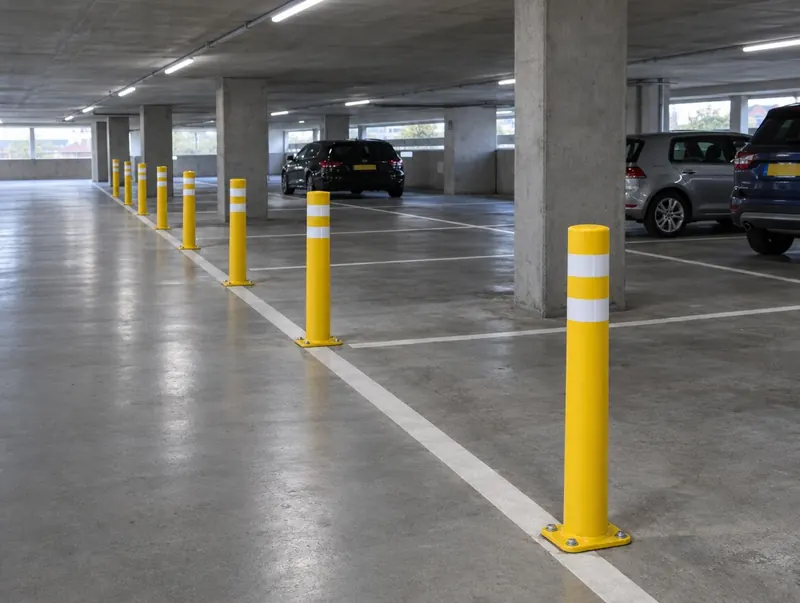 Computer-generated image
Flexible bollards in Atherton
From filling-station forecourts, small industrial units and community car parks, Atherton has plenty of places where flexible bollards earn their keep. Polyurethane and spring-based bollards that bend when hit and return upright, for car parks, depots and lane separation.
We cover every part of Atherton in the M46 postcode district. We also cover neighbouring Tyldesley (1.3 miles), Leigh (2.2 miles), Westhoughton (2.2 miles) and Hindley (3.7 miles) — distances are straight-line. Manchester is around 11 miles away.
Key facts for this area
- Area
- Greater Manchester, England
- Highway authority
- Wigan Council (local roads)
- Planning authority
- Wigan Council
- Postcodes
- M46
- Guide price
- Typically £195–£585 per bollard + VAT; minimum job £435
- Survey
- Free, with a fixed written quote
- Nearby
- Tyldesley (1.3 mi), Leigh (2.2 mi), Westhoughton (2.2 mi), Hindley (3.7 mi)
Atherton: typical flexible bollard prices
| Specification | Guide price | Includes |
|---|---|---|
| Standard | £195–£355 + VAT | Standard post, foundation, reinstatement |
| Upgraded | £305–£475 + VAT | Upgraded finish or fittings, reflective band, matched keys |
| Premium | £425–£585 + VAT | Heavy-duty or architectural spec, premium finish |
Per bollard, supplied and fixed; -2% for North West. Guide only — the fixed price follows a survey.
Typical flexible bollards jobs in Atherton
Common uses in a place like Atherton:
- Bus stations and coach parks
- Temporary or trial layouts before permanent kerbs
- Approaches to barriers, pay stations and ticket machines
Permissions and groundwork in Atherton
In Atherton, work on adopted pavements and verges needs consent from Wigan Council, the local highway authority. Car parks, forecourts and other private land only need the owner's permission.
Bollards on private land often don't need planning permission, but it depends on the council's view, the height and the location; in a conservation area, next to a listed building or under an Article 4 direction, ask the local planning authority (Wigan Council) first — we flag this at survey.
Flexible bollards put repeated load on their fixings, because every knock rocks the base. Where posts go in a line across a drainage fall, positions avoid channels and gullies.
- Check drilling into car park decks or podium slabs with the building owner before fixing.
- Do not use flexible bollards where a physical barrier is needed to protect people or buildings; they guide rather than stop.
How the job runs
Check the surface
Slabs and decks are checked for thickness, reinforcement and waterproofing before drilling. Weak tarmac may need a concrete pad or socket base.
Fix the bases
Holes are drilled and cleaned, resin anchors or bolts are set and the bases fixed and torqued once cured. Socket bases are set flush in concrete.
Fit posts and test
Posts are fitted and bent by hand to confirm they return upright, and reflective sleeves are applied.
Finishes and options
| Option | Detail |
|---|---|
| Low-profile deck bases | Shallow fixings for multi-storey decks where deep drilling is not permitted. |
| Heights and diameters | Commonly 750–1,000 mm high and around 80–200 mm diameter, with slimmer wand-style posts for lane lines. |
| Bolt-down or socket bases | Bolt-down for existing slabs; socket bases allow posts to be replaced without new fixings. |
What affects the quote
Our North West guide prices are a starting point; the survey in Atherton firms them up. What tends to move them:
- Bolt-down or socket base
- Number of posts and length of line
- Deck scanning and restrictions on drilling
Keeping them working
Check flexible bollards for splits, permanent bends and loose bases, and tighten or replace fixings that have worked loose. Clean reflective sleeves so they stay visible, and replace them when they fade or peel.
We can also service, repair or replace existing posts anywhere in Atherton.
Flexible bollards in Atherton: FAQs
Which parts of Atherton do you cover for flexible bollards?
We cover all of Atherton (M46) and the rest of Greater Manchester. We also work in Tyldesley, Leigh and Westhoughton.
Do I need consent for flexible bollards on a public footway in Atherton?
The highway authority for local roads in Atherton is Wigan Council; motorways and trunk roads sit with National Highways. Flexible bollards on the adopted footway are a matter for the highway authority, so we only install there with its written agreement.
What's a typical price for flexible bollards in Atherton?
In Atherton, typically £195–£585 per bollard, supplied and fixed, plus VAT, with a minimum job of £435 plus VAT, using our North West guide prices. The fixed figure comes in writing after we've seen the site.
Do flexible bollards damage vehicles?
Typically very little in a low-speed knock, which is a large part of their appeal. They may leave a scuff on paintwork. A rigid post in the same position would usually dent the vehicle and bend itself.
How many times can a flexible bollard be hit?
Many times in normal use, as long as the impacts are the low-speed bumps it is designed for. A heavy vehicle running right over it, or a high-speed strike, can tear it. Manufacturers give guidance for their products.
Flexible bollards in nearby towns
- Tyldesley (1.3 mi)
- Leigh (2.2 mi)
- Westhoughton (2.2 mi)
- Hindley (3.7 mi)
- Walkden (3.9 mi)
- Farnworth (4.2 mi)