Kent · England
Flexible bollard installation in Canterbury
Flexible bollards for sites across Canterbury and the rest of Kent, from the first measurement to the last relaid paving block.
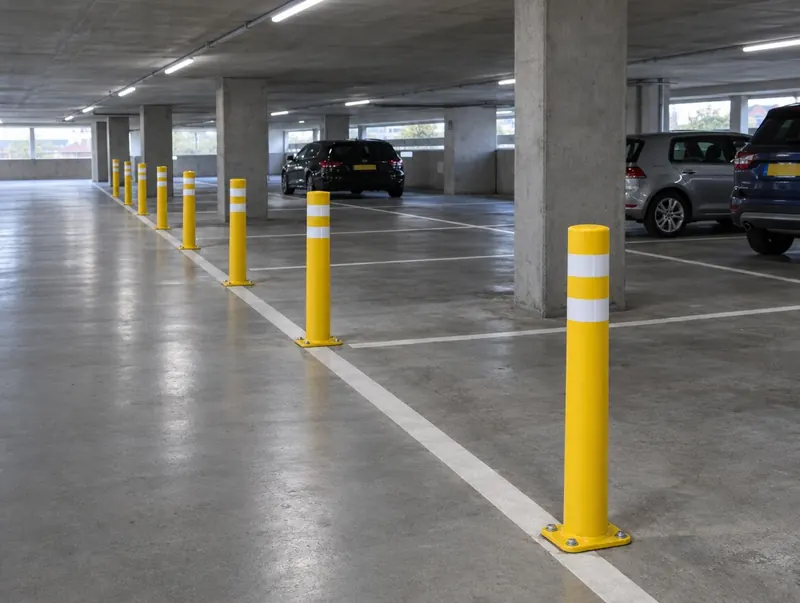 Computer-generated image
Canterbury flexible bollards
Flexible bollards are traffic management products, not barriers, and will not stop a vehicle that is driven at them. In Canterbury, that tends to mean sites such as high street shopfronts, small industrial units and local parades.
Coverage in Canterbury takes in the CT1, CT2 and CT4 postcode districts and nearby places like Sturry, Rough Common, Blean and Westbere. Jobs in Canterbury can be combined with work in Whitstable (6.1 miles), Herne Bay (6.8 miles), Faversham (8.6 miles) and Ashford, Kent (12.8 miles) (straight-line distances).
Key facts for this area
- Area
- Kent, England
- Highway authority
- Kent County Council (local roads)
- Planning authority
- the council for Canterbury
- Postcodes
- CT1, CT2 and CT4
- Guide price
- Typically £205–£635 per bollard + VAT; minimum job £465
- Survey
- Free, with a fixed written quote
- Nearby
- Whitstable (6.1 mi), Herne Bay (6.8 mi), Faversham (8.6 mi), Ashford, Kent (12.8 mi)
Where flexible bollards go in around Canterbury
Around Canterbury, flexible bollards usually solve one of these:
- Lane separation at car park entrances and exits
- Marking pedestrian routes inside multi-storey car parks
- Drive-thru lanes and fuel forecourts
Guide prices for Canterbury
| Specification | Guide price | Includes |
|---|---|---|
| Standard | £205–£385 + VAT | Standard post, foundation, reinstatement |
| Upgraded | £335–£515 + VAT | Upgraded finish or fittings, reflective band, matched keys |
| Premium | £465–£635 + VAT | Heavy-duty or architectural spec, premium finish |
Per bollard, supplied and fixed; +6% for South East. Guide only — the fixed price follows a survey.
Consents, ground and services in Canterbury
In Canterbury, work on adopted pavements and verges needs consent from Kent County Council, the local highway authority. Car parks, forecourts and other private land only need the owner's permission.
Bollards on private land often don't need planning permission, but it depends on the council's view, the height and the location; in a conservation area, next to a listed building or under an Article 4 direction, ask the local planning authority (the council for Canterbury) first — we flag this at survey.
Multi-storey and rooftop decks are a special case: slabs may be post-tensioned or carry waterproofing and heating, so drilling depth and positions are agreed with the building owner and scanned first. Flexible bollards put repeated load on their fixings, because every knock rocks the base.
- On public highway, including cycle lane segregation, the highway authority's agreement and specification are needed.
- Do not use flexible bollards where a physical barrier is needed to protect people or buildings; they guide rather than stop.
How the job runs
Survey traffic movements
The free site survey looks at vehicle sizes, turning paths and where drivers currently clip posts or kerbs. You receive a fixed written quote with post type and fixing.
Set out the line
Posts are set out to guide vehicles along the intended path, with spacing that reads as a line to drivers.
Fix the bases
Holes are drilled and cleaned, resin anchors or bolts are set and the bases fixed and torqued once cured. Socket bases are set flush in concrete.
Options to consider
| Option | Detail |
|---|---|
| Heights and diameters | Commonly 750–1,000 mm high and around 80–200 mm diameter, with slimmer wand-style posts for lane lines. |
| Bolt-down or socket bases | Bolt-down for existing slabs; socket bases allow posts to be replaced without new fixings. |
| Colours and reflective sleeves | Yellow, black, red, white or orange, with reflective sleeves for visibility in low light. |
Pricing flexible bollards in Canterbury
Our South East guide prices are a starting point; the survey in Canterbury firms them up. What tends to move them:
- Bolt-down or socket base
- Polymer posts or sprung-base bollards
- Deck scanning and restrictions on drilling
Looking after them
Clean reflective sleeves so they stay visible, and replace them when they fade or peel. After resurfacing or line repainting, check that the bases were not disturbed or painted over, and that posts still line up with the new markings.
For damaged or loose posts in Canterbury, repairs and replacements are priced in writing first.
Flexible bollards in Canterbury: FAQs
Can you install flexible bollards anywhere in Canterbury?
We cover all of Canterbury (CT1, CT2 and CT4) and the rest of Kent. We also work in Whitstable, Herne Bay and Faversham.
Do I need consent for flexible bollards on a public footway in Canterbury?
In Canterbury, work on adopted pavements and verges needs consent from Kent County Council, the local highway authority. Car parks, forecourts and other private land only need the owner's permission.
How much do flexible bollards cost in Canterbury?
In Canterbury, typically £205–£635 per bollard, supplied and fixed, plus VAT, with a minimum job of £465 plus VAT, using our South East guide prices. The fixed figure comes in writing after we've seen the site.
Can flexible bollards go in a multi-storey car park?
Yes, often with low-profile bases. The deck has to be checked first, as some slabs contain tendons or waterproofing that must not be drilled. The building owner usually needs to agree the fixing method.
How many times can a flexible bollard be hit?
Many times in normal use, as long as the impacts are the low-speed bumps it is designed for. A heavy vehicle running right over it, or a high-speed strike, can tear it. Manufacturers give guidance for their products.
Flexible bollards near Canterbury
- Whitstable (6.1 mi)
- Herne Bay (6.8 mi)
- Faversham (8.6 mi)
- Ashford, Kent (12.8 mi)
- Folkestone (14.2 mi)
- Deal (14.5 mi)