Kent · England
Flexible bollard installation in Deal
Flexible bollards for sites across Deal and the rest of Kent, from the first measurement to the last relaid paving block.
 Computer-generated image
Deal flexible bollards
Whether it's community buildings, high street shopfronts and schools, flexible bollards in Deal are planned around who needs to get through and who doesn't. Polyurethane and spring-based bollards that bend when hit and return upright, for car parks, depots and lane separation.
We cover Deal's CT14 and CT13 postcode districts, including places such as Sholden, Ringwould, Tilmanstone and Ripple. Jobs in Deal can be combined with work in Dover (7.8 miles), Ramsgate (7.8 miles), Broadstairs (9.5 miles) and Margate (11 miles) (straight-line distances).
Key facts for this area
- Area
- Kent, England
- Highway authority
- Kent County Council (local roads)
- Planning authority
- the council for Dover
- Postcodes
- CT14 and CT13
- Guide price
- Typically £205–£635 per bollard + VAT; minimum job £465
- Survey
- Free, with a fixed written quote
- Nearby
- Dover (7.8 mi), Ramsgate (7.8 mi), Broadstairs (9.5 mi), Margate (11 mi)
Guide prices for Deal
| Specification | Guide price | Includes |
|---|---|---|
| Standard | £205–£385 + VAT | Standard post, foundation, reinstatement |
| Upgraded | £335–£515 + VAT | Upgraded finish or fittings, reflective band, matched keys |
| Premium | £465–£635 + VAT | Heavy-duty or architectural spec, premium finish |
Per bollard, supplied and fixed; +6% for South East. Guide only — the fixed price follows a survey.
What Deal sites use flexible bollards for
Typical reasons Deal sites choose flexible bollards:
- Temporary or trial layouts before permanent kerbs
- Depot and yard routes where vehicles knock posts daily
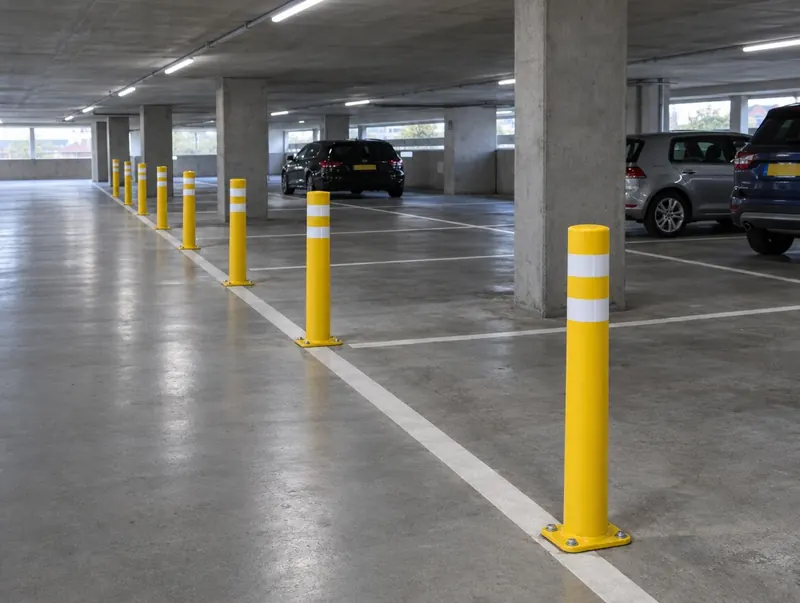
- Marking pedestrian routes inside multi-storey car parks
What we check first in Deal
Kent County Council is the highway authority covering Deal's local roads. If any post would stand on adopted highway rather than your land, that consent is the first thing we sort out.
Bollards on private land often don't need planning permission, but it depends on the council's view, the height and the location; in a conservation area, next to a listed building or under an Article 4 direction, ask the local planning authority (the council for Dover) first — we flag this at survey.
Flexible bollards put repeated load on their fixings, because every knock rocks the base. On tarmac, a small concrete pad or a socket base cast in concrete is the reliable option.
- Check drilling into car park decks or podium slabs with the building owner before fixing.
- Keep pedestrian gaps and routes clear, referring to Inclusive Mobility guidance where people walk through the line.
What happens on site
Survey traffic movements
The free site survey looks at vehicle sizes, turning paths and where drivers currently clip posts or kerbs. You receive a fixed written quote with post type and fixing.
Fix the bases
Holes are drilled and cleaned, resin anchors or bolts are set and the bases fixed and torqued once cured. Socket bases are set flush in concrete.
Hand over spares and records
Post and base details are recorded so replacements match, and spare posts can be left on site for busy locations. Staff are shown how a post is swapped on its base.
Finishes and options
| Option | Detail |
|---|---|
| Bolt-down or socket bases | Bolt-down for existing slabs; socket bases allow posts to be replaced without new fixings. |
| Colours and reflective sleeves | Yellow, black, red, white or orange, with reflective sleeves for visibility in low light. |
| Sprung-base bollards | A rigid post on a heavy spring or elastomer base that tilts and returns. Looks like a conventional bollard. |
What affects the quote
When we price flexible bollards in Deal, these make the biggest difference:
- Surface condition and need for concrete pads
- Number of posts and length of line
- Deck scanning and restrictions on drilling
After installation
Keep a few spare posts on site where knocks are frequent, so a damaged one can be swapped before the line develops a gap. Posts exposed to strong sunlight slowly lose flexibility and colour, and eventually crack; replacing the post on its existing base is usually quick.
If posts in Deal are later hit or damaged, we can repair or replace them — see bollard repairs.
Flexible bollards in Deal: FAQs
Can you install flexible bollards anywhere in Deal?
We cover all of Deal (CT14 and CT13) and the rest of Kent. We also work in Dover, Ramsgate and Broadstairs.
Who gives permission for bollards on the pavement in Deal?
The highway authority for local roads in Deal is Kent County Council; motorways and trunk roads sit with National Highways. Flexible bollards on the adopted footway are a matter for the highway authority, so we only install there with its written agreement.
How much do flexible bollards cost in Deal?
In Deal, typically £205–£635 per bollard, supplied and fixed, plus VAT, with a minimum job of £465 plus VAT, using our South East guide prices. The fixed figure comes in writing after we've seen the site.
Do flexible bollards damage vehicles?
Typically very little in a low-speed knock, which is a large part of their appeal. They may leave a scuff on paintwork. A rigid post in the same position would usually dent the vehicle and bend itself.
Can a damaged flexible post be replaced on the same base?
Usually, yes, especially with socket bases designed for it. The post is removed and a new one fitted. If the base itself is damaged or loose, it is re-fixed or replaced at the same time.
Flexible bollards in nearby towns
- Dover (7.8 mi)
- Ramsgate (7.8 mi)
- Broadstairs (9.5 mi)
- Margate (11 mi)
- Folkestone (14.1 mi)
- Canterbury (14.5 mi)