Kent · England
Pedestrian protection bollards in Deal
Pedestrian protection bollards for sites across Deal and the rest of Kent, from the first measurement to the last relaid paving block.
 Computer-generated image
Pedestrian protection in Deal
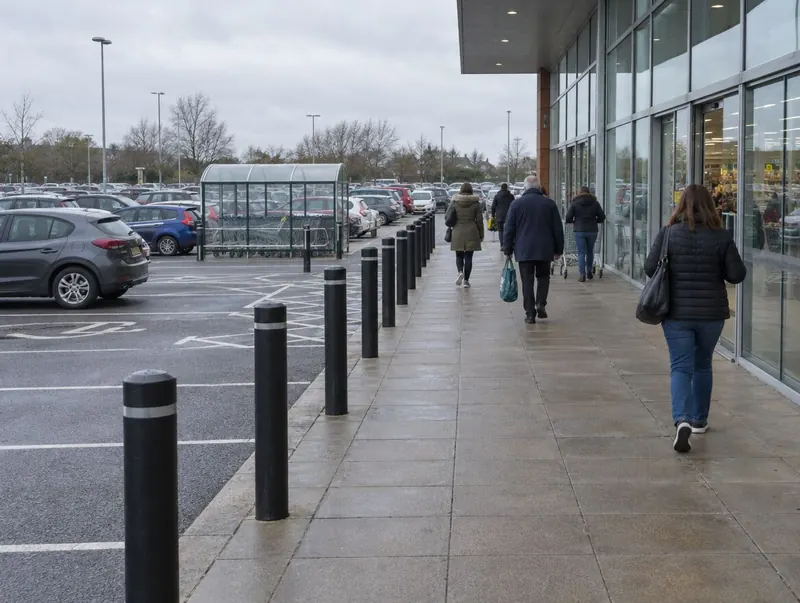
Across Deal, typical sites for pedestrian protection bollards include local parades, high street shopfronts and filling-station forecourts. Bollards that separate people from vehicles at car parks, forecourts, walkways, drive-thrus and shop entrances.
Coverage in Deal takes in the CT14 and CT13 postcode districts and nearby places like Sholden, Ringwould, Tilmanstone and Ripple. Nearby, we also work in Dover (7.8 miles), Ramsgate (7.8 miles), Broadstairs (9.5 miles) and Margate (11 miles), measured as the crow flies.
Key facts for this area
- Area
- Kent, England
- Highway authority
- Kent County Council (local roads)
- Planning authority
- the council for Dover
- Postcodes
- CT14 and CT13
- Guide price
- Typically £265–£1,245 per bollard + VAT; minimum job £625
- Survey
- Free, with a fixed written quote
- Nearby
- Dover (7.8 mi), Ramsgate (7.8 mi), Broadstairs (9.5 mi), Margate (11 mi)
Pedestrian protection bollards in Deal: common uses
Typical reasons Deal sites choose pedestrian protection bollards:
- Drive-thru lanes and order points next to seating
- Shop entrances facing nose-in parking bays
- Petrol station forecourts and kiosk frontages
Deal: typical pedestrian protection bollard prices
| Specification | Guide price | Includes |
|---|---|---|
| Standard | £265–£685 + VAT | Standard post, foundation, reinstatement |
| Upgraded | £565–£985 + VAT | Upgraded finish or fittings, reflective band, matched keys |
| Premium | £865–£1,245 + VAT | Heavy-duty or architectural spec, premium finish |
Per bollard, supplied and installed; +6% for South East. Guide only — the fixed price follows a survey.
Consents, ground and services in Deal
The highway authority for local roads in Deal is Kent County Council; motorways and trunk roads sit with National Highways. Pedestrian protection bollards on the adopted footway are a matter for the highway authority, so we only install there with its written agreement.
Many private-land installations in Deal need no planning application, but the rules don't clearly cover bollards, so listed buildings, conservation areas and prominent frontages are worth raising with the planning team at the council for Dover before posts go in.
Where bollards protect a shopfront, the building's own foundations and any canopy columns may sit close to the line, which limits how deep and wide each base can go. Car park edges and walkways tend to be built quickly over shallow hardcore, and their kerb lines often carry lighting cables, drainage channels and ducts for EV chargers or signs.
- If a tested product has been requested, confirm PAS 170-1 or another stated standard and install to the tested foundation.
- Use contrasting bands so posts are visible to partially sighted people, and avoid linking chains across routes.
What happens on site
Watch how the site works
The free site survey looks at where cars park, where people walk and queue, and where incidents or near misses have happened. You receive a fixed written quote with positions marked.
Excavate and set
Each position is cut, dug and checked for services, and the posts are set plumb in concrete to a consistent height.
Agree a plan for live trading
Work is phased so entrances and walkways stay open, with each section fenced while it is dug and set. Busy sites often prefer early starts or quieter weekdays.
Finishes and options
| Option | Detail |
|---|---|
| Concrete-filled steel posts | Root-fixed galvanised and powder-coated steel, the standard unrated choice for walkways and frontages. |
| PAS 170-1 tested bollards | Tested against low-speed vehicle impacts, for sites where proven performance has been asked for. |
| Wheel stops and kerbs | Used with bollards to stop cars before they reach the posts, reducing daily knocks. |
What affects the quote
Two Deal jobs with the same number of posts can price quite differently. The usual reasons:
- Reinstatement of tactile paving and walkway surfaces
- Ground conditions and services along kerb lines
- Working around trading hours and live car parks
Looking after them
Protection bollards take the knocks they are there for, so inspect them regularly and after any reported strike. Damaged posts near entrances should be dealt with quickly, as a bent post with a torn edge is a hazard in its own right.
We can also service, repair or replace existing posts anywhere in Deal.
Common questions
Do you install pedestrian protection bollards in Deal?
We cover all of Deal (CT14 and CT13) and the rest of Kent. We also work in Dover, Ramsgate and Broadstairs.
Do I need consent for pedestrian protection bollards on a public footway in Deal?
The highway authority for local roads in Deal is Kent County Council; motorways and trunk roads sit with National Highways. Pedestrian protection bollards on the adopted footway are a matter for the highway authority, so we only install there with its written agreement.
How much do pedestrian protection bollards cost in Deal?
In Deal, typically £265–£1,245 per bollard, supplied and installed, plus VAT, with a minimum job of £625 plus VAT, using our South East guide prices. The fixed figure comes in writing after we've seen the site.
Our outdoor seating faces the car park: what should we do?
Put a line of posts between the seating and the nearest parking or driving lane, with gaps narrow enough to stop a car. Positions should allow for cars that overshoot a bay. It is worth recording the decision in your risk assessment.
Are wheel stops enough on their own?
Wheel stops help drivers judge where to stop but a car can mount them with a firm press on the accelerator. Used with bollards, they reduce daily knocks on the posts. On their own they are not a barrier.
Pedestrian protection near Deal
- Dover (7.8 mi)
- Ramsgate (7.8 mi)
- Broadstairs (9.5 mi)
- Margate (11 mi)
- Folkestone (14.1 mi)
- Canterbury (14.5 mi)