London · England
Flexible bollard installation in Hackney
Local installation of flexible bollards in Hackney — free survey, fixed written price, and posts set to the right spacing for people and vehicles.
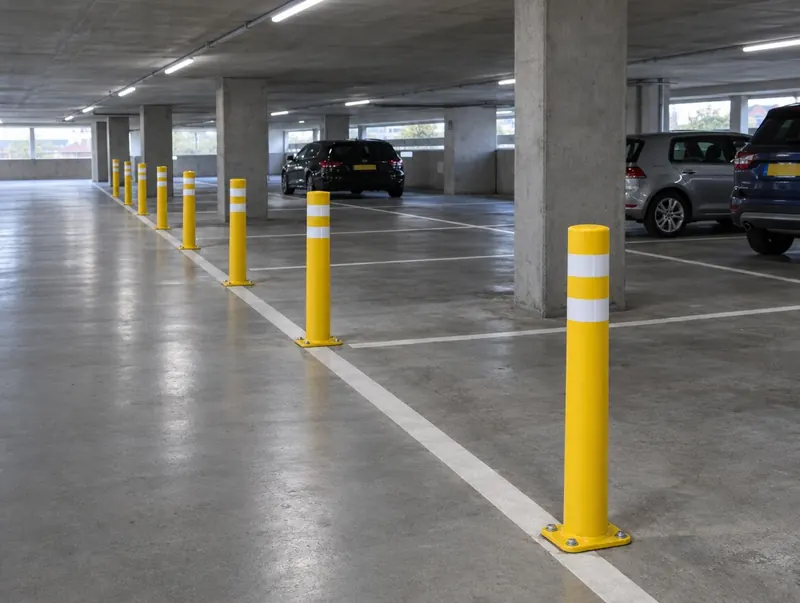 Computer-generated image
About flexible bollards in Hackney
We supply and fit flexible bollards throughout Hackney, typically for sites such as hospital approaches, places of worship and school gates. Flexible bollards are traffic management products, not barriers, and will not stop a vehicle that is driven at them.
Coverage in Hackney takes in the E9, E5, E8 and N16 postcode districts and nearby places like Stoke Newington. Nearby, we also work in Islington (2.3 miles), Tower Hamlets (2.4 miles), City of London (3 miles) and Newham (3.5 miles), measured as the crow flies.
Key facts for this area
- Area
- London, England
- Highway authority
- Hackney Council (local roads)
- Planning authority
- Hackney Council
- Postcodes
- E9, E5, E8 and N16
- Guide price
- Typically £225–£685 per bollard + VAT; minimum job £505
- Survey
- Free, with a fixed written quote
- Nearby
- Islington (2.3 mi), Tower Hamlets (2.4 mi), City of London (3 mi), Newham (3.5 mi)
Hackney: typical flexible bollard prices
| Specification | Guide price | Includes |
|---|---|---|
| Standard | £225–£415 + VAT | Standard post, foundation, reinstatement |
| Upgraded | £365–£555 + VAT | Upgraded finish or fittings, reflective band, matched keys |
| Premium | £505–£685 + VAT | Heavy-duty or architectural spec, premium finish |
Per bollard, supplied and fixed; +15% for London. Guide only — the fixed price follows a survey.
What Hackney sites use flexible bollards for
Common uses in a place like Hackney:
- Lane separation at car park entrances and exits
- Approaches to barriers, pay stations and ticket machines
- Drive-thru lanes and fuel forecourts
Permissions and groundwork in Hackney
In Hackney, work on adopted pavements and verges needs consent from Hackney Council, the local highway authority. Red routes are managed by Transport for London. Car parks, forecourts and other private land only need the owner's permission.
Many private-land installations in Hackney need no planning application, but the rules don't clearly cover bollards, so listed buildings, conservation areas and prominent frontages are worth raising with the planning team at Hackney Council before posts go in.
Where posts go in a line across a drainage fall, positions avoid channels and gullies. Multi-storey and rooftop decks are a special case: slabs may be post-tensioned or carry waterproofing and heating, so drilling depth and positions are agreed with the building owner and scanned first.
- Do not use flexible bollards where a physical barrier is needed to protect people or buildings; they guide rather than stop.
- Check drilling into car park decks or podium slabs with the building owner before fixing.
Installation, step by step
Set out the line
Posts are set out to guide vehicles along the intended path, with spacing that reads as a line to drivers.
Fix the bases
Holes are drilled and cleaned, resin anchors or bolts are set and the bases fixed and torqued once cured. Socket bases are set flush in concrete.
Hand over spares and records
Post and base details are recorded so replacements match, and spare posts can be left on site for busy locations. Staff are shown how a post is swapped on its base.
Choosing the right spec
| Option | Detail |
|---|---|
| Low-profile deck bases | Shallow fixings for multi-storey decks where deep drilling is not permitted. |
| Heights and diameters | Commonly 750–1,000 mm high and around 80–200 mm diameter, with slimmer wand-style posts for lane lines. |
| Colours and reflective sleeves | Yellow, black, red, white or orange, with reflective sleeves for visibility in low light. |
What affects the quote
Our London guide prices are a starting point; the survey in Hackney firms them up. What tends to move them:
- Surface condition and need for concrete pads
- Number of posts and length of line
- Out-of-hours working in busy car parks
Looking after them
Posts exposed to strong sunlight slowly lose flexibility and colour, and eventually crack; replacing the post on its existing base is usually quick. Check flexible bollards for splits, permanent bends and loose bases, and tighten or replace fixings that have worked loose.
We can also service, repair or replace existing posts anywhere in Hackney.
Questions about flexible bollards in Hackney
Do you install flexible bollards in Hackney?
We cover all of Hackney (E9, E5, E8 and N16) and the rest of London. We also work in Islington, Tower Hamlets and City of London.
Do I need consent for flexible bollards on a public footway in Hackney?
Hackney Council is the highway authority covering Hackney's local roads. Red routes are managed by Transport for London. If any post would stand on adopted highway rather than your land, that consent is the first thing we sort out.
What's a typical price for flexible bollards in Hackney?
In Hackney, typically £225–£685 per bollard, supplied and fixed, plus VAT, with a minimum job of £505 plus VAT, using our London guide prices. The fixed figure comes in writing after we've seen the site.
Can a damaged flexible post be replaced on the same base?
Usually, yes, especially with socket bases designed for it. The post is removed and a new one fitted. If the base itself is damaged or loose, it is re-fixed or replaced at the same time.
How many times can a flexible bollard be hit?
Many times in normal use, as long as the impacts are the low-speed bumps it is designed for. A heavy vehicle running right over it, or a high-speed strike, can tear it. Manufacturers give guidance for their products.
Flexible bollards in nearby towns
- Islington (2.3 mi)
- Tower Hamlets (2.4 mi)
- City of London (3 mi)
- Newham (3.5 mi)
- Haringey (3.6 mi)
- Waltham Forest (3.6 mi)