Northumberland · England
Flexible bollard installation in Ashington
Flexible bollards for sites across Ashington and the rest of Northumberland, from the first measurement to the last relaid paving block.
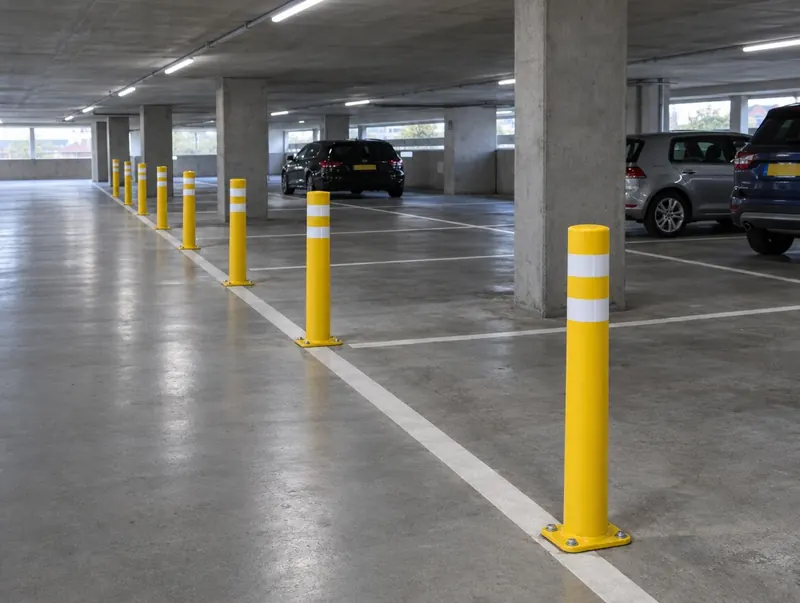 Computer-generated image
Flexible bollards in Ashington
From community buildings, local parades and schools, Ashington has plenty of places where flexible bollards earn their keep. Polyurethane and spring-based bollards that bend when hit and return upright, for car parks, depots and lane separation.
Coverage in Ashington takes in the NE63, NE62, NE64, NE22 and NE61 postcode districts and nearby places like Woodhorn, Stakeford, Guide Post and Choppington. We also cover neighbouring Blyth (4.1 miles), Cramlington (6.3 miles), Whitley Bay (10.6 miles) and North Shields (12 miles) — distances are straight-line. Ashington is about 14 miles from Newcastle upon Tyne.
Local details
- Area
- Northumberland, England
- Highway authority
- Northumberland County Council (local roads)
- Planning authority
- Northumberland County Council
- Postcodes
- NE63, NE62, NE64, NE22 and NE61
- Guide price
- Typically £185–£575 per bollard + VAT; minimum job £425
- Survey
- Free, with a fixed written quote
- Nearby
- Blyth (4.1 mi), Cramlington (6.3 mi), Whitley Bay (10.6 mi), North Shields (12 mi)
What Ashington sites use flexible bollards for
Common uses in a place like Ashington:
- Depot and yard routes where vehicles knock posts daily
- Marking pedestrian routes inside multi-storey car parks
- Drive-thru lanes and fuel forecourts
Guide prices for Ashington
| Specification | Guide price | Includes |
|---|---|---|
| Standard | £185–£345 + VAT | Standard post, foundation, reinstatement |
| Upgraded | £305–£465 + VAT | Upgraded finish or fittings, reflective band, matched keys |
| Premium | £415–£575 + VAT | Heavy-duty or architectural spec, premium finish |
Per bollard, supplied and fixed; -4% for North East. Guide only — the fixed price follows a survey.
What we check first in Ashington
The highway authority for local roads in Ashington is Northumberland County Council; motorways and trunk roads sit with National Highways. Flexible bollards on the adopted footway are a matter for the highway authority, so we only install there with its written agreement.
Bollards on private land often don't need planning permission, but it depends on the council's view, the height and the location; in a conservation area, next to a listed building or under an Article 4 direction, ask the local planning authority (Northumberland County Council) first — we flag this at survey.
Multi-storey and rooftop decks are a special case: slabs may be post-tensioned or carry waterproofing and heating, so drilling depth and positions are agreed with the building owner and scanned first. Flexible bollards put repeated load on their fixings, because every knock rocks the base.
- Keep pedestrian gaps and routes clear, referring to Inclusive Mobility guidance where people walk through the line.
- Check drilling into car park decks or podium slabs with the building owner before fixing.
What happens on site
Set out the line
Posts are set out to guide vehicles along the intended path, with spacing that reads as a line to drivers.
Fix the bases
Holes are drilled and cleaned, resin anchors or bolts are set and the bases fixed and torqued once cured. Socket bases are set flush in concrete.
Hand over spares and records
Post and base details are recorded so replacements match, and spare posts can be left on site for busy locations. Staff are shown how a post is swapped on its base.
Options to consider
| Option | Detail |
|---|---|
| Low-profile deck bases | Shallow fixings for multi-storey decks where deep drilling is not permitted. |
| Heights and diameters | Commonly 750–1,000 mm high and around 80–200 mm diameter, with slimmer wand-style posts for lane lines. |
| Polyurethane posts | Flex along their length and return to shape. Gentle on vehicles and common in car parks and on forecourts. |
What moves the price in Ashington
Our North East guide prices are a starting point; the survey in Ashington firms them up. What tends to move them:
- Bolt-down or socket base
- Out-of-hours working in busy car parks
- Deck scanning and restrictions on drilling
After installation
Keep a few spare posts on site where knocks are frequent, so a damaged one can be swapped before the line develops a gap. Clean reflective sleeves so they stay visible, and replace them when they fade or peel.
If posts in Ashington are later hit or damaged, we can repair or replace them — see bollard repairs.
Flexible bollards in Ashington: FAQs
Which parts of Ashington do you cover for flexible bollards?
We cover all of Ashington (NE63, NE62, NE64, NE22 and NE61) and the rest of Northumberland. We also work in Blyth, Cramlington and Whitley Bay.
Do I need consent for flexible bollards on a public footway in Ashington?
Northumberland County Council is the highway authority covering Ashington's local roads. If any post would stand on adopted highway rather than your land, that consent is the first thing we sort out.
How much do flexible bollards cost in Ashington?
In Ashington, typically £185–£575 per bollard, supplied and fixed, plus VAT, with a minimum job of £425 plus VAT, using our North East guide prices. The fixed figure comes in writing after we've seen the site.
Can flexible bollards go in a multi-storey car park?
Yes, often with low-profile bases. The deck has to be checked first, as some slabs contain tendons or waterproofing that must not be drilled. The building owner usually needs to agree the fixing method.
Do flexible bollards damage vehicles?
Typically very little in a low-speed knock, which is a large part of their appeal. They may leave a scuff on paintwork. A rigid post in the same position would usually dent the vehicle and bend itself.
Flexible bollards in nearby towns
- Blyth (4.1 mi)
- Cramlington (6.3 mi)
- Whitley Bay (10.6 mi)
- North Shields (12 mi)
- Tynemouth (12.3 mi)
- Wallsend (12.9 mi)