Northumberland · England
Flexible bollard installation in Blyth
Planning flexible bollards in Blyth? We check ownership, consents and buried services first, then quote a fixed price.
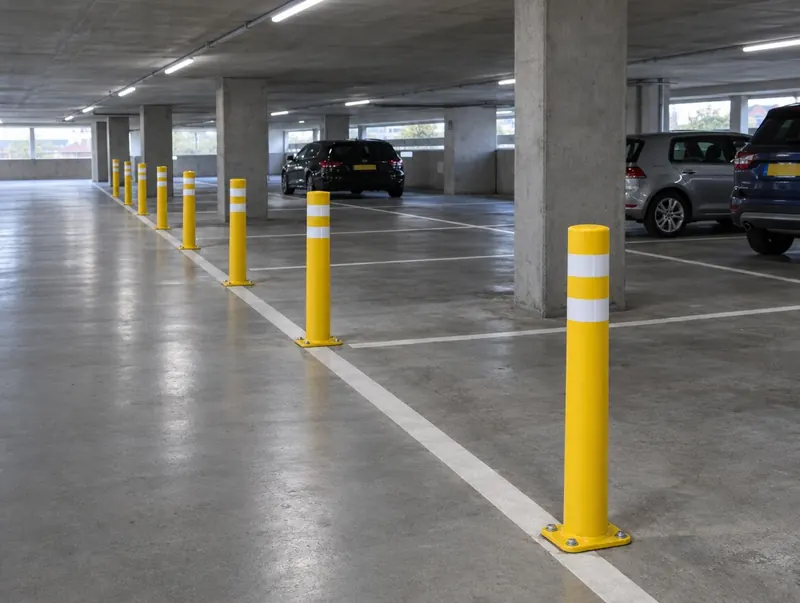 Computer-generated image
Flexible bollards in Blyth
We supply and fit flexible bollards throughout Blyth, typically for sites such as filling-station forecourts, community buildings and schools. Flexible bollards are traffic management products, not barriers, and will not stop a vehicle that is driven at them.
We cover Blyth's NE24 postcode district, including places such as Cambois. Nearby, we also work in Ashington (4.1 miles), Cramlington (4.1 miles), Whitley Bay (6.5 miles) and North Shields (8 miles), measured as the crow flies. Blyth is about 11 miles from Newcastle upon Tyne.
Local details
- Area
- Northumberland, England
- Highway authority
- Northumberland County Council (local roads)
- Planning authority
- Northumberland County Council
- Postcodes
- NE24
- Guide price
- Typically £185–£575 per bollard + VAT; minimum job £425
- Survey
- Free, with a fixed written quote
- Nearby
- Ashington (4.1 mi), Cramlington (4.1 mi), Whitley Bay (6.5 mi), North Shields (8 mi)
What flexible bollards cost in Blyth
| Specification | Guide price | Includes |
|---|---|---|
| Standard | £185–£345 + VAT | Standard post, foundation, reinstatement |
| Upgraded | £305–£465 + VAT | Upgraded finish or fittings, reflective band, matched keys |
| Premium | £415–£575 + VAT | Heavy-duty or architectural spec, premium finish |
Per bollard, supplied and fixed; -4% for North East. Guide only — the fixed price follows a survey.
Flexible bollards in Blyth: common uses
Typical reasons Blyth sites choose flexible bollards:
- Approaches to barriers, pay stations and ticket machines
- Lane separation at car park entrances and exits
- Temporary or trial layouts before permanent kerbs
Consents, ground and services in Blyth
In Blyth, work on adopted pavements and verges needs consent from Northumberland County Council, the local highway authority. Car parks, forecourts and other private land only need the owner's permission.
Bollards on private land often don't need planning permission, but it depends on the council's view, the height and the location; in a conservation area, next to a listed building or under an Article 4 direction, ask the local planning authority (Northumberland County Council) first — we flag this at survey.
Flexible bollards put repeated load on their fixings, because every knock rocks the base. Multi-storey and rooftop decks are a special case: slabs may be post-tensioned or carry waterproofing and heating, so drilling depth and positions are agreed with the building owner and scanned first.
- On public highway, including cycle lane segregation, the highway authority's agreement and specification are needed.
- Keep pedestrian gaps and routes clear, referring to Inclusive Mobility guidance where people walk through the line.
What happens on site
Check the surface
Slabs and decks are checked for thickness, reinforcement and waterproofing before drilling. Weak tarmac may need a concrete pad or socket base.
Set out the line
Posts are set out to guide vehicles along the intended path, with spacing that reads as a line to drivers.
Hand over spares and records
Post and base details are recorded so replacements match, and spare posts can be left on site for busy locations. Staff are shown how a post is swapped on its base.
Options to consider
| Option | Detail |
|---|---|
| Bolt-down or socket bases | Bolt-down for existing slabs; socket bases allow posts to be replaced without new fixings. |
| Low-profile deck bases | Shallow fixings for multi-storey decks where deep drilling is not permitted. |
| Colours and reflective sleeves | Yellow, black, red, white or orange, with reflective sleeves for visibility in low light. |
What affects the quote
Two Blyth jobs with the same number of posts can price quite differently. The usual reasons:
- Deck scanning and restrictions on drilling
- Polymer posts or sprung-base bollards
- Out-of-hours working in busy car parks
Keeping them working
Check flexible bollards for splits, permanent bends and loose bases, and tighten or replace fixings that have worked loose. Posts exposed to strong sunlight slowly lose flexibility and colour, and eventually crack; replacing the post on its existing base is usually quick.
If posts in Blyth are later hit or damaged, we can repair or replace them — see bollard repairs.
Common questions
Can you install flexible bollards anywhere in Blyth?
We cover all of Blyth (NE24) and the rest of Northumberland. We also work in Ashington, Cramlington and Whitley Bay.
Do I need consent for flexible bollards on a public footway in Blyth?
In Blyth, work on adopted pavements and verges needs consent from Northumberland County Council, the local highway authority. Car parks, forecourts and other private land only need the owner's permission.
What's a typical price for flexible bollards in Blyth?
In Blyth, typically £185–£575 per bollard, supplied and fixed, plus VAT, with a minimum job of £425 plus VAT, using our North East guide prices. The fixed figure comes in writing after we've seen the site.
How many times can a flexible bollard be hit?
Many times in normal use, as long as the impacts are the low-speed bumps it is designed for. A heavy vehicle running right over it, or a high-speed strike, can tear it. Manufacturers give guidance for their products.
Do flexible bollards work in cold weather?
They do, but polymers become stiffer in cold conditions and recover more slowly after a knock. Sprung-base designs are less affected. Neither type is damaged by normal UK winter temperatures.
Flexible bollards in nearby towns
- Ashington (4.1 mi)
- Cramlington (4.1 mi)
- Whitley Bay (6.5 mi)
- North Shields (8 mi)
- Tynemouth (8.2 mi)
- South Shields (9.4 mi)