Scottish Borders · Scotland
Flexible bollard installation in Galashiels
Planning flexible bollards in Galashiels? We check ownership, consents and buried services first, then quote a fixed price.
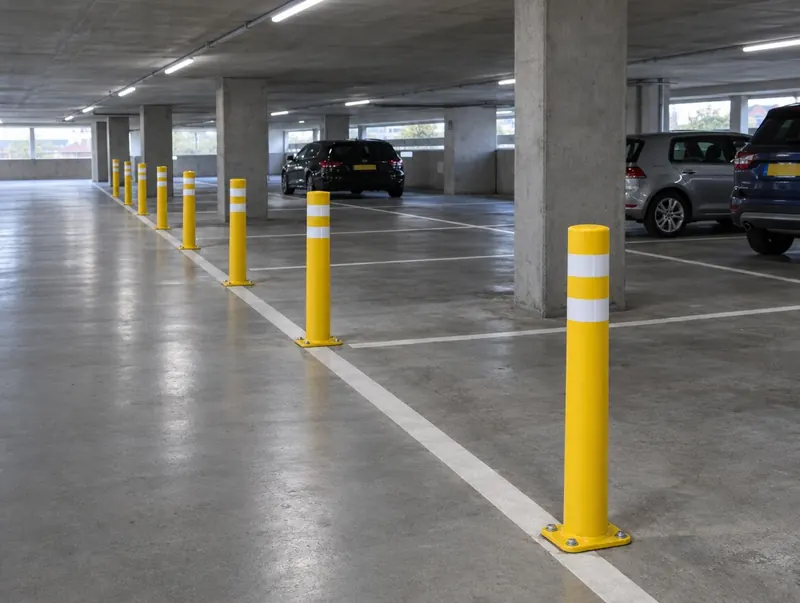 Computer-generated image
Flexible bollards in Galashiels
Across Galashiels, typical sites for flexible bollards include small industrial units, high street shopfronts and community car parks. Polyurethane and spring-based bollards that bend when hit and return upright, for car parks, depots and lane separation.
Coverage in Galashiels takes in the TD1, TD6, TD4 and TD7 postcode districts and nearby places like Clovenfords, Fountainhall, Killochyett and Nether Blainslie. We also cover neighbouring Hawick (13.3 miles), Bonnyrigg (21.3 miles) and Dalkeith (21.8 miles) — distances are straight-line. Edinburgh is around 28 miles away.
Local details
- Area
- Scottish Borders, Scotland
- Roads authority
- Scottish Borders Council (local roads)
- Planning authority
- Scottish Borders Council
- Postcodes
- TD1, TD6, TD4 and TD7
- Guide price
- Typically £195–£595 per bollard + VAT; minimum job £445
- Survey
- Free, with a fixed written quote
What flexible bollards cost in Galashiels
| Specification | Guide price | Includes |
|---|---|---|
| Standard | £195–£365 + VAT | Standard post, foundation, reinstatement |
| Upgraded | £315–£485 + VAT | Upgraded finish or fittings, reflective band, matched keys |
| Premium | £435–£595 + VAT | Heavy-duty or architectural spec, premium finish |
Per bollard, supplied and fixed; no regional adjustment. Guide only — the fixed price follows a survey.
Typical flexible bollards jobs in Galashiels
Typical reasons Galashiels sites choose flexible bollards:
- Drive-thru lanes and fuel forecourts
- Temporary or trial layouts before permanent kerbs
- Depot and yard routes where vehicles knock posts daily
Before we dig in Galashiels
In Scotland the council is the roads authority for local roads, which in Galashiels means Scottish Borders Council. Flexible bollards on an adopted footway need its consent; trunk roads sit with Transport Scotland.
Bollards on private land often need no planning application, but listed buildings and conservation areas are different; the planning service at Scottish Borders Council can confirm before anything is ordered.
Anchors therefore need sound concrete with enough edge distance; anchoring into thin, cracked or weak surfaces means the base works loose within weeks. Multi-storey and rooftop decks are a special case: slabs may be post-tensioned or carry waterproofing and heating, so drilling depth and positions are agreed with the building owner and scanned first.
- Keep pedestrian gaps and routes clear, referring to Inclusive Mobility guidance where people walk through the line.
- Do not use flexible bollards where a physical barrier is needed to protect people or buildings; they guide rather than stop.
How the job runs
Check the surface
Slabs and decks are checked for thickness, reinforcement and waterproofing before drilling. Weak tarmac may need a concrete pad or socket base.
Set out the line
Posts are set out to guide vehicles along the intended path, with spacing that reads as a line to drivers.
Hand over spares and records
Post and base details are recorded so replacements match, and spare posts can be left on site for busy locations. Staff are shown how a post is swapped on its base.
Finishes and options
| Option | Detail |
|---|---|
| Low-profile deck bases | Shallow fixings for multi-storey decks where deep drilling is not permitted. |
| Bolt-down or socket bases | Bolt-down for existing slabs; socket bases allow posts to be replaced without new fixings. |
| Heights and diameters | Commonly 750–1,000 mm high and around 80–200 mm diameter, with slimmer wand-style posts for lane lines. |
What affects the quote
When we price flexible bollards in Galashiels, these make the biggest difference:
- Out-of-hours working in busy car parks
- Number of posts and length of line
- Bolt-down or socket base
Keeping them working
Check flexible bollards for splits, permanent bends and loose bases, and tighten or replace fixings that have worked loose. Posts exposed to strong sunlight slowly lose flexibility and colour, and eventually crack; replacing the post on its existing base is usually quick.
If posts in Galashiels are later hit or damaged, we can repair or replace them — see bollard repairs.
Questions about flexible bollards in Galashiels
Do you install flexible bollards in Galashiels?
We cover all of Galashiels (TD1, TD6, TD4 and TD7) and the rest of Scottish Borders. We also work in Hawick, Bonnyrigg and Dalkeith.
Who gives permission for bollards on the pavement in Galashiels?
For anything on the public footway in Galashiels we check with the roads authority first — Scottish Borders Council for local roads, Transport Scotland on trunk routes. Private ground such as a car park or forecourt only needs the owner's go-ahead.
How much do flexible bollards cost in Galashiels?
In Galashiels, typically £195–£595 per bollard, supplied and fixed, plus VAT, with a minimum job of £445 plus VAT, using our Scotland guide prices. The fixed figure comes in writing after we've seen the site.
Do flexible bollards work in cold weather?
They do, but polymers become stiffer in cold conditions and recover more slowly after a knock. Sprung-base designs are less affected. Neither type is damaged by normal UK winter temperatures.
Will a flexible bollard stop a car?
No. It is designed to bend and recover, so a car can push past it. It marks the line and discourages drivers from crossing it. Where a vehicle must be physically stopped, use a rigid bollard.