Cumbria · England
Lighting bollard installation in Workington
Local installation of lighting bollards in Workington — free survey, fixed written price, and posts set to the right spacing for people and vehicles.
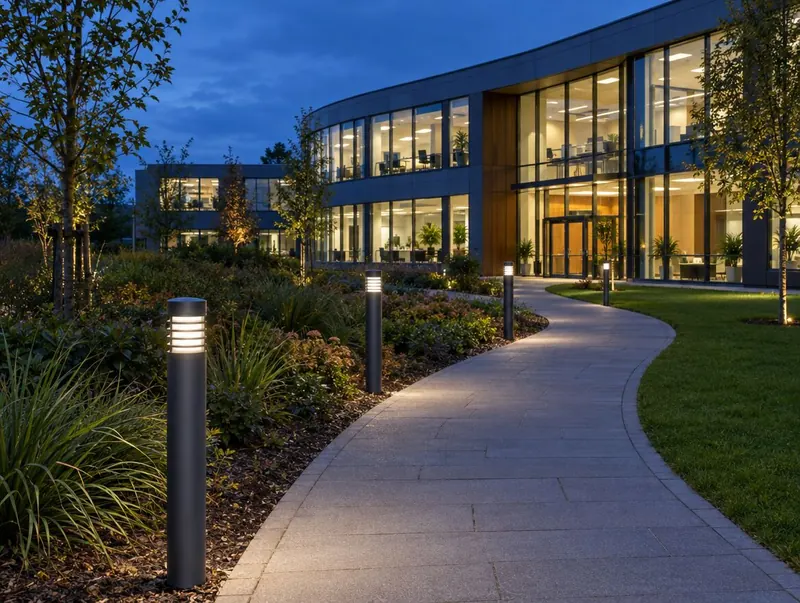 Computer-generated image
Lighting bollards in Workington
In the town of Workington, lighting bollards tend to go in at filling-station forecourts, schools and local parades. Low-level LED bollard lights for paths, car parks, entrances and gardens, installed with a qualified electrician.
Coverage in Workington takes in the CA14 and CA15 postcode districts and nearby places like High Harrington, Stainburn, Great Clifton and Winscales. Jobs in Workington can be combined with work in Whitehaven (6.7 miles) (straight-line distances).
Workington at a glance
- Area
- Cumbria, England
- Highway authority
- Cumberland Council (local roads)
- Planning authority
- Cumberland Council
- Postcodes
- CA14 and CA15
- Guide price
- Typically £335–£1,195 per bollard + VAT (£395–£1,445 inc VAT for homes); minimum job £825
- Survey
- Free, with a fixed written quote
- Nearby
- Whitehaven (6.7 mi)
Lighting bollard prices in Workington
| Specification | Guide price | Includes |
|---|---|---|
| Standard | £335–£685 + VAT · £395–£815 inc VAT | Standard post, foundation, reinstatement |
| Upgraded | £585–£935 + VAT · £695–£1,095 inc VAT | Upgraded finish or fittings, reflective band, matched keys |
| Premium | £835–£1,195 + VAT · £995–£1,445 inc VAT | Heavy-duty or architectural spec, premium finish |
Per bollard, installed with a qualified electrician (supply run extra); -2% for North West. Guide only — the fixed price follows a survey.
What Workington sites use lighting bollards for
Common uses in a place like Workington:
- Building entrances and approach routes
- Parks and areas where tall columns would be intrusive
- Hotel, restaurant and pub frontages
Permissions and groundwork in Workington
Cumberland Council is the highway authority covering Workington's local roads. If any post would stand on adopted highway rather than your land, that consent is the first thing we sort out.
Bollards on private land often don't need planning permission, but it depends on the council's view, the height and the location; in a conservation area, next to a listed building or under an Article 4 direction, ask the local planning authority (Cumberland Council) first — we flag this at survey.
Cable trenches run between every position and back to the supply, often crossing paths, drives and planting, so the routes are planned to minimise cuts through hard surfaces and to avoid existing gas, water and telecoms services. Bases are set in firm ground with the cable entry facing the right way, and on paved routes the bollards are positioned so cables can be pulled through ducts rather than requiring surfaces to be lifted again later.
- Limit glare and upward light, and check for any planning or ecology conditions on lighting near sensitive habitats.
- Choose IP and IK ratings that suit the location, and do not rely on lighting bollards as vehicle barriers.
How the job runs
Survey and lighting layout
A free site survey looks at the routes to be lit, where power can come from, surfaces and buried services. Bollard spacing is set from the product's light data, and you receive a fixed written quote.
Test, aim and certify
The circuit is tested and certified, bollards are checked at night for coverage and glare, and asymmetric heads are turned to face the path.
Reinstate
Trenches are backfilled and surfaces made good, whether paving, tarmac, gravel or turf.
Choosing the right spec
| Option | Detail |
|---|---|
| Controls | Photocells, timers, motion sensors and dimming to light only when and as much as needed. |
| Colour temperature | Warm white for residential and amenity areas; warmer or amber options near sensitive wildlife habitats. |
| Fixings | Anchor cages cast in concrete, base plates on existing slabs, or ground spikes for garden models. |
Pricing lighting bollards in Workington
Two Workington jobs with the same number of posts can price quite differently. The usual reasons:
- Number of bollards and their specification
- Distance from the supply and circuit requirements
- Length of cable routes and surfaces to be cut
Keeping them working
LED lighting bollards need far less maintenance than older lamp types, but they are not maintenance-free. If a run of bollards trips the circuit after rain, water ingress at a connection is the usual cause and needs an electrician.
For damaged or loose posts in Workington, repairs and replacements are priced in writing first.
Questions about lighting bollards in Workington
Do you install lighting bollards in Workington?
We cover all of Workington (CA14 and CA15) and the rest of Cumbria. We also work in Whitehaven.
Who gives permission for bollards on the pavement in Workington?
The highway authority for local roads in Workington is Cumberland Council; motorways and trunk roads sit with National Highways. Lighting bollards on the adopted footway are a matter for the highway authority, so we only install there with its written agreement.
What's a typical price for lighting bollards in Workington?
In Workington, typically £335–£1,195 per bollard, installed with a qualified electrician (supply run extra), plus VAT (£395–£1,445 including VAT for homeowners), with a minimum job of £825 plus VAT, using our North West guide prices. The fixed figure comes in writing after we've seen the site.
How far apart should lighting bollards be?
That depends on the light output, beam pattern and how evenly the path needs to be lit. Spacing is worked out from the product's light data rather than a fixed distance. Too far apart leaves dark patches between pools of light.
Can bollard lights work on a timer or motion sensor?
Yes. Photocells switch them on at dusk, timers switch them off or dim them late at night and motion sensors bring them up when someone approaches. Combining controls saves energy and reduces light pollution.