Lincolnshire · England
Lighting bollard installation in Boston
Lighting bollards for sites across Boston and the rest of Lincolnshire, from the first measurement to the last relaid paving block.
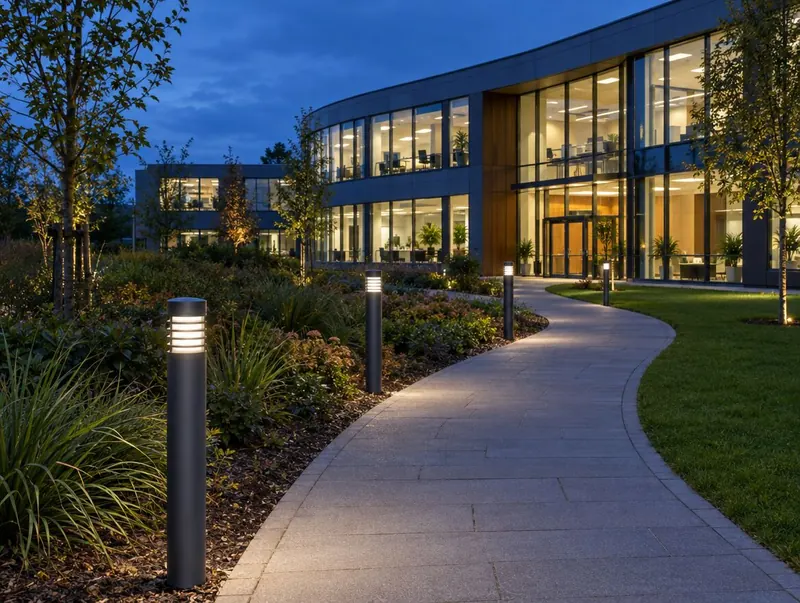 Computer-generated image
Lighting bollards in Boston
Lighting bollards suit plenty of Boston sites, residential driveways, local parades and community buildings among them. Low-level LED bollard lights for paths, car parks, entrances and gardens, installed with a qualified electrician.
Coverage in Boston takes in the PE21, PE20 and PE22 postcode districts and nearby places like Fishtoft, Hall Hills, Sutterton and Bicker. Nearby, we also work in Spalding (14.1 miles) and Skegness (19 miles), measured as the crow flies.
Local details
- Area
- Lincolnshire, England
- Highway authority
- Lincolnshire County Council (local roads)
- Planning authority
- the council for Boston
- Postcodes
- PE21, PE20 and PE22
- Guide price
- Typically £355–£1,245 per bollard + VAT (£425–£1,495 inc VAT for homes); minimum job £865
- Survey
- Free, with a fixed written quote
Boston: typical lighting bollard prices
| Specification | Guide price | Includes |
|---|---|---|
| Standard | £355–£725 + VAT · £425–£865 inc VAT | Standard post, foundation, reinstatement |
| Upgraded | £615–£985 + VAT · £735–£1,195 inc VAT | Upgraded finish or fittings, reflective band, matched keys |
| Premium | £885–£1,245 + VAT · £1,045–£1,495 inc VAT | Heavy-duty or architectural spec, premium finish |
Per bollard, installed with a qualified electrician (supply run extra); +3% for East of England. Guide only — the fixed price follows a survey.
Where lighting bollards go in around Boston
Common uses in a place like Boston:
- Private gardens and long driveways
- Footpaths through housing developments and campuses
- Steps, ramps and changes in level
Consents, ground and services in Boston
Lincolnshire County Council is the highway authority covering Boston's local roads. If any post would stand on adopted highway rather than your land, that consent is the first thing we sort out.
Many private-land installations in Boston need no planning application, but the rules don't clearly cover bollards, so listed buildings, conservation areas and prominent frontages are worth raising with the planning team at the council for Boston before posts go in.
Cable trenches run between every position and back to the supply, often crossing paths, drives and planting, so the routes are planned to minimise cuts through hard surfaces and to avoid existing gas, water and telecoms services. Bases are set in firm ground with the cable entry facing the right way, and on paved routes the bollards are positioned so cables can be pulled through ducts rather than requiring surfaces to be lifted again later.
- Have the electrical installation designed, installed, tested and certified by a qualified electrician to BS 7671.
- Choose IP and IK ratings that suit the location, and do not rely on lighting bollards as vehicle barriers.
From survey to handover
Survey and lighting layout
A free site survey looks at the routes to be lit, where power can come from, surfaces and buried services. Bollard spacing is set from the product's light data, and you receive a fixed written quote.
Set the bases
Anchor cages or foundations are cast at each position with the cable entry in the right place, set level so each bollard stands plumb.
Electrical connection
A qualified electrician installs the circuit protection, makes the connections in weatherproof enclosures and fits controls such as a photocell or timer.
Options to consider
| Option | Detail |
|---|---|
| Controls | Photocells, timers, motion sensors and dimming to light only when and as much as needed. |
| Light distribution | 360-degree, asymmetric or louvred heads to light paths while limiting glare and light spill. |
| Body materials and finishes | Powder-coated aluminium or steel, or stainless steel, in colours to suit the building. |
What affects the quote
Our East of England guide prices are a starting point; the survey in Boston firms them up. What tends to move them:
- Controls such as photocells, timers or sensors
- Reinstatement of paving, tarmac or planting
- Distance from the supply and circuit requirements
Looking after them
LED lighting bollards need far less maintenance than older lamp types, but they are not maintenance-free. Clean diffusers so dirt and algae do not dim the light, check seals and fixings, and look for impact damage, especially in car parks.
We can also service, repair or replace existing posts anywhere in Boston.
Lighting bollards in Boston: FAQs
Do you install lighting bollards in Boston?
We cover all of Boston (PE21, PE20 and PE22) and the rest of Lincolnshire. We also work in Spalding and Skegness.
Who gives permission for bollards on the pavement in Boston?
In Boston, work on adopted pavements and verges needs consent from Lincolnshire County Council, the local highway authority. Car parks, forecourts and other private land only need the owner's permission.
What's a typical price for lighting bollards in Boston?
In Boston, typically £355–£1,245 per bollard, installed with a qualified electrician (supply run extra), plus VAT (£425–£1,495 including VAT for homeowners), with a minimum job of £865 plus VAT, using our East of England guide prices. The fixed figure comes in writing after we've seen the site.
Will lighting bollards survive in a car park?
Choose robust bodies with a high impact rating and place them where vehicles are unlikely to hit them, such as behind kerbs or alongside protective posts. A lighting bollard is not designed to stop a car.
How far apart should lighting bollards be?
That depends on the light output, beam pattern and how evenly the path needs to be lit. Spacing is worked out from the product's light data rather than a fixed distance. Too far apart leaves dark patches between pools of light.