Norfolk · England
Lighting bollard installation in Great Yarmouth
Lighting bollards supplied and fitted in Great Yarmouth, Norfolk: surveyed, scanned for services, set in proper foundations and finished to match the ground.
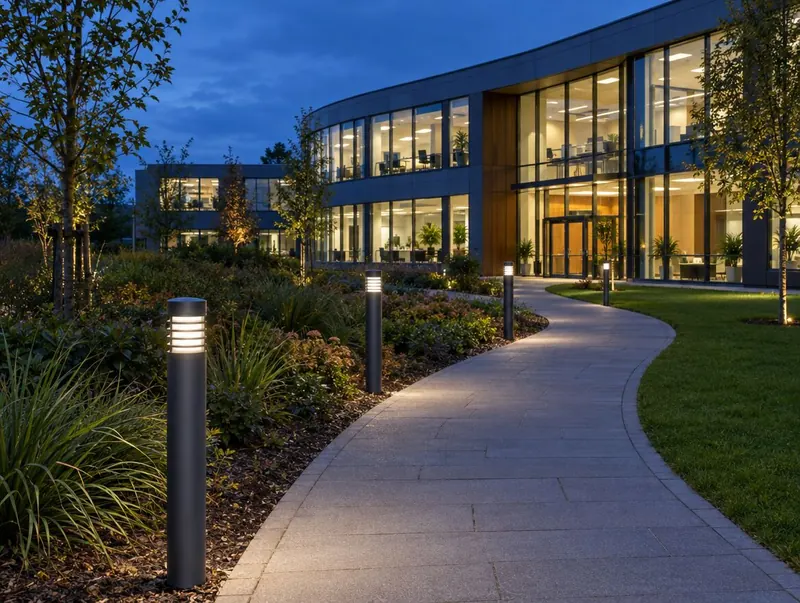 Computer-generated image
About lighting bollards in Great Yarmouth
Lighting bollards suit plenty of Great Yarmouth sites, schools, community buildings and small industrial units among them. Low-level LED bollard lights for paths, car parks, entrances and gardens, installed with a qualified electrician.
We cover Great Yarmouth's NR30, NR29 and NR31 postcode districts, including places such as Caister-on-Sea, West Caister, Martham and Hemsby. Nearby, we also work in Lowestoft (9.2 miles) and Norwich (18.2 miles), measured as the crow flies.
Great Yarmouth at a glance
- Area
- Norfolk, England
- Highway authority
- Norfolk County Council (local roads)
- Planning authority
- the council for Great Yarmouth
- Postcodes
- NR30, NR29 and NR31
- Guide price
- Typically £355–£1,245 per bollard + VAT (£425–£1,495 inc VAT for homes); minimum job £865
- Survey
- Free, with a fixed written quote
Typical lighting bollards jobs in Great Yarmouth
Common uses in a place like Great Yarmouth:
- Private gardens and long driveways
- Building entrances and approach routes
- Steps, ramps and changes in level
Lighting bollard prices in Great Yarmouth
| Specification | Guide price | Includes |
|---|---|---|
| Standard | £355–£725 + VAT · £425–£865 inc VAT | Standard post, foundation, reinstatement |
| Upgraded | £615–£985 + VAT · £735–£1,195 inc VAT | Upgraded finish or fittings, reflective band, matched keys |
| Premium | £885–£1,245 + VAT · £1,045–£1,495 inc VAT | Heavy-duty or architectural spec, premium finish |
Per bollard, installed with a qualified electrician (supply run extra); +3% for East of England. Guide only — the fixed price follows a survey.
Consents, ground and services in Great Yarmouth
The highway authority for local roads in Great Yarmouth is Norfolk County Council; motorways and trunk roads sit with National Highways. Lighting bollards on the adopted footway are a matter for the highway authority, so we only install there with its written agreement.
Bollards on private land often don't need planning permission, but it depends on the council's view, the height and the location; in a conservation area, next to a listed building or under an Article 4 direction, ask the local planning authority (the council for Great Yarmouth) first — we flag this at survey.
Cable trenches run between every position and back to the supply, often crossing paths, drives and planting, so the routes are planned to minimise cuts through hard surfaces and to avoid existing gas, water and telecoms services. Cable is protected by armour or duct, buried deep enough to avoid garden tools and future paving works, and marked with warning tape.
- Limit glare and upward light, and check for any planning or ecology conditions on lighting near sensitive habitats.
- In homes, new outdoor circuits are often notifiable building work; a registered electrician can usually self-certify it.
From survey to handover
Set the bases
Anchor cages or foundations are cast at each position with the cable entry in the right place, set level so each bollard stands plumb.
Test, aim and certify
The circuit is tested and certified, bollards are checked at night for coverage and glare, and asymmetric heads are turned to face the path.
Reinstate
Trenches are backfilled and surfaces made good, whether paving, tarmac, gravel or turf.
Choosing the right spec
| Option | Detail |
|---|---|
| Body materials and finishes | Powder-coated aluminium or steel, or stainless steel, in colours to suit the building. |
| Solar bollards | Self-contained with panel and battery; no cabling. Suited to markers and low-use routes where lower output is acceptable. |
| Colour temperature | Warm white for residential and amenity areas; warmer or amber options near sensitive wildlife habitats. |
What affects the quote
When we price lighting bollards in Great Yarmouth, these make the biggest difference:
- Reinstatement of paving, tarmac or planting
- Length of cable routes and surfaces to be cut
- Controls such as photocells, timers or sensors
Looking after them
If a run of bollards trips the circuit after rain, water ingress at a connection is the usual cause and needs an electrician. A periodic electrical inspection checks that connections and protection are still sound.
If posts in Great Yarmouth are later hit or damaged, we can repair or replace them — see bollard repairs.
Lighting bollards in Great Yarmouth: FAQs
Do you install lighting bollards in Great Yarmouth?
We cover all of Great Yarmouth (NR30, NR29 and NR31) and the rest of Norfolk. We also work in Lowestoft and Norwich.
Who gives permission for bollards on the pavement in Great Yarmouth?
Norfolk County Council is the highway authority covering Great Yarmouth's local roads. If any post would stand on adopted highway rather than your land, that consent is the first thing we sort out.
What's a typical price for lighting bollards in Great Yarmouth?
In Great Yarmouth, typically £355–£1,245 per bollard, installed with a qualified electrician (supply run extra), plus VAT (£425–£1,495 including VAT for homeowners), with a minimum job of £865 plus VAT, using our East of England guide prices. The fixed figure comes in writing after we've seen the site.
Are solar bollard lights worth it?
For marking edges and low-use paths, they can be, because there is no cabling to install. They give less light than mains bollards and perform poorly in shaded spots and short winter days. For lighting a route properly, mains bollards are more dependable.
How far apart should lighting bollards be?
That depends on the light output, beam pattern and how evenly the path needs to be lit. Spacing is worked out from the product's light data rather than a fixed distance. Too far apart leaves dark patches between pools of light.