Cambridgeshire · England
Pedestrian protection bollards in March
Pedestrian protection bollards supplied and fitted in March, Cambridgeshire: surveyed, scanned for services, set in proper foundations and finished to match the ground.
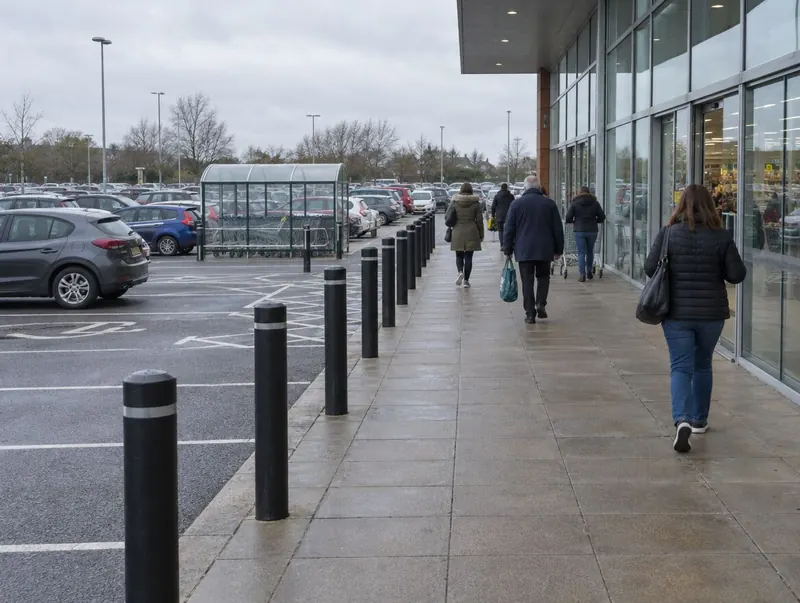 Computer-generated image
About pedestrian protection bollards in March
Bollards that separate people from vehicles at car parks, forecourts, walkways, drive-thrus and shop entrances. In March, that tends to mean sites such as high street shopfronts, small industrial units and community buildings.
We work across PE15 — March itself and places including Doddington, Manea, Wimblington and Benwick. Jobs in March can be combined with work in Wisbech (8.5 miles), Ely (12.8 miles), Peterborough (14.2 miles) and King's Lynn (18.9 miles) (straight-line distances).
Key facts for this area
- Area
- Cambridgeshire, England
- Highway authority
- Cambridgeshire County Council (local roads)
- Planning authority
- the council for Fenland
- Postcodes
- PE15
- Guide price
- Typically £255–£1,245 per bollard + VAT; minimum job £605
- Survey
- Free, with a fixed written quote
- Nearby
- Wisbech (8.5 mi), Ely (12.8 mi), Peterborough (14.2 mi), King's Lynn (18.9 mi)
Pedestrian protection bollards in March: common uses
Around March, pedestrian protection bollards usually solve one of these:
- Drive-thru lanes and order points next to seating
- School and hospital drop-off zones
- EV charging points and trolley shelters
Pedestrian protection bollard prices in March
| Specification | Guide price | Includes |
|---|---|---|
| Standard | £255–£665 + VAT | Standard post, foundation, reinstatement |
| Upgraded | £545–£955 + VAT | Upgraded finish or fittings, reflective band, matched keys |
| Premium | £835–£1,245 + VAT | Heavy-duty or architectural spec, premium finish |
Per bollard, supplied and installed; +3% for East of England. Guide only — the fixed price follows a survey.
Permissions and groundwork in March
Cambridgeshire County Council is the highway authority covering March's local roads. If any post would stand on adopted highway rather than your land, that consent is the first thing we sort out.
If your site in March is listed or inside a conservation area, check with the local planning authority (the council for Fenland) before choosing a finish — heritage settings often favour cast iron or painted steel over stainless.
Car park edges and walkways tend to be built quickly over shallow hardcore, and their kerb lines often carry lighting cables, drainage channels and ducts for EV chargers or signs. Positions are scanned and hand-dug before committing, and foundations are sized for the ground found rather than a fixed hole size.
- Use contrasting bands so posts are visible to partially sighted people, and avoid linking chains across routes.
- If a tested product has been requested, confirm PAS 170-1 or another stated standard and install to the tested foundation.
How the job runs
Watch how the site works
The free site survey looks at where cars park, where people walk and queue, and where incidents or near misses have happened. You receive a fixed written quote with positions marked.
Set out the line
Posts are set out allowing for bumper overhang and keeping clear routes for pedestrians, trolleys and wheelchairs.
Agree a plan for live trading
Work is phased so entrances and walkways stay open, with each section fenced while it is dug and set. Busy sites often prefer early starts or quieter weekdays.
Options to consider
| Option | Detail |
|---|---|
| Wheel stops and kerbs | Used with bollards to stop cars before they reach the posts, reducing daily knocks. |
| PAS 170-1 tested bollards | Tested against low-speed vehicle impacts, for sites where proven performance has been asked for. |
| Stainless or architectural finishes | Stainless sleeves or decorative posts for shop entrances and public-facing frontages. |
What moves the price in March
Our East of England guide prices are a starting point; the survey in March firms them up. What tends to move them:
- Working around trading hours and live car parks
- Reinstatement of tactile paving and walkway surfaces
- Finishes such as stainless or decorative posts
Keeping them working
Protection bollards take the knocks they are there for, so inspect them regularly and after any reported strike. If one post keeps being hit, look at the bay layout or add a wheel stop rather than replacing the same post repeatedly.
We can also service, repair or replace existing posts anywhere in March.
Pedestrian protection in March: FAQs
Which parts of March do you cover for pedestrian protection bollards?
We cover all of March (PE15) and the rest of Cambridgeshire. We also work in Wisbech, Ely and Peterborough.
Who gives permission for bollards on the pavement in March?
The highway authority for local roads in March is Cambridgeshire County Council; motorways and trunk roads sit with National Highways. Pedestrian protection bollards on the adopted footway are a matter for the highway authority, so we only install there with its written agreement.
What's a typical price for pedestrian protection bollards in March?
In March, typically £255–£1,245 per bollard, supplied and installed, plus VAT, with a minimum job of £605 plus VAT, using our East of England guide prices. The fixed figure comes in writing after we've seen the site.
Will bollards block trolleys?
They should not if gaps are planned for trolleys and wheelchairs. Main routes to trolley bays need wider openings. We set gaps to suit the way the site works.
Do pedestrian protection bollards need to be crash-rated?
Not usually. They deal with low-speed driver errors, so firmly founded steel posts often suffice. Where an owner, insurer or designer wants proven performance, PAS 170-1 tested products are the usual choice.
Pedestrian protection in nearby towns
- Wisbech (8.5 mi)
- Ely (12.8 mi)
- Peterborough (14.2 mi)
- King's Lynn (18.9 mi)
- Spalding (19.1 mi)
- Huntingdon (19.2 mi)