Dumfries and Galloway · Scotland
Pedestrian protection bollards in Dumfries
Local installation of pedestrian protection bollards in Dumfries — free survey, fixed written price, and posts set to the right spacing for people and vehicles.
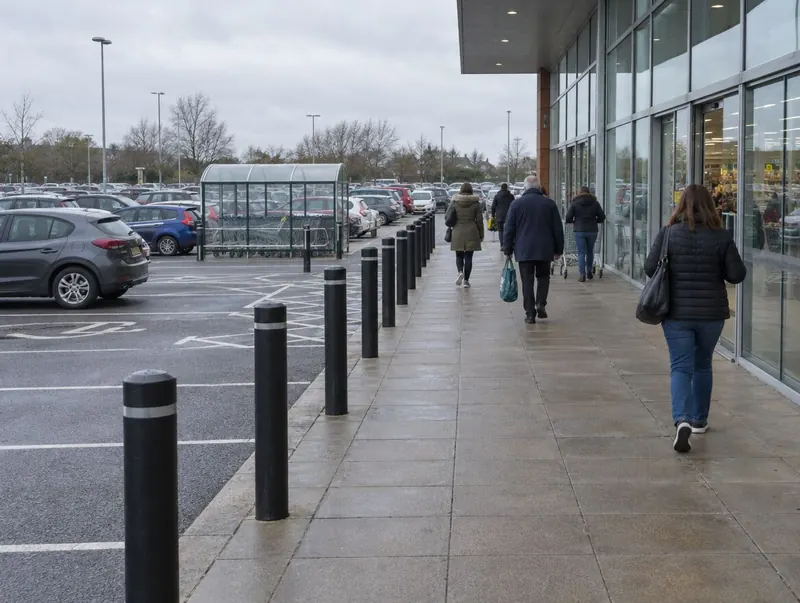 Computer-generated image
About pedestrian protection bollards in Dumfries
From filling-station forecourts, high street shopfronts and community buildings, Dumfries has plenty of places where pedestrian protection bollards earn their keep. Products range from unrated steel posts to bollards tested against low-speed impacts under PAS 170-1.
We work across DG1 and DG2 — Dumfries itself and places including Heathhall, Locharbriggs, Collin and Torthorwald. Dumfries is fairly self-contained, with no other large town within about 20 miles.
Key facts for this area
- Area
- Dumfries and Galloway, Scotland
- Roads authority
- Dumfries and Galloway Council (local roads)
- Planning authority
- Dumfries and Galloway Council
- Postcodes
- DG1 and DG2
- Guide price
- Typically £245–£1,195 per bollard + VAT; minimum job £595
- Survey
- Free, with a fixed written quote
Pedestrian protection bollard prices in Dumfries
| Specification | Guide price | Includes |
|---|---|---|
| Standard | £245–£645 + VAT | Standard post, foundation, reinstatement |
| Upgraded | £535–£925 + VAT | Upgraded finish or fittings, reflective band, matched keys |
| Premium | £815–£1,195 + VAT | Heavy-duty or architectural spec, premium finish |
Per bollard, supplied and installed; no regional adjustment. Guide only — the fixed price follows a survey.
Where pedestrian protection bollards go in around Dumfries
Around Dumfries, pedestrian protection bollards usually solve one of these:
- Drive-thru lanes and order points next to seating
- School and hospital drop-off zones
- Walkways through supermarket and retail park car parks
Permissions and groundwork in Dumfries
In Scotland the council is the roads authority for local roads, which in Dumfries means Dumfries and Galloway Council. Pedestrian protection bollards on an adopted footway need its consent; trunk roads sit with Transport Scotland.
Bollards on private land often need no planning application, but listed buildings and conservation areas are different; the planning service at Dumfries and Galloway Council can confirm before anything is ordered.
Raised kerbs also change the picture: a high kerb slows a wheel but does not stop a bumper, so the post still needs to sit within reach of the overhang rather than behind it. Car park edges and walkways tend to be built quickly over shallow hardcore, and their kerb lines often carry lighting cables, drainage channels and ducts for EV chargers or signs.
- If a tested product has been requested, confirm PAS 170-1 or another stated standard and install to the tested foundation.
- Keep clear gaps of typically at least 1,000–1,200 mm and keep main walkways wide enough, referring to Inclusive Mobility guidance.
From survey to handover
Watch how the site works
The free site survey looks at where cars park, where people walk and queue, and where incidents or near misses have happened. You receive a fixed written quote with positions marked.
Set out the line
Posts are set out allowing for bumper overhang and keeping clear routes for pedestrians, trolleys and wheelchairs.
Agree a plan for live trading
Work is phased so entrances and walkways stay open, with each section fenced while it is dug and set. Busy sites often prefer early starts or quieter weekdays.
Options to consider
| Option | Detail |
|---|---|
| PAS 170-1 tested bollards | Tested against low-speed vehicle impacts, for sites where proven performance has been asked for. |
| Stainless or architectural finishes | Stainless sleeves or decorative posts for shop entrances and public-facing frontages. |
| Lit bollards | Low-level lighting bollards double as protection on walkways where the product is robust enough for the job. |
What affects the quote
Our Scotland guide prices are a starting point; the survey in Dumfries firms them up. What tends to move them:
- Reinstatement of tactile paving and walkway surfaces
- Unrated steel or PAS 170-1 tested products
- Number of posts and length of line
Looking after them
A post that leans or rocks has lost much of its value and should be re-bedded or replaced. Keep a simple note of strikes and their locations; over a year it shows which parts of the car park drivers find awkward, which is useful when the site is next resurfaced or re-lined.
If posts in Dumfries are later hit or damaged, we can repair or replace them — see bollard repairs.
Pedestrian protection in Dumfries: FAQs
Do you install pedestrian protection bollards in Dumfries?
We cover all of Dumfries (DG1 and DG2) and the rest of Dumfries and Galloway.
Who gives permission for bollards on the pavement in Dumfries?
Dumfries falls under Dumfries and Galloway Council as roads authority. If the line of posts crosses onto adopted road or pavement, permission comes before excavation; on private land it does not.
How much do pedestrian protection bollards cost in Dumfries?
In Dumfries, typically £245–£1,195 per bollard, supplied and installed, plus VAT, with a minimum job of £595 plus VAT, using our Scotland guide prices. The fixed figure comes in writing after we've seen the site.
How far from the kerb should car park bollards go?
Far enough back that parked bumpers do not hit them, but not so far that they narrow the walkway. That distance depends on the bay length and kerb height. We set it on site with the layout in front of us.
Do pedestrian protection bollards need to be crash-rated?
Not usually. They deal with low-speed driver errors, so firmly founded steel posts often suffice. Where an owner, insurer or designer wants proven performance, PAS 170-1 tested products are the usual choice.