Dumfries and Galloway · Scotland
Telescopic bollard installation in Dumfries
Local installation of telescopic bollards in Dumfries — free survey, fixed written price, and posts set to the right spacing for people and vehicles.
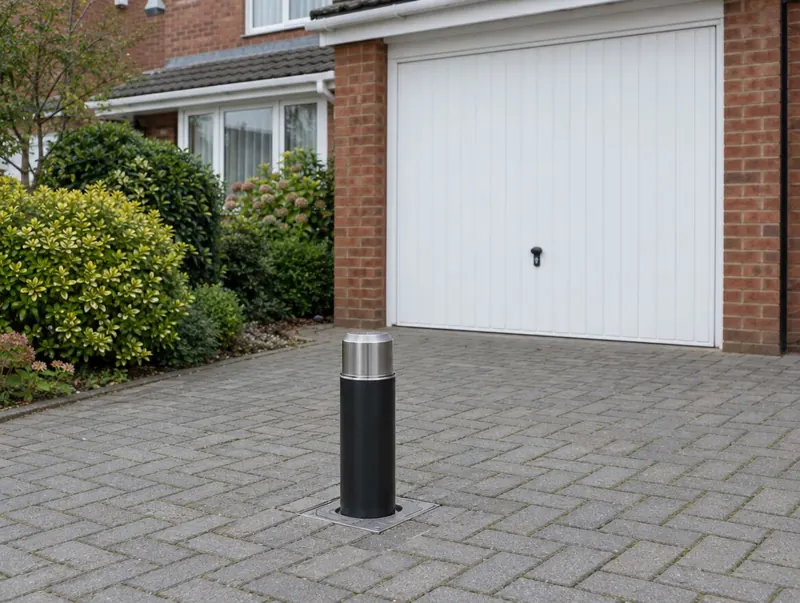 Computer-generated image
Telescopic bollards in Dumfries
We supply and fit telescopic bollards throughout Dumfries, typically for sites such as high street shopfronts, schools and community car parks. Because the post stays in its cassette, there is nothing to store and nothing to lose.
Coverage in Dumfries takes in the DG1 and DG2 postcode districts and nearby places like Heathhall, Locharbriggs, Collin and Torthorwald. There are no other towns of Dumfries's size close by, so crews travel in specifically for jobs here.
Local details
- Area
- Dumfries and Galloway, Scotland
- Roads authority
- Dumfries and Galloway Council (local roads)
- Planning authority
- Dumfries and Galloway Council
- Postcodes
- DG1 and DG2
- Guide price
- Typically £345–£1,195 per bollard + VAT (£405–£1,445 inc VAT for homes); minimum job £645
- Survey
- Free, with a fixed written quote
Guide prices for Dumfries
| Specification | Guide price | Includes |
|---|---|---|
| Standard | £345–£705 + VAT · £405–£845 inc VAT | Standard post, foundation, reinstatement |
| Upgraded | £605–£955 + VAT · £725–£1,145 inc VAT | Upgraded finish or fittings, reflective band, matched keys |
| Premium | £855–£1,195 + VAT · £1,045–£1,445 inc VAT | Heavy-duty or architectural spec, premium finish |
Per bollard with cassette, supplied and installed; no regional adjustment. Guide only — the fixed price follows a survey.
What Dumfries sites use telescopic bollards for
Typical reasons Dumfries sites choose telescopic bollards:
- Access roads closed outside working hours
- Domestic driveways where the bollard is used daily
- Sites with no power for automatic bollards
What we check first in Dumfries
Dumfries falls under Dumfries and Galloway Council as roads authority. If the line of posts crosses onto adopted road or pavement, permission comes before excavation; on private land it does not.
Bollards on private land often need no planning application, but listed buildings and conservation areas are different; the planning service at Dumfries and Galloway Council can confirm before anything is ordered.
Telescopic bollards need a deeper excavation than other manual bollards, so ground and services decide where they can go. Reinstatement matches the drive, whether block paving, tarmac, resin-bound or imprinted concrete.
- Leave access for emergency services on commercial and multi-occupancy sites, and record who holds keys.
- Confirm the bollard is on your land; bollards on a public footway or dropped kerb need the roads authority's agreement.
Installation, step by step
Check depth and drainage
The free site survey checks how far down we can dig, where services run under the drive and how the ground drains. If water will stand, a drain connection is priced into the fixed written quote.
Set the cassette
The cassette is set vertical and its top exactly at finished surface level and fall, then concreted in. A cassette set high or low is a common cause of tyre damage and trip edges.
Reinstate and test
The surface is made good to match. The post is raised, locked, lowered and locked several times to confirm smooth operation, and keys are handed over.
Specification choices
| Option | Detail |
|---|---|
| Diameter and height | Commonly around 90–140 mm diameter and 600–900 mm raised height, with larger posts for commercial use. |
| Lock types | Keyed cylinder locks, often with a cover to keep out dirt; keyed alike for multi-bay sites where one key should open every post. |
| Standard or lift-assisted | Lift-assisted models use a spring or counterweight so the post rises with little effort, useful for daily domestic use. |
What moves the price in Dumfries
Two Dumfries jobs with the same number of posts can price quite differently. The usual reasons:
- Drainage: simple soakaway or a connection to a drain
- Excavation depth and the presence of services under the drive
- Number of posts and keyed-alike locks
After installation
Lower and raise the bollard regularly, even if you rarely need to, so the mechanism stays free. Clear leaves and grit from around the lid, and a few times a year lift the post fully and look into the cassette for standing water or silt.
We can also service, repair or replace existing posts anywhere in Dumfries.
Common questions
Which parts of Dumfries do you cover for telescopic bollards?
We cover all of Dumfries (DG1 and DG2) and the rest of Dumfries and Galloway.
Do I need consent for telescopic bollards on a public footway in Dumfries?
Dumfries falls under Dumfries and Galloway Council as roads authority. If the line of posts crosses onto adopted road or pavement, permission comes before excavation; on private land it does not.
How much do telescopic bollards cost in Dumfries?
In Dumfries, typically £345–£1,195 per bollard with cassette, supplied and installed, plus VAT (£405–£1,445 including VAT for homeowners), with a minimum job of £645 plus VAT, using our Scotland guide prices. The fixed figure comes in writing after we've seen the site.
How deep does a telescopic bollard go into the ground?
Usually around the exposed height of the post plus the cassette base and drainage layer, which often comes to a metre or more. The exact depth depends on the model. That depth is why we check for services under the drive first.
Will a telescopic bollard stop my car being stolen?
It adds a physical barrier that a thief has to defeat before driving away, which slows them down and makes the car a less attractive target. It is one layer of protection, not a complete answer to keyless car theft.