Essex · England
Pedestrian protection bollards in Clacton-on-Sea
Local installation of pedestrian protection bollards in Clacton-on-Sea — free survey, fixed written price, and posts set to the right spacing for people and vehicles.
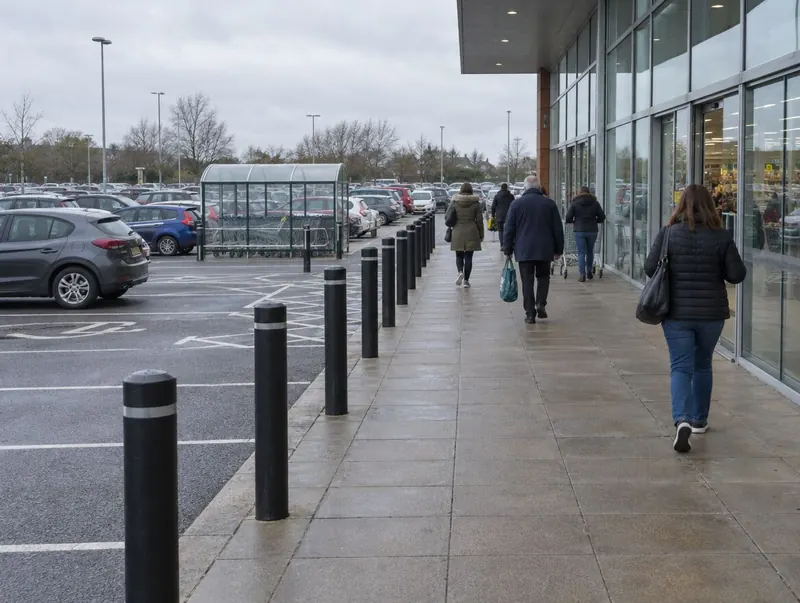 Computer-generated image
Clacton-on-Sea pedestrian protection bollards
We supply and fit pedestrian protection bollards throughout Clacton-on-Sea, typically for sites such as community buildings, local parades and schools. Products range from unrated steel posts to bollards tested against low-speed impacts under PAS 170-1.
We cover Clacton-on-Sea's CO15, CO16 and CO13 postcode districts, including places such as Jaywick, Little Clacton, Thorpe-le-Soken and St Osyth. Jobs in Clacton-on-Sea can be combined with work in Harwich (11.9 miles), Colchester (12.8 miles), Felixstowe (14.6 miles) and Ipswich (18.6 miles) (straight-line distances). It sits roughly 26 miles from Southend-on-Sea as the crow flies.
Local details
- Area
- Essex, England
- Highway authority
- Essex County Council (local roads)
- Planning authority
- the council for Tendring
- Postcodes
- CO15, CO16 and CO13
- Guide price
- Typically £255–£1,245 per bollard + VAT; minimum job £605
- Survey
- Free, with a fixed written quote
- Nearby
- Harwich (11.9 mi), Colchester (12.8 mi), Felixstowe (14.6 mi), Ipswich (18.6 mi)
Clacton-on-Sea: typical pedestrian protection bollard prices
| Specification | Guide price | Includes |
|---|---|---|
| Standard | £255–£665 + VAT | Standard post, foundation, reinstatement |
| Upgraded | £545–£955 + VAT | Upgraded finish or fittings, reflective band, matched keys |
| Premium | £835–£1,245 + VAT | Heavy-duty or architectural spec, premium finish |
Per bollard, supplied and installed; +3% for East of England. Guide only — the fixed price follows a survey.
Where pedestrian protection bollards go in around Clacton-on-Sea
Typical reasons Clacton-on-Sea sites choose pedestrian protection bollards:
- EV charging points and trolley shelters
- Outdoor seating at cafes, pubs and restaurants
- Petrol station forecourts and kiosk frontages
Before we dig in Clacton-on-Sea
In Clacton-on-Sea, work on adopted pavements and verges needs consent from Essex County Council, the local highway authority. Car parks, forecourts and other private land only need the owner's permission.
Many private-land installations in Clacton-on-Sea need no planning application, but the rules don't clearly cover bollards, so listed buildings, conservation areas and prominent frontages are worth raising with the planning team at the council for Tendring before posts go in.
Car park edges and walkways tend to be built quickly over shallow hardcore, and their kerb lines often carry lighting cables, drainage channels and ducts for EV chargers or signs. Reinstatement keeps walkways level and flush, because a trip edge around a new post in a busy car park creates the very hazard the posts are meant to reduce.
- Record why posts are where they are in the site's risk assessment, especially at drive-thrus and seating areas.
- Use contrasting bands so posts are visible to partially sighted people, and avoid linking chains across routes.
How the job runs
Excavate and set
Each position is cut, dug and checked for services, and the posts are set plumb in concrete to a consistent height.
Reinstate
Paving, tarmac or concrete is made good flush around each post, with tactile paving reinstated where it was disturbed.
Add bands and markings
Reflective bands are fitted and any wheel stops or line markings agreed in the scheme are installed.
Specification choices
| Option | Detail |
|---|---|
| Lit bollards | Low-level lighting bollards double as protection on walkways where the product is robust enough for the job. |
| Concrete-filled steel posts | Root-fixed galvanised and powder-coated steel, the standard unrated choice for walkways and frontages. |
| Visibility bands | Reflective and contrasting bands help drivers and partially sighted pedestrians see posts. |
What moves the price in Clacton-on-Sea
Two Clacton-on-Sea jobs with the same number of posts can price quite differently. The usual reasons:
- Finishes such as stainless or decorative posts
- Number of posts and length of line
- Ground conditions and services along kerb lines
After installation
Keep a simple note of strikes and their locations; over a year it shows which parts of the car park drivers find awkward, which is useful when the site is next resurfaced or re-lined. Touch up chipped coatings, renew faded bands, and check the surface around each base for cracks that suggest movement.
For damaged or loose posts in Clacton-on-Sea, repairs and replacements are priced in writing first.
Pedestrian protection in Clacton-on-Sea: FAQs
Which parts of Clacton-on-Sea do you cover for pedestrian protection bollards?
We cover all of Clacton-on-Sea (CO15, CO16 and CO13) and the rest of Essex. We also work in Harwich, Colchester and Felixstowe.
Who gives permission for bollards on the pavement in Clacton-on-Sea?
In Clacton-on-Sea, work on adopted pavements and verges needs consent from Essex County Council, the local highway authority. Car parks, forecourts and other private land only need the owner's permission.
What's a typical price for pedestrian protection bollards in Clacton-on-Sea?
In Clacton-on-Sea, typically £255–£1,245 per bollard, supplied and installed, plus VAT, with a minimum job of £605 plus VAT, using our East of England guide prices. The fixed figure comes in writing after we've seen the site.
Are wheel stops enough on their own?
Wheel stops help drivers judge where to stop but a car can mount them with a firm press on the accelerator. Used with bollards, they reduce daily knocks on the posts. On their own they are not a barrier.
Do pedestrian protection bollards need to be crash-rated?
Not usually. They deal with low-speed driver errors, so firmly founded steel posts often suffice. Where an owner, insurer or designer wants proven performance, PAS 170-1 tested products are the usual choice.