Highland · Scotland
Pedestrian protection bollards in Inverness
Local installation of pedestrian protection bollards in Inverness — free survey, fixed written price, and posts set to the right spacing for people and vehicles.
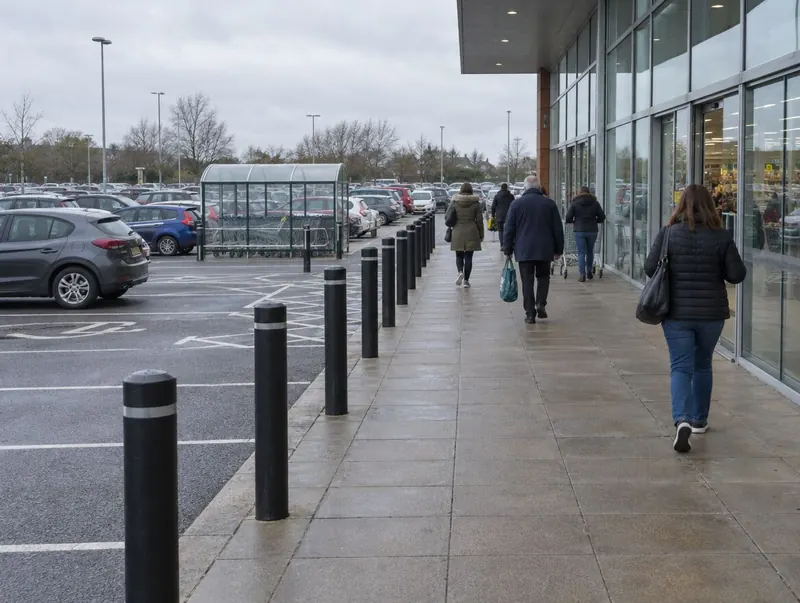 Computer-generated image
Pedestrian protection in Inverness
We supply and fit pedestrian protection bollards throughout Inverness, typically for sites such as schools, community buildings and community car parks. Bollards that separate people from vehicles at car parks, forecourts, walkways, drive-thrus and shop entrances.
We work across IV1, IV3, IV2 and IV8 — Inverness itself and places including North Kessock, Leachkin, Cradlehall and Ardersier. Inverness is fairly self-contained, with no other large town within about 20 miles.
Inverness at a glance
- Area
- Highland, Scotland
- Roads authority
- The Highland Council (local roads)
- Planning authority
- The Highland Council
- Postcodes
- IV1, IV3, IV2 and IV8
- Guide price
- Typically £245–£1,195 per bollard + VAT; minimum job £595
- Survey
- Free, with a fixed written quote
Typical pedestrian protection bollards jobs in Inverness
Common uses in a place like Inverness:
- School and hospital drop-off zones
- EV charging points and trolley shelters
- Drive-thru lanes and order points next to seating
What pedestrian protection bollards cost in Inverness
| Specification | Guide price | Includes |
|---|---|---|
| Standard | £245–£645 + VAT | Standard post, foundation, reinstatement |
| Upgraded | £535–£925 + VAT | Upgraded finish or fittings, reflective band, matched keys |
| Premium | £815–£1,195 + VAT | Heavy-duty or architectural spec, premium finish |
Per bollard, supplied and installed; no regional adjustment. Guide only — the fixed price follows a survey.
What we check first in Inverness
For anything on the public footway in Inverness we check with the roads authority first — The Highland Council for local roads, Transport Scotland on trunk routes. Private ground such as a car park or forecourt only needs the owner's go-ahead.
Many private-land installations in Inverness need no planning application, but the rules don't clearly cover bollards, so listed buildings, conservation areas and prominent frontages are worth raising with the planning team at The Highland Council before posts go in.
Positions are scanned and hand-dug before committing, and foundations are sized for the ground found rather than a fixed hole size. Car park edges and walkways tend to be built quickly over shallow hardcore, and their kerb lines often carry lighting cables, drainage channels and ducts for EV chargers or signs.
- If a tested product has been requested, confirm PAS 170-1 or another stated standard and install to the tested foundation.
- Keep clear gaps of typically at least 1,000–1,200 mm and keep main walkways wide enough, referring to Inclusive Mobility guidance.
How the job runs
Watch how the site works
The free site survey looks at where cars park, where people walk and queue, and where incidents or near misses have happened. You receive a fixed written quote with positions marked.
Reinstate
Paving, tarmac or concrete is made good flush around each post, with tactile paving reinstated where it was disturbed.
Add bands and markings
Reflective bands are fitted and any wheel stops or line markings agreed in the scheme are installed.
Specification choices
| Option | Detail |
|---|---|
| PAS 170-1 tested bollards | Tested against low-speed vehicle impacts, for sites where proven performance has been asked for. |
| Stainless or architectural finishes | Stainless sleeves or decorative posts for shop entrances and public-facing frontages. |
| Concrete-filled steel posts | Root-fixed galvanised and powder-coated steel, the standard unrated choice for walkways and frontages. |
What moves the price in Inverness
When we price pedestrian protection bollards in Inverness, these make the biggest difference:
- Working around trading hours and live car parks
- Ground conditions and services along kerb lines
- Number of posts and length of line
Keeping them working
Protection bollards take the knocks they are there for, so inspect them regularly and after any reported strike. Damaged posts near entrances should be dealt with quickly, as a bent post with a torn edge is a hazard in its own right.
For damaged or loose posts in Inverness, repairs and replacements are priced in writing first.
Pedestrian protection in Inverness: FAQs
Which parts of Inverness do you cover for pedestrian protection bollards?
We cover all of Inverness (IV1, IV3, IV2 and IV8) and the rest of Highland.
Do I need consent for pedestrian protection bollards on a public footway in Inverness?
For anything on the public footway in Inverness we check with the roads authority first — The Highland Council for local roads, Transport Scotland on trunk routes. Private ground such as a car park or forecourt only needs the owner's go-ahead.
What's a typical price for pedestrian protection bollards in Inverness?
In Inverness, typically £245–£1,195 per bollard, supplied and installed, plus VAT, with a minimum job of £595 plus VAT, using our Scotland guide prices. The fixed figure comes in writing after we've seen the site.
Should bollards be added at a drive-thru order point?
Often, yes, where people queue or sit beside the lane. Posts should follow the curve of the lane and be closest together at corners, where drivers tend to misjudge the turn. The positions are agreed on site with the operator.
Are wheel stops enough on their own?
Wheel stops help drivers judge where to stop but a car can mount them with a firm press on the accelerator. Used with bollards, they reduce daily knocks on the posts. On their own they are not a barrier.