London · England
Pedestrian protection bollards in Barking and Dagenham
Local installation of pedestrian protection bollards in Barking and Dagenham — free survey, fixed written price, and posts set to the right spacing for people and vehicles.
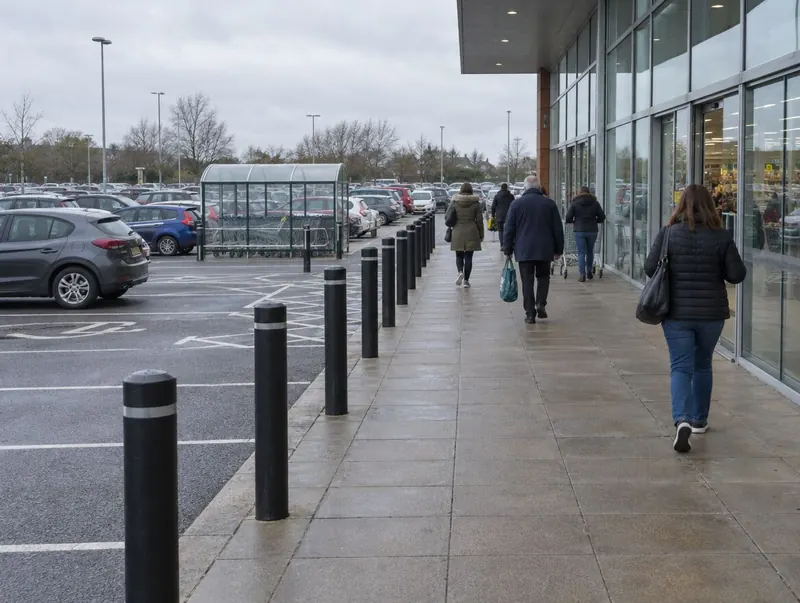 Computer-generated image
Barking and Dagenham pedestrian protection bollards
In the borough of Barking and Dagenham, pedestrian protection bollards tend to go in at estate car parks, places of worship and station forecourts. Products range from unrated steel posts to bollards tested against low-speed impacts under PAS 170-1.
Coverage in Barking and Dagenham takes in the RM10, RM8, RM9, RM6 and IG11 postcode districts. We also cover neighbouring Redbridge (4 miles), Havering (4.3 miles), Newham (5.5 miles) and Bexley (6.6 miles) — distances are straight-line.
Local details
- Area
- London, England
- Highway authority
- Barking and Dagenham Council (local roads)
- Planning authority
- Barking and Dagenham Council
- Postcodes
- RM10, RM8, RM9, RM6 and IG11
- Guide price
- Typically £285–£1,395 per bollard + VAT; minimum job £675
- Survey
- Free, with a fixed written quote
Barking and Dagenham: typical pedestrian protection bollard prices
| Specification | Guide price | Includes |
|---|---|---|
| Standard | £285–£745 + VAT | Standard post, foundation, reinstatement |
| Upgraded | £615–£1,045 + VAT | Upgraded finish or fittings, reflective band, matched keys |
| Premium | £935–£1,395 + VAT | Heavy-duty or architectural spec, premium finish |
Per bollard, supplied and installed; +15% for London. Guide only — the fixed price follows a survey.
Pedestrian protection bollards in Barking and Dagenham: common uses
Typical reasons Barking and Dagenham sites choose pedestrian protection bollards:
- Shop entrances facing nose-in parking bays
- Drive-thru lanes and order points next to seating
- School and hospital drop-off zones
Permissions and groundwork in Barking and Dagenham
Barking and Dagenham Council is the highway authority covering Barking and Dagenham's local roads. Red routes are managed by Transport for London. If any post would stand on adopted highway rather than your land, that consent is the first thing we sort out.
Bollards on private land often don't need planning permission, but it depends on the council's view, the height and the location; in a conservation area, next to a listed building or under an Article 4 direction, ask the local planning authority (Barking and Dagenham Council) first — we flag this at survey.
Car park edges and walkways tend to be built quickly over shallow hardcore, and their kerb lines often carry lighting cables, drainage channels and ducts for EV chargers or signs. Positions are scanned and hand-dug before committing, and foundations are sized for the ground found rather than a fixed hole size.
- Record why posts are where they are in the site's risk assessment, especially at drive-thrus and seating areas.
- Keep clear gaps of typically at least 1,000–1,200 mm and keep main walkways wide enough, referring to Inclusive Mobility guidance.
Installation, step by step
Watch how the site works
The free site survey looks at where cars park, where people walk and queue, and where incidents or near misses have happened. You receive a fixed written quote with positions marked.
Excavate and set
Each position is cut, dug and checked for services, and the posts are set plumb in concrete to a consistent height.
Agree a plan for live trading
Work is phased so entrances and walkways stay open, with each section fenced while it is dug and set. Busy sites often prefer early starts or quieter weekdays.
Choosing the right spec
| Option | Detail |
|---|---|
| Lit bollards | Low-level lighting bollards double as protection on walkways where the product is robust enough for the job. |
| Wheel stops and kerbs | Used with bollards to stop cars before they reach the posts, reducing daily knocks. |
| PAS 170-1 tested bollards | Tested against low-speed vehicle impacts, for sites where proven performance has been asked for. |
Pricing pedestrian protection bollards in Barking and Dagenham
When we price pedestrian protection bollards in Barking and Dagenham, these make the biggest difference:
- Finishes such as stainless or decorative posts
- Number of posts and length of line
- Working around trading hours and live car parks
Looking after them
Keep a simple note of strikes and their locations; over a year it shows which parts of the car park drivers find awkward, which is useful when the site is next resurfaced or re-lined. Touch up chipped coatings, renew faded bands, and check the surface around each base for cracks that suggest movement.
For damaged or loose posts in Barking and Dagenham, repairs and replacements are priced in writing first.
Common questions
Which parts of Barking and Dagenham do you cover for pedestrian protection bollards?
We cover all of Barking and Dagenham (RM10, RM8, RM9, RM6 and IG11) and the rest of London. We also work in Redbridge, Havering and Newham.
Who gives permission for bollards on the pavement in Barking and Dagenham?
In Barking and Dagenham, work on adopted pavements and verges needs consent from Barking and Dagenham Council, the local highway authority. Red routes are managed by Transport for London. Car parks, forecourts and other private land only need the owner's permission.
How much do pedestrian protection bollards cost in Barking and Dagenham?
In Barking and Dagenham, typically £285–£1,395 per bollard, supplied and installed, plus VAT, with a minimum job of £675 plus VAT, using our London guide prices. The fixed figure comes in writing after we've seen the site.
Our outdoor seating faces the car park: what should we do?
Put a line of posts between the seating and the nearest parking or driving lane, with gaps narrow enough to stop a car. Positions should allow for cars that overshoot a bay. It is worth recording the decision in your risk assessment.
Should bollards be added at a drive-thru order point?
Often, yes, where people queue or sit beside the lane. Posts should follow the curve of the lane and be closest together at corners, where drivers tend to misjudge the turn. The positions are agreed on site with the operator.
Pedestrian protection in nearby towns
- Redbridge (4 mi)
- Havering (4.3 mi)
- Newham (5.5 mi)
- Bexley (6.6 mi)
- South Ockendon (6.6 mi)
- Greenwich (7.5 mi)