London · England
Pedestrian protection bollards in Islington
Pedestrian protection bollards for sites across Islington and the rest of London, from the first measurement to the last relaid paving block.
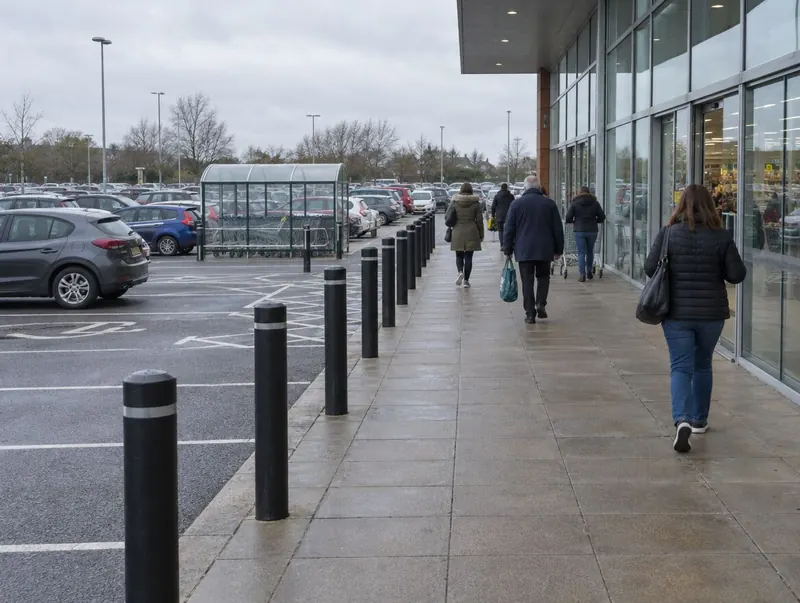 Computer-generated image
About pedestrian protection bollards in Islington
Pedestrian protection bollards suit plenty of Islington sites, station forecourts, office entrances and hospital approaches among them. Products range from unrated steel posts to bollards tested against low-speed impacts under PAS 170-1.
We cover every part of Islington in the N5, N1, N7, EC1V, EC1R and EC1Y postcode districts. Jobs in Islington can be combined with work in City of London (2.2 miles), Hackney (2.3 miles), Camden (2.6 miles) and Haringey (2.8 miles) (straight-line distances).
Local details
- Area
- London, England
- Highway authority
- Islington Council (local roads)
- Planning authority
- Islington Council
- Postcodes
- N5, N1, N7, EC1V, EC1R, EC1Y, N19 and EC2A
- Guide price
- Typically £285–£1,395 per bollard + VAT; minimum job £675
- Survey
- Free, with a fixed written quote
- Nearby
- City of London (2.2 mi), Hackney (2.3 mi), Camden (2.6 mi), Haringey (2.8 mi)
Where pedestrian protection bollards go in around Islington
Typical reasons Islington sites choose pedestrian protection bollards:
- Walkways through supermarket and retail park car parks
- EV charging points and trolley shelters
- Outdoor seating at cafes, pubs and restaurants
What pedestrian protection bollards cost in Islington
| Specification | Guide price | Includes |
|---|---|---|
| Standard | £285–£745 + VAT | Standard post, foundation, reinstatement |
| Upgraded | £615–£1,045 + VAT | Upgraded finish or fittings, reflective band, matched keys |
| Premium | £935–£1,395 + VAT | Heavy-duty or architectural spec, premium finish |
Per bollard, supplied and installed; +15% for London. Guide only — the fixed price follows a survey.
Before we dig in Islington
In Islington, work on adopted pavements and verges needs consent from Islington Council, the local highway authority. Red routes are managed by Transport for London. Car parks, forecourts and other private land only need the owner's permission.
Bollards on private land often don't need planning permission, but it depends on the council's view, the height and the location; in a conservation area, next to a listed building or under an Article 4 direction, ask the local planning authority (Islington Council) first — we flag this at survey.
Positions are scanned and hand-dug before committing, and foundations are sized for the ground found rather than a fixed hole size. Where bollards protect a shopfront, the building's own foundations and any canopy columns may sit close to the line, which limits how deep and wide each base can go.
- Keep clear gaps of typically at least 1,000–1,200 mm and keep main walkways wide enough, referring to Inclusive Mobility guidance.
- Record why posts are where they are in the site's risk assessment, especially at drive-thrus and seating areas.
How the job runs
Set out the line
Posts are set out allowing for bumper overhang and keeping clear routes for pedestrians, trolleys and wheelchairs.
Excavate and set
Each position is cut, dug and checked for services, and the posts are set plumb in concrete to a consistent height.
Agree a plan for live trading
Work is phased so entrances and walkways stay open, with each section fenced while it is dug and set. Busy sites often prefer early starts or quieter weekdays.
Specification choices
| Option | Detail |
|---|---|
| Lit bollards | Low-level lighting bollards double as protection on walkways where the product is robust enough for the job. |
| Wheel stops and kerbs | Used with bollards to stop cars before they reach the posts, reducing daily knocks. |
| Stainless or architectural finishes | Stainless sleeves or decorative posts for shop entrances and public-facing frontages. |
What moves the price in Islington
Two Islington jobs with the same number of posts can price quite differently. The usual reasons:
- Working around trading hours and live car parks
- Unrated steel or PAS 170-1 tested products
- Ground conditions and services along kerb lines
Keeping them working
Protection bollards take the knocks they are there for, so inspect them regularly and after any reported strike. A post that leans or rocks has lost much of its value and should be re-bedded or replaced.
For damaged or loose posts in Islington, repairs and replacements are priced in writing first.
Pedestrian protection in Islington: FAQs
Do you install pedestrian protection bollards in Islington?
We cover all of Islington (N5, N1, N7, EC1V, EC1R and EC1Y) and the rest of London. We also work in City of London, Hackney and Camden.
Who gives permission for bollards on the pavement in Islington?
In Islington, work on adopted pavements and verges needs consent from Islington Council, the local highway authority. Red routes are managed by Transport for London. Car parks, forecourts and other private land only need the owner's permission.
What's a typical price for pedestrian protection bollards in Islington?
In Islington, typically £285–£1,395 per bollard, supplied and installed, plus VAT, with a minimum job of £675 plus VAT, using our London guide prices. The fixed figure comes in writing after we've seen the site.
Will bollards block trolleys?
They should not if gaps are planned for trolleys and wheelchairs. Main routes to trolley bays need wider openings. We set gaps to suit the way the site works.
Should bollards be added at a drive-thru order point?
Often, yes, where people queue or sit beside the lane. Posts should follow the curve of the lane and be closest together at corners, where drivers tend to misjudge the turn. The positions are agreed on site with the operator.
Pedestrian protection near Islington
- City of London (2.2 mi)
- Hackney (2.3 mi)
- Camden (2.6 mi)
- Haringey (2.8 mi)
- Westminster (3.3 mi)
- Tower Hamlets (3.6 mi)