Mid Ulster · Northern Ireland
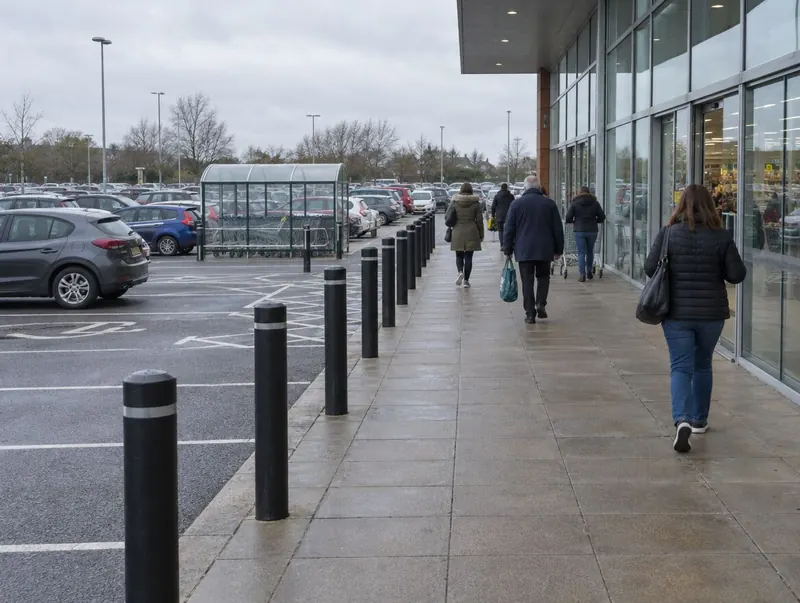
Pedestrian protection bollards in Cookstown
Pedestrian protection bollards supplied and fitted in Cookstown, Mid Ulster: surveyed, scanned for services, set in proper foundations and finished to match the ground.
 Computer-generated image
Cookstown pedestrian protection bollards
Bollards that separate people from vehicles at car parks, forecourts, walkways, drive-thrus and shop entrances. In Cookstown, that tends to mean sites such as filling-station forecourts, schools and community car parks.
Coverage in Cookstown takes in the BT80 postcode district. Jobs in Cookstown can be combined with work in Dungannon (9.7 miles), Portadown (19.4 miles), Craigavon (19.8 miles) and Armagh (20.5 miles) (straight-line distances). It sits roughly 33 miles from Belfast as the crow flies.
Key facts for this area
- Area
- Mid Ulster, Northern Ireland
- Roads authority
- the Department for Infrastructure (DfI Roads)
- Planning authority
- Mid Ulster District Council
- Postcodes
- BT80
- Guide price
- Typically £245–£1,195 per bollard + VAT; minimum job £575
- Survey
- Free, with a fixed written quote
What pedestrian protection bollards cost in Cookstown
| Specification | Guide price | Includes |
|---|---|---|
| Standard | £245–£635 + VAT | Standard post, foundation, reinstatement |
| Upgraded | £515–£915 + VAT | Upgraded finish or fittings, reflective band, matched keys |
| Premium | £795–£1,195 + VAT | Heavy-duty or architectural spec, premium finish |
Per bollard, supplied and installed; -2% for Northern Ireland. Guide only — the fixed price follows a survey.
What Cookstown sites use pedestrian protection bollards for
Around Cookstown, pedestrian protection bollards usually solve one of these:
- EV charging points and trolley shelters
- School and hospital drop-off zones
- Petrol station forecourts and kiosk frontages
Permissions and groundwork in Cookstown
In Cookstown, as everywhere in Northern Ireland, public roads and footways are looked after by DfI Roads rather than the council. If a post would sit on adopted footway, that consent comes first; private forecourts and car parks are a matter for the owner.
Many private-land installations in Cookstown need no planning application, but the rules don't clearly cover bollards, so listed buildings, conservation areas and prominent frontages are worth raising with the planning team at Mid Ulster District Council before posts go in.
Positions are scanned and hand-dug before committing, and foundations are sized for the ground found rather than a fixed hole size. Reinstatement keeps walkways level and flush, because a trip edge around a new post in a busy car park creates the very hazard the posts are meant to reduce.
- Record why posts are where they are in the site's risk assessment, especially at drive-thrus and seating areas.
- Use contrasting bands so posts are visible to partially sighted people, and avoid linking chains across routes.
How the job runs
Set out the line
Posts are set out allowing for bumper overhang and keeping clear routes for pedestrians, trolleys and wheelchairs.
Excavate and set
Each position is cut, dug and checked for services, and the posts are set plumb in concrete to a consistent height.
Agree a plan for live trading
Work is phased so entrances and walkways stay open, with each section fenced while it is dug and set. Busy sites often prefer early starts or quieter weekdays.
Finishes and options
| Option | Detail |
|---|---|
| Stainless or architectural finishes | Stainless sleeves or decorative posts for shop entrances and public-facing frontages. |
| Wheel stops and kerbs | Used with bollards to stop cars before they reach the posts, reducing daily knocks. |
| PAS 170-1 tested bollards | Tested against low-speed vehicle impacts, for sites where proven performance has been asked for. |
What affects the quote
Our Northern Ireland guide prices are a starting point; the survey in Cookstown firms them up. What tends to move them:
- Number of posts and length of line
- Reinstatement of tactile paving and walkway surfaces
- Ground conditions and services along kerb lines
Keeping them working
Touch up chipped coatings, renew faded bands, and check the surface around each base for cracks that suggest movement. If one post keeps being hit, look at the bay layout or add a wheel stop rather than replacing the same post repeatedly.
If posts in Cookstown are later hit or damaged, we can repair or replace them — see bollard repairs.
Pedestrian protection in Cookstown: FAQs
Can you install pedestrian protection bollards anywhere in Cookstown?
We cover all of Cookstown (BT80) and the rest of Mid Ulster. We also work in Dungannon, Portadown and Craigavon.
Do I need consent for pedestrian protection bollards on a public footway in Cookstown?
In Cookstown, as everywhere in Northern Ireland, public roads and footways are looked after by DfI Roads rather than the council. If a post would sit on adopted footway, that consent comes first; private forecourts and car parks are a matter for the owner.
What's a typical price for pedestrian protection bollards in Cookstown?
In Cookstown, typically £245–£1,195 per bollard, supplied and installed, plus VAT, with a minimum job of £575 plus VAT, using our Northern Ireland guide prices. The fixed figure comes in writing after we've seen the site.
Should bollards be added at a drive-thru order point?
Often, yes, where people queue or sit beside the lane. Posts should follow the curve of the lane and be closest together at corners, where drivers tend to misjudge the turn. The positions are agreed on site with the operator.
How far from the kerb should car park bollards go?
Far enough back that parked bumpers do not hit them, but not so far that they narrow the walkway. That distance depends on the bay length and kerb height. We set it on site with the layout in front of us.