Oxfordshire · England
Pedestrian protection bollards in Oxford
Pedestrian protection bollards for sites across Oxford and the rest of Oxfordshire, from the first measurement to the last relaid paving block.
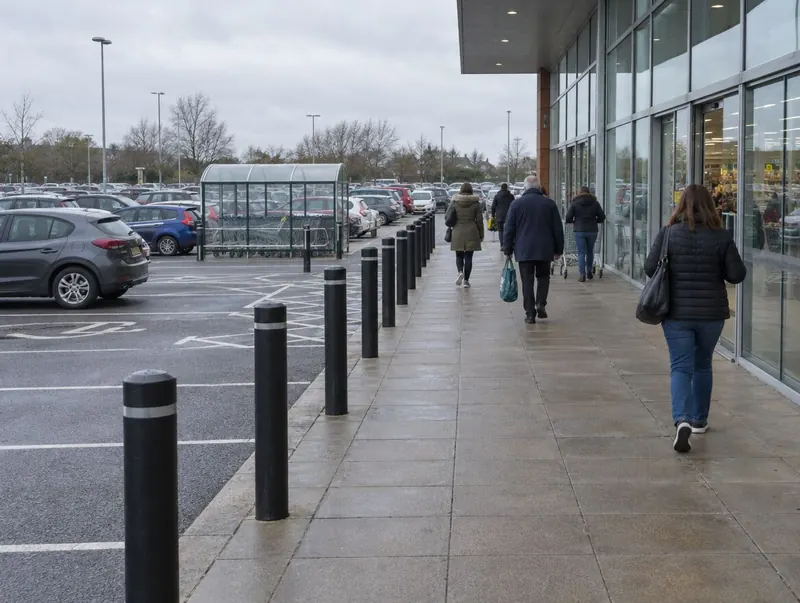 Computer-generated image
Pedestrian protection in Oxford
Bollards that separate people from vehicles at car parks, forecourts, walkways, drive-thrus and shop entrances. In Oxford, that tends to mean sites such as stadium approaches, pedestrianised streets and city-centre plazas.
We cover Oxford's OX1, OX2, OX3 and OX4 postcode districts, including places such as Wolvercote and Sandford-on-Thames. Nearby, we also work in Abingdon (5.7 miles), Didcot (9.9 miles), Witney (10 miles) and Bicester (11.1 miles), measured as the crow flies. Oxford is about 24 miles from Reading.
Key facts for this area
- Area
- Oxfordshire, England
- Highway authority
- Oxfordshire County Council (local roads)
- Planning authority
- Oxfordshire County Council
- Postcodes
- OX1, OX2, OX3 and OX4
- Guide price
- Typically £265–£1,245 per bollard + VAT; minimum job £625
- Survey
- Free, with a fixed written quote
Pedestrian protection bollards in Oxford: common uses
Typical reasons Oxford sites choose pedestrian protection bollards:
- Shop entrances facing nose-in parking bays
- Outdoor seating at cafes, pubs and restaurants
- Walkways through supermarket and retail park car parks
What pedestrian protection bollards cost in Oxford
| Specification | Guide price | Includes |
|---|---|---|
| Standard | £265–£685 + VAT | Standard post, foundation, reinstatement |
| Upgraded | £565–£985 + VAT | Upgraded finish or fittings, reflective band, matched keys |
| Premium | £865–£1,245 + VAT | Heavy-duty or architectural spec, premium finish |
Per bollard, supplied and installed; +6% for South East. Guide only — the fixed price follows a survey.
What we check first in Oxford
Oxfordshire County Council is the highway authority covering Oxford's local roads. If any post would stand on adopted highway rather than your land, that consent is the first thing we sort out.
If your site in Oxford is listed or inside a conservation area, check with the local planning authority (Oxfordshire County Council) before choosing a finish — heritage settings often favour cast iron or painted steel over stainless.
Car park edges and walkways tend to be built quickly over shallow hardcore, and their kerb lines often carry lighting cables, drainage channels and ducts for EV chargers or signs. Where bollards protect a shopfront, the building's own foundations and any canopy columns may sit close to the line, which limits how deep and wide each base can go.
- Record why posts are where they are in the site's risk assessment, especially at drive-thrus and seating areas.
- Keep clear gaps of typically at least 1,000–1,200 mm and keep main walkways wide enough, referring to Inclusive Mobility guidance.
How the job runs
Excavate and set
Each position is cut, dug and checked for services, and the posts are set plumb in concrete to a consistent height.
Add bands and markings
Reflective bands are fitted and any wheel stops or line markings agreed in the scheme are installed.
Agree a plan for live trading
Work is phased so entrances and walkways stay open, with each section fenced while it is dug and set. Busy sites often prefer early starts or quieter weekdays.
Specification choices
| Option | Detail |
|---|---|
| PAS 170-1 tested bollards | Tested against low-speed vehicle impacts, for sites where proven performance has been asked for. |
| Wheel stops and kerbs | Used with bollards to stop cars before they reach the posts, reducing daily knocks. |
| Stainless or architectural finishes | Stainless sleeves or decorative posts for shop entrances and public-facing frontages. |
What affects the quote
Our South East guide prices are a starting point; the survey in Oxford firms them up. What tends to move them:
- Number of posts and length of line
- Ground conditions and services along kerb lines
- Unrated steel or PAS 170-1 tested products
After installation
Keep a simple note of strikes and their locations; over a year it shows which parts of the car park drivers find awkward, which is useful when the site is next resurfaced or re-lined. Protection bollards take the knocks they are there for, so inspect them regularly and after any reported strike.
If posts in Oxford are later hit or damaged, we can repair or replace them — see bollard repairs.
Common questions
Do you install pedestrian protection bollards in Oxford?
We cover all of Oxford (OX1, OX2, OX3 and OX4) and the rest of Oxfordshire. We also work in Abingdon, Didcot and Witney.
Do I need consent for pedestrian protection bollards on a public footway in Oxford?
In Oxford, work on adopted pavements and verges needs consent from Oxfordshire County Council, the local highway authority. Car parks, forecourts and other private land only need the owner's permission.
How much do pedestrian protection bollards cost in Oxford?
In Oxford, typically £265–£1,245 per bollard, supplied and installed, plus VAT, with a minimum job of £625 plus VAT, using our South East guide prices. The fixed figure comes in writing after we've seen the site.
Our outdoor seating faces the car park: what should we do?
Put a line of posts between the seating and the nearest parking or driving lane, with gaps narrow enough to stop a car. Positions should allow for cars that overshoot a bay. It is worth recording the decision in your risk assessment.
Do pedestrian protection bollards need to be crash-rated?
Not usually. They deal with low-speed driver errors, so firmly founded steel posts often suffice. Where an owner, insurer or designer wants proven performance, PAS 170-1 tested products are the usual choice.
Pedestrian protection near Oxford
- Abingdon (5.7 mi)
- Didcot (9.9 mi)
- Witney (10 mi)
- Bicester (11.1 mi)
- Aylesbury (19.4 mi)
- Banbury (21.8 mi)