West Lothian · Scotland
Pedestrian protection bollards in Livingston
Pedestrian protection bollards supplied and fitted in Livingston, West Lothian: surveyed, scanned for services, set in proper foundations and finished to match the ground.
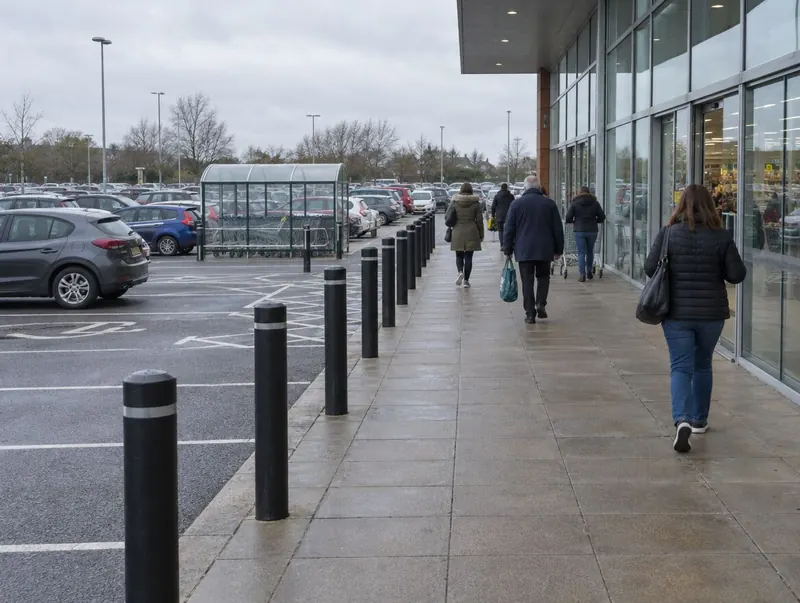 Computer-generated image
Pedestrian protection in Livingston
Pedestrian protection bollards suit plenty of Livingston sites, local parades, filling-station forecourts and schools among them. Bollards that separate people from vehicles at car parks, forecourts, walkways, drive-thrus and shop entrances.
We work across EH54, EH53 and EH55 — Livingston itself and places including East Calder, Oakbank, Polbeth and West Calder. Jobs in Livingston can be combined with work in Broxburn (2.9 miles), Bathgate (4.7 miles), Linlithgow (6 miles) and Whitburn (6.7 miles) (straight-line distances). Livingston is about 13 miles from Edinburgh.
Local details
- Area
- West Lothian, Scotland
- Roads authority
- West Lothian Council (local roads)
- Planning authority
- West Lothian Council
- Postcodes
- EH54, EH53 and EH55
- Guide price
- Typically £245–£1,195 per bollard + VAT; minimum job £595
- Survey
- Free, with a fixed written quote
- Nearby
- Broxburn (2.9 mi), Bathgate (4.7 mi), Linlithgow (6 mi), Whitburn (6.7 mi)
Typical pedestrian protection bollards jobs in Livingston
Common uses in a place like Livingston:
- School and hospital drop-off zones
- Outdoor seating at cafes, pubs and restaurants
- Drive-thru lanes and order points next to seating
Guide prices for Livingston
| Specification | Guide price | Includes |
|---|---|---|
| Standard | £245–£645 + VAT | Standard post, foundation, reinstatement |
| Upgraded | £535–£925 + VAT | Upgraded finish or fittings, reflective band, matched keys |
| Premium | £815–£1,195 + VAT | Heavy-duty or architectural spec, premium finish |
Per bollard, supplied and installed; no regional adjustment. Guide only — the fixed price follows a survey.
What we check first in Livingston
Livingston falls under West Lothian Council as roads authority. If the line of posts crosses onto adopted road or pavement, permission comes before excavation; on private land it does not.
Many private-land installations in Livingston need no planning application, but the rules don't clearly cover bollards, so listed buildings, conservation areas and prominent frontages are worth raising with the planning team at West Lothian Council before posts go in.
Reinstatement keeps walkways level and flush, because a trip edge around a new post in a busy car park creates the very hazard the posts are meant to reduce. Where bollards protect a shopfront, the building's own foundations and any canopy columns may sit close to the line, which limits how deep and wide each base can go.
- Record why posts are where they are in the site's risk assessment, especially at drive-thrus and seating areas.
- Use contrasting bands so posts are visible to partially sighted people, and avoid linking chains across routes.
How the job runs
Excavate and set
Each position is cut, dug and checked for services, and the posts are set plumb in concrete to a consistent height.
Reinstate
Paving, tarmac or concrete is made good flush around each post, with tactile paving reinstated where it was disturbed.
Add bands and markings
Reflective bands are fitted and any wheel stops or line markings agreed in the scheme are installed.
Options to consider
| Option | Detail |
|---|---|
| Lit bollards | Low-level lighting bollards double as protection on walkways where the product is robust enough for the job. |
| PAS 170-1 tested bollards | Tested against low-speed vehicle impacts, for sites where proven performance has been asked for. |
| Visibility bands | Reflective and contrasting bands help drivers and partially sighted pedestrians see posts. |
What affects the quote
Two Livingston jobs with the same number of posts can price quite differently. The usual reasons:
- Working around trading hours and live car parks
- Reinstatement of tactile paving and walkway surfaces
- Number of posts and length of line
After installation
Touch up chipped coatings, renew faded bands, and check the surface around each base for cracks that suggest movement. If one post keeps being hit, look at the bay layout or add a wheel stop rather than replacing the same post repeatedly.
We can also service, repair or replace existing posts anywhere in Livingston.
Common questions
Which parts of Livingston do you cover for pedestrian protection bollards?
We cover all of Livingston (EH54, EH53 and EH55) and the rest of West Lothian. We also work in Broxburn, Bathgate and Linlithgow.
Who gives permission for bollards on the pavement in Livingston?
Livingston falls under West Lothian Council as roads authority. If the line of posts crosses onto adopted road or pavement, permission comes before excavation; on private land it does not.
What's a typical price for pedestrian protection bollards in Livingston?
In Livingston, typically £245–£1,195 per bollard, supplied and installed, plus VAT, with a minimum job of £595 plus VAT, using our Scotland guide prices. The fixed figure comes in writing after we've seen the site.
Should bollards be added at a drive-thru order point?
Often, yes, where people queue or sit beside the lane. Posts should follow the curve of the lane and be closest together at corners, where drivers tend to misjudge the turn. The positions are agreed on site with the operator.
Do pedestrian protection bollards need to be crash-rated?
Not usually. They deal with low-speed driver errors, so firmly founded steel posts often suffice. Where an owner, insurer or designer wants proven performance, PAS 170-1 tested products are the usual choice.
Pedestrian protection in nearby towns
- Broxburn (2.9 mi)
- Bathgate (4.7 mi)
- Linlithgow (6 mi)
- Whitburn (6.7 mi)
- Armadale (7 mi)
- South Queensferry (7.7 mi)