Highland · Scotland
Ram-raid protection bollards in Fort William
Planning ram-raid bollards in Fort William? We check ownership, consents and buried services first, then quote a fixed price.
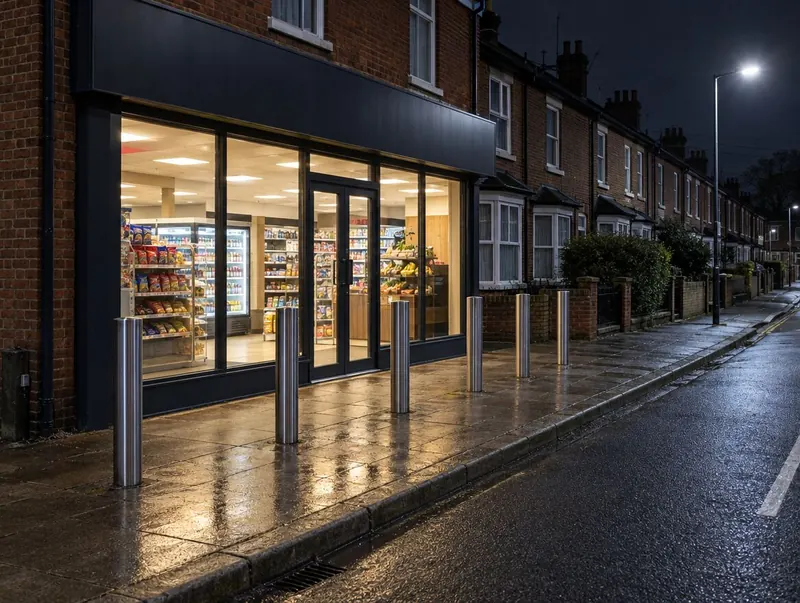 Computer-generated image
About ram-raid bollards in Fort William
We supply and fit ram-raid bollards throughout Fort William, typically for sites such as small industrial units, high street shopfronts and town-centre squares. Bollards fitted in front of shopfronts, ATMs, jewellers and convenience stores to stop vehicles being used to break in.
We cover Fort William's PH33 postcode district, including places such as Caol, Inchree, Torlundy and Blarmachfoldach. There are no other towns of Fort William's size close by, so crews travel in specifically for jobs here.
Key facts for this area
- Area
- Highland, Scotland
- Roads authority
- The Highland Council (local roads)
- Planning authority
- The Highland Council
- Postcodes
- PH33
- Guide price
- Typically £395–£1,495 per bollard + VAT; minimum job £945
- Survey
- Free, with a fixed written quote
Guide prices for Fort William
| Specification | Guide price | Includes |
|---|---|---|
| Standard | £395–£855 + VAT | Standard post, foundation, reinstatement |
| Upgraded | £725–£1,195 + VAT | Upgraded finish or fittings, reflective band, matched keys |
| Premium | £1,045–£1,495 + VAT | Heavy-duty or architectural spec, premium finish |
Per bollard, supplied and installed; no regional adjustment. Guide only — the fixed price follows a survey.
Typical ram-raid bollards jobs in Fort William
Around Fort William, ram-raid bollards usually solve one of these:
- Filling station kiosks and forecourt shops
- Warehouses and trade counters with roller-shutter entrances
- Premises that have already been targeted once
Consents, ground and services in Fort William
In Scotland the council is the roads authority for local roads, which in Fort William means The Highland Council. Ram-raid bollards on an adopted footway need its consent; trunk roads sit with Transport Scotland.
Many private-land installations in Fort William need no planning application, but the rules don't clearly cover bollards, so listed buildings, conservation areas and prominent frontages are worth raising with the planning team at The Highland Council before posts go in.
Shop forecourts may be thin concrete over old fill, and filling station forecourts carry fuel lines, tank vents and interceptors that must be located precisely before anything is dug. Shopfronts often sit over cellars, coal holes, vaults and service entries, so what lies under the pavement can be more complicated than it looks.
- In conservation areas or on listed buildings, ask the local planning authority whether consent is needed.
- Leave clear gaps for wheelchairs and buggies, typically at least 1,000 mm, and keep the footway width usable, referring to Inclusive Mobility guidance.
What happens on site
Agree the post type and positions
We agree unrated or tested posts with you, your landlord and any insurer or security adviser involved. A fixed written quote sets out the positions, foundations and reinstatement.
Excavate and set the posts
Each position is hand-dug near services and taken to depth, then the post is set plumb in a reinforced concrete base. Work is planned around trading hours where possible.
Reinstate the pavement
Paving, tarmac or forecourt concrete is made good flush with the base of each post, leaving no trip edges.
Choosing the right spec
| Option | Detail |
|---|---|
| Concrete-filled steel posts | Thick-walled steel tube root-fixed in a deep reinforced base. The usual unrated choice for shopfronts and ATMs. |
| PAS 170-1 tested bollards | Tested against low-speed vehicle impacts and suited to ram-raid risks where a tested product is requested. |
| Reflective and contrasting bands | Bands near the top help pedestrians, including partially sighted people, see the posts on a busy pavement. |
What affects the quote
Our Scotland guide prices are a starting point; the survey in Fort William firms them up. What tends to move them:
- Number of posts across the frontage or ATM
- Reinstatement of forecourt or natural stone surfaces
- Out-of-hours working to avoid closing the shop
After installation
If you have been raided despite having bollards, look again at the positions and gaps, because offenders tend to aim at any weak point. Check them after any knock, because a post that has been hit may have cracked its foundation even if it still looks straight.
We can also service, repair or replace existing posts anywhere in Fort William.
Ram-raid bollards in Fort William: FAQs
Which parts of Fort William do you cover for ram-raid bollards?
We cover all of Fort William (PH33) and the rest of Highland.
Do I need consent for ram-raid bollards on a public footway in Fort William?
For anything on the public footway in Fort William we check with the roads authority first — The Highland Council for local roads, Transport Scotland on trunk routes. Private ground such as a car park or forecourt only needs the owner's go-ahead.
How much do ram-raid bollards cost in Fort William?
In Fort William, typically £395–£1,495 per bollard, supplied and installed, plus VAT, with a minimum job of £945 plus VAT, using our Scotland guide prices. The fixed figure comes in writing after we've seen the site.
Will bollards stop an ATM being ripped out?
Correctly placed bollards stop a vehicle getting close enough to attach chains or ram the surround. They work alongside the machine's own anchoring and the bank's security measures. Positions need to cover the wall either side of the ATM as well as the front.
Can we still take deliveries through the front?
Yes, if one or more positions are removable. Staff unlock and lift out the post for deliveries, then refit it. The socket is designed to sit flush when the post is out.