East Riding of Yorkshire · England
Removable bollard installation in Hull
Planning removable bollards in Hull? We check ownership, consents and buried services first, then quote a fixed price.
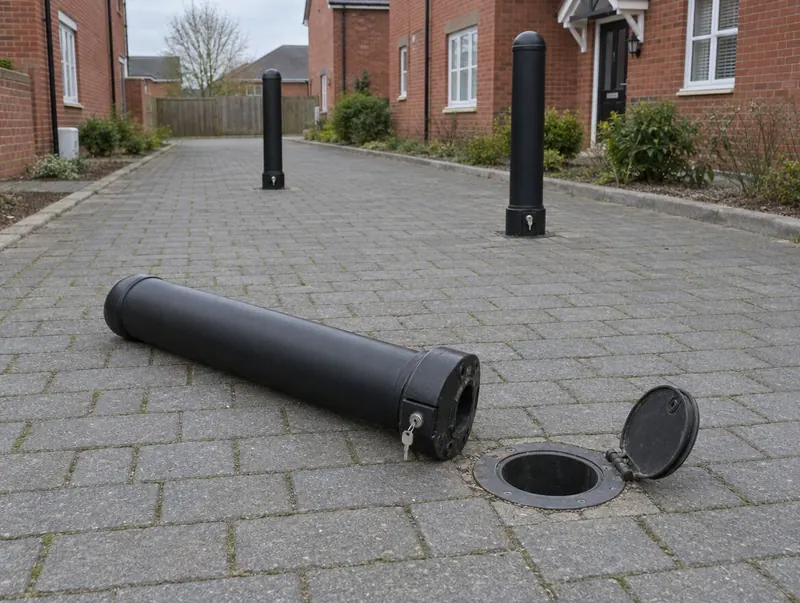 Computer-generated image
Removable bollards in Hull
Across Hull, typical sites for removable bollards include office forecourts, pedestrianised streets and university campuses. When the post is out, the socket is closed with a hinged lid or cap so the surface is flush.
Coverage in Hull takes in the HU1, HU2, HU3, HU5, HU9 and HU8 postcode districts. Jobs in Hull can be combined with work in Beverley (7.9 miles) (straight-line distances).
Hull at a glance
- Area
- East Riding of Yorkshire, England
- Highway authority
- Hull City Council (local roads)
- Planning authority
- Hull City Council
- Postcodes
- HU1, HU2, HU3, HU5, HU9, HU8, HU4 and HU6
- Guide price
- Typically £235–£815 per bollard + VAT (£275–£975 inc VAT for homes); minimum job £575
- Survey
- Free, with a fixed written quote
- Nearby
- Beverley (7.9 mi)
What Hull sites use removable bollards for
Common uses in a place like Hull:
- Emergency and fire service access routes
- Driveways and private parking bays
- School gates closed during drop-off and pick-up
Removable bollard prices in Hull
| Specification | Guide price | Includes |
|---|---|---|
| Standard | £235–£485 + VAT · £275–£575 inc VAT | Standard post, foundation, reinstatement |
| Upgraded | £415–£655 + VAT · £495–£785 inc VAT | Upgraded finish or fittings, reflective band, matched keys |
| Premium | £585–£815 + VAT · £695–£975 inc VAT | Heavy-duty or architectural spec, premium finish |
Per bollard with ground socket, supplied and installed; -3% for Yorkshire and the Humber. Guide only — the fixed price follows a survey.
Permissions and groundwork in Hull
In Hull, work on adopted pavements and verges needs consent from Hull City Council, the local highway authority. Car parks, forecourts and other private land only need the owner's permission.
Many private-land installations in Hull need no planning application, but the rules don't clearly cover bollards, so listed buildings, conservation areas and prominent frontages are worth raising with the planning team at Hull City Council before posts go in.
The base sits on free-draining stone or connects to a drainage route, so rainwater does not stand in the socket and freeze around the post in winter. Removable bollards need modest depth, which makes them one of the easier bollards to fit around services.
- Keep a clear route of typically at least 1,000–1,200 mm between posts on pedestrian routes, and check against Inclusive Mobility guidance.
- Check whether the location is public highway; a highway authority agreement is usually needed there.
Installation, step by step
Agree who will lift the post
At the free site survey we talk through who will remove the post, how often and where it will be stored. That decides material, diameter and lock, and goes into a fixed written quote.
Cut and excavate
A small square of surface is cut out and excavated to socket depth, with a bed of free-draining stone at the bottom so water can leave the socket.
Set the socket flush
The socket is set in concrete with its rim exactly at finished surface level and to the fall of the ground, so the lid sits flat and nothing catches on it.
Choosing the right spec
| Option | Detail |
|---|---|
| Socket lids | Spring-closing, hinged or lockable lids that sit flush when the post is removed, so there is no open hole. |
| Rated removable posts | Crash-tested removable models exist for security lines; they use heavier sockets and tested foundations. |
| Diameter and height | Commonly 76–140 mm diameter and around 900–1,000 mm high, chosen to suit visibility and handling. |
What affects the quote
Our Yorkshire and the Humber guide prices are a starting point; the survey in Hull firms them up. What tends to move them:
- Number of posts and sockets
- Lock type and whether locks are keyed alike
- Surface type and reinstatement
Looking after them
Check the lid springs and hinges. Lubricate locks a few times a year with a graphite or lock-specific spray, lift the posts out periodically even if they are not needed, and clear the socket of debris.
If posts in Hull are later hit or damaged, we can repair or replace them — see bollard repairs.
Common questions
Which parts of Hull do you cover for removable bollards?
We cover all of Hull (HU1, HU2, HU3, HU5, HU9 and HU8) and the rest of East Riding of Yorkshire. We also work in Beverley.
Who gives permission for bollards on the pavement in Hull?
The highway authority for local roads in Hull is Hull City Council; motorways and trunk roads sit with National Highways. Removable bollards on the adopted footway are a matter for the highway authority, so we only install there with its written agreement.
How much do removable bollards cost in Hull?
In Hull, typically £235–£815 per bollard with ground socket, supplied and installed, plus VAT (£275–£975 including VAT for homeowners), with a minimum job of £575 plus VAT, using our Yorkshire and the Humber guide prices. The fixed figure comes in writing after we've seen the site.
What happens to the hole when the bollard is out?
A lid on the socket closes over it so the surface is flush. Spring-closing lids shut automatically when the post is lifted. That stops trips and keeps debris out.
Will a removable bollard freeze in place?
It can if water sits in the socket and freezes around the post. Good drainage at the socket base is the main defence. A little lubricant on the post and lifting it out occasionally in winter also helps.