Devon · England
Semi-automatic bollard installation in Exmouth
Semi-automatic bollards for sites across Exmouth and the rest of Devon, from the first measurement to the last relaid paving block.
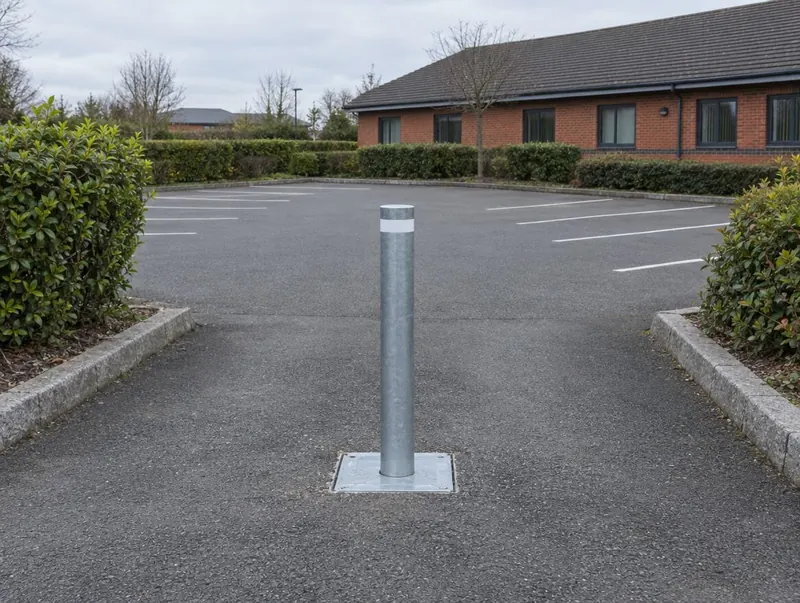 Computer-generated image
Semi-automatic bollards in Exmouth
From small industrial units, residential driveways and community car parks, Exmouth has plenty of places where semi-automatic bollards earn their keep. Gas-strut assisted bollards that rise on their own when unlocked and lower by hand, with no mains power needed.
Coverage in Exmouth takes in the EX8 and EX9 postcode districts and nearby places like Lympstone, Budleigh Salterton, Otterton and East Budleigh. Nearby, we also work in Exeter (9.2 miles), Newton Abbot (11 miles), Torquay (12 miles) and Paignton (14.5 miles), measured as the crow flies. It sits roughly 37 miles from Plymouth as the crow flies.
Exmouth at a glance
- Area
- Devon, England
- Highway authority
- Devon County Council (local roads)
- Planning authority
- the council for East Devon
- Postcodes
- EX8 and EX9
- Guide price
- Typically £1,095–£3,495 per bollard + VAT (£1,295–£4,195 inc VAT for homes); minimum job £1,195
- Survey
- Free, with a fixed written quote
- Nearby
- Exeter (9.2 mi), Newton Abbot (11 mi), Torquay (12 mi), Paignton (14.5 mi)
What Exmouth sites use semi-automatic bollards for
Typical reasons Exmouth sites choose semi-automatic bollards:
- Temporary closure points on campuses and estates
- Delivery entrances without a power supply nearby
- Staff car parks and reserved bays used several times a day
Semi-automatic bollard prices in Exmouth
| Specification | Guide price | Includes |
|---|---|---|
| Standard | £1,095–£2,095 + VAT · £1,295–£2,495 inc VAT | Standard post, foundation, reinstatement |
| Upgraded | £1,795–£2,845 + VAT · £2,145–£3,395 inc VAT | Upgraded finish or fittings, reflective band, matched keys |
| Premium | £2,545–£3,495 + VAT · £3,045–£4,195 inc VAT | Heavy-duty or architectural spec, premium finish |
Per bollard, supplied and installed; no regional adjustment. Guide only — the fixed price follows a survey.
Permissions and groundwork in Exmouth
In Exmouth, work on adopted pavements and verges needs consent from Devon County Council, the local highway authority. Car parks, forecourts and other private land only need the owner's permission.
Many private-land installations in Exmouth need no planning application, but the rules don't clearly cover bollards, so listed buildings, conservation areas and prominent frontages are worth raising with the planning team at the council for East Devon before posts go in.
Buried services across the entrance are traced and the position adjusted if needed, as the cassette cannot simply be made shallower. Because the cassette houses both the post and its strut mechanism, the pit is deep and must stay dry.
- Keep clear gaps of typically at least 1,000–1,200 mm where pedestrians pass between posts, referring to Inclusive Mobility guidance.
- Warn users and passers-by that the post rises on its own; fit reflective bands and consider a sign at busy sites.
Installation, step by step
Set the cassette
The cassette is set plumb and flush with the finished surface, connected to drainage and concreted in. The strut is fitted or released only as the manufacturer instructs.
Reinstate the surface
Paving or surfacing is made good tight to the cassette collar so there is no lip for tyres or feet to catch.
Test and show users
The post is cycled several times to check it rises fully, locks at both heights and lowers smoothly. Users are shown how to operate it and to keep clear of the head when it rises.
Finishes and options
| Option | Detail |
|---|---|
| Head lighting | Some models include battery or solar LEDs in the head to improve visibility on unlit sites. |
| Finishes | Galvanised and powder-coated or stainless steel, with reflective bands for visibility. |
| Duty level | Light-duty domestic models and heavier commercial versions with stronger cassettes and posts. |
What affects the quote
Two Exmouth jobs with the same number of posts can price quite differently. The usual reasons:
- Drainage method
- Excavation depth and services in the way
- Finish and any head lighting
After installation
Operate the bollard regularly and keep the head and lid clear of grit. Watch the rising speed: when it slows or the post no longer reaches full height, the strut is losing pressure and should be replaced before it fails altogether.
We can also service, repair or replace existing posts anywhere in Exmouth.
Common questions
Which parts of Exmouth do you cover for semi-automatic bollards?
We cover all of Exmouth (EX8 and EX9) and the rest of Devon. We also work in Exeter, Newton Abbot and Torquay.
Who gives permission for bollards on the pavement in Exmouth?
The highway authority for local roads in Exmouth is Devon County Council; motorways and trunk roads sit with National Highways. Semi-automatic bollards on the adopted footway are a matter for the highway authority, so we only install there with its written agreement.
How much do semi-automatic bollards cost in Exmouth?
In Exmouth, typically £1,095–£3,495 per bollard, supplied and installed, plus VAT (£1,295–£4,195 including VAT for homeowners), with a minimum job of £1,195 plus VAT, using our South West guide prices. The fixed figure comes in writing after we've seen the site.
Is it hard to push the bollard back down?
Not usually; most users press it down with a hand or foot. The strut resists, so it needs a steady push rather than a sharp kick. Heavier commercial models take more effort than domestic ones.
Can a semi-automatic bollard injure someone as it rises?
It rises with some force, so nobody should stand over it or put a hand on the head when releasing it. Users should be shown how to operate it safely. On busy sites, a sign and reflective bands help.