Kent · England
Semi-automatic bollard installation in Broadstairs
Planning semi-automatic bollards in Broadstairs? We check ownership, consents and buried services first, then quote a fixed price.
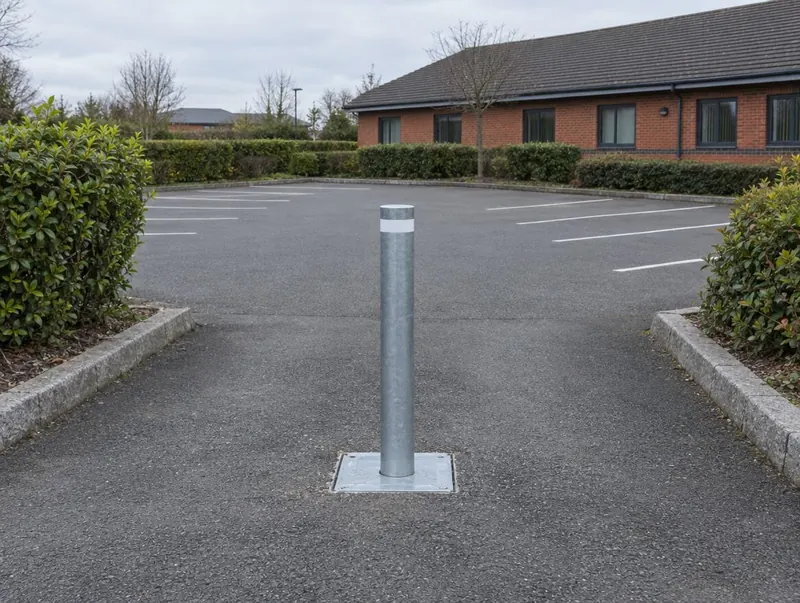 Computer-generated image
About semi-automatic bollards in Broadstairs
In the town of Broadstairs, semi-automatic bollards tend to go in at small industrial units, schools and high street shopfronts. Gas-strut assisted bollards that rise on their own when unlocked and lower by hand, with no mains power needed.
Coverage in Broadstairs takes in the CT10 postcode district. Nearby, we also work in Ramsgate (1.9 miles), Margate (2.9 miles), Deal (9.5 miles) and Herne Bay (13.6 miles), measured as the crow flies.
Local details
- Area
- Kent, England
- Highway authority
- Kent County Council (local roads)
- Planning authority
- the council for Thanet
- Postcodes
- CT10
- Guide price
- Typically £1,145–£3,695 per bollard + VAT (£1,345–£4,445 inc VAT for homes); minimum job £1,245
- Survey
- Free, with a fixed written quote
Typical semi-automatic bollards jobs in Broadstairs
Typical reasons Broadstairs sites choose semi-automatic bollards:
- Private roads and courtyards with a small number of key holders
- Staff car parks and reserved bays used several times a day
- Delivery entrances without a power supply nearby
Semi-automatic bollard prices in Broadstairs
| Specification | Guide price | Includes |
|---|---|---|
| Standard | £1,145–£2,245 + VAT · £1,345–£2,695 inc VAT | Standard post, foundation, reinstatement |
| Upgraded | £1,945–£2,995 + VAT · £2,345–£3,595 inc VAT | Upgraded finish or fittings, reflective band, matched keys |
| Premium | £2,695–£3,695 + VAT · £3,245–£4,445 inc VAT | Heavy-duty or architectural spec, premium finish |
Per bollard, supplied and installed; +6% for South East. Guide only — the fixed price follows a survey.
Permissions and groundwork in Broadstairs
In Broadstairs, work on adopted pavements and verges needs consent from Kent County Council, the local highway authority. Car parks, forecourts and other private land only need the owner's permission.
Bollards on private land often don't need planning permission, but it depends on the council's view, the height and the location; in a conservation area, next to a listed building or under an Article 4 direction, ask the local planning authority (the council for Thanet) first — we flag this at survey.
Reinstatement around the collar has to be firm, because the post is pushed down by foot and any movement in the surround soon shows as cracking. On sandy or gravel ground a soakaway beneath the cassette often drains it adequately; on clay, chalk with poor drainage or where groundwater rises, a pipe to a surface water drain or a dedicated soakaway is needed.
- Warn users and passers-by that the post rises on its own; fit reflective bands and consider a sign at busy sites.
- Check land ownership; bollards on public highway need the highway authority's agreement.
Installation, step by step
Excavate the pit
The surface is cut and the pit dug to the cassette depth plus a drainage layer, by hand near services.
Set the cassette
The cassette is set plumb and flush with the finished surface, connected to drainage and concreted in. The strut is fitted or released only as the manufacturer instructs.
Reinstate the surface
Paving or surfacing is made good tight to the cassette collar so there is no lip for tyres or feet to catch.
Specification choices
| Option | Detail |
|---|---|
| Gas strut or spring assist | Most models use a gas strut; some use springs. Both store energy to raise the post when unlocked. |
| Lock types | Keyed cylinder locks, typically operating at ground level, with keyed-alike options for multi-post sites. |
| Duty level | Light-duty domestic models and heavier commercial versions with stronger cassettes and posts. |
What moves the price in Broadstairs
Our South East guide prices are a starting point; the survey in Broadstairs firms them up. What tends to move them:
- Surface reinstatement
- Drainage method
- Finish and any head lighting
After installation
Look into the cassette periodically for water or debris, and lubricate the lock and latch as the manufacturer suggests. In winter, keep an eye on the lid after frost or snow; ice around the head can stop the post rising, and forcing the key or the post at that point damages the latch.
For damaged or loose posts in Broadstairs, repairs and replacements are priced in writing first.
Questions about semi-automatic bollards in Broadstairs
Do you install semi-automatic bollards in Broadstairs?
We cover all of Broadstairs (CT10) and the rest of Kent. We also work in Ramsgate, Margate and Deal.
Who gives permission for bollards on the pavement in Broadstairs?
Kent County Council is the highway authority covering Broadstairs's local roads. If any post would stand on adopted highway rather than your land, that consent is the first thing we sort out.
What's a typical price for semi-automatic bollards in Broadstairs?
In Broadstairs, typically £1,145–£3,695 per bollard, supplied and installed, plus VAT (£1,345–£4,445 including VAT for homeowners), with a minimum job of £1,245 plus VAT, using our South East guide prices. The fixed figure comes in writing after we've seen the site.
What makes a semi-automatic bollard rise without power?
A gas strut or spring inside the cassette. Pushing the post down compresses it and a latch holds the post below ground. Turning the key releases the latch and the stored energy lifts the post.
Why has my semi-automatic bollard stopped rising fully?
Usually because the gas strut has lost pressure, or debris and water in the cassette are slowing it. Check and clean the cassette first. If it still stops short, the strut needs replacing.