Scottish Borders · Scotland
Semi-automatic bollard installation in Hawick
Semi-automatic bollards for sites across Hawick and the rest of Scottish Borders, from the first measurement to the last relaid paving block.
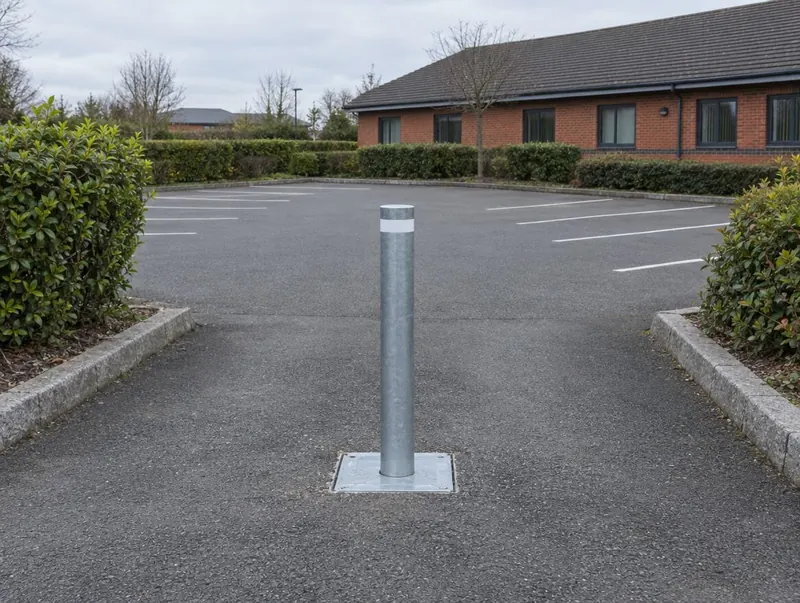 Computer-generated image
About semi-automatic bollards in Hawick
Whether it's community buildings, high street shopfronts and schools, semi-automatic bollards in Hawick are planned around who needs to get through and who doesn't. Gas-strut assisted bollards that rise on their own when unlocked and lower by hand, with no mains power needed.
Coverage in Hawick takes in the TD9 postcode district and nearby places like Denholm and Bonchester Bridge. We also cover neighbouring Galashiels (13.3 miles) — distances are straight-line. It sits roughly 40 miles from Edinburgh as the crow flies.
Hawick at a glance
- Area
- Scottish Borders, Scotland
- Roads authority
- Scottish Borders Council (local roads)
- Planning authority
- Scottish Borders Council
- Postcodes
- TD9
- Guide price
- Typically £1,095–£3,495 per bollard + VAT (£1,295–£4,195 inc VAT for homes); minimum job £1,195
- Survey
- Free, with a fixed written quote
- Nearby
- Galashiels (13.3 mi)
Guide prices for Hawick
| Specification | Guide price | Includes |
|---|---|---|
| Standard | £1,095–£2,095 + VAT · £1,295–£2,495 inc VAT | Standard post, foundation, reinstatement |
| Upgraded | £1,795–£2,845 + VAT · £2,145–£3,395 inc VAT | Upgraded finish or fittings, reflective band, matched keys |
| Premium | £2,545–£3,495 + VAT · £3,045–£4,195 inc VAT | Heavy-duty or architectural spec, premium finish |
Per bollard, supplied and installed; no regional adjustment. Guide only — the fixed price follows a survey.
What Hawick sites use semi-automatic bollards for
Common uses in a place like Hawick:
- Sites where telescopic posts are too heavy for regular users
- Driveways where the owner wants minimal effort
- Private roads and courtyards with a small number of key holders
Permissions and groundwork in Hawick
Hawick falls under Scottish Borders Council as roads authority. If the line of posts crosses onto adopted road or pavement, permission comes before excavation; on private land it does not.
Bollards on private land often need no planning application, but listed buildings and conservation areas are different; the planning service at Scottish Borders Council can confirm before anything is ordered.
Because the cassette houses both the post and its strut mechanism, the pit is deep and must stay dry. On sandy or gravel ground a soakaway beneath the cassette often drains it adequately; on clay, chalk with poor drainage or where groundwater rises, a pipe to a surface water drain or a dedicated soakaway is needed.
- Agree how emergency services will gain access if the post is locked up.
- Check land ownership; bollards on public highway need the roads authority's agreement.
How the job runs
Survey use and ground
At the free site survey we look at how often the post will be used, who will operate it and what is under the surface. A fixed written quote follows, including drainage.
Excavate the pit
The surface is cut and the pit dug to the cassette depth plus a drainage layer, by hand near services.
Test and show users
The post is cycled several times to check it rises fully, locks at both heights and lowers smoothly. Users are shown how to operate it and to keep clear of the head when it rises.
Finishes and options
| Option | Detail |
|---|---|
| Lock types | Keyed cylinder locks, typically operating at ground level, with keyed-alike options for multi-post sites. |
| Gas strut or spring assist | Most models use a gas strut; some use springs. Both store energy to raise the post when unlocked. |
| Duty level | Light-duty domestic models and heavier commercial versions with stronger cassettes and posts. |
Pricing semi-automatic bollards in Hawick
Two Hawick jobs with the same number of posts can price quite differently. The usual reasons:
- Number of posts and keyed-alike locks
- Domestic or commercial duty model
- Excavation depth and services in the way
Looking after them
Watch the rising speed: when it slows or the post no longer reaches full height, the strut is losing pressure and should be replaced before it fails altogether. In winter, keep an eye on the lid after frost or snow; ice around the head can stop the post rising, and forcing the key or the post at that point damages the latch.
For damaged or loose posts in Hawick, repairs and replacements are priced in writing first.
Questions about semi-automatic bollards in Hawick
Can you install semi-automatic bollards anywhere in Hawick?
We cover all of Hawick (TD9) and the rest of Scottish Borders. We also work in Galashiels.
Who gives permission for bollards on the pavement in Hawick?
In Scotland the council is the roads authority for local roads, which in Hawick means Scottish Borders Council. Semi-automatic bollards on an adopted footway need its consent; trunk roads sit with Transport Scotland.
What's a typical price for semi-automatic bollards in Hawick?
In Hawick, typically £1,095–£3,495 per bollard, supplied and installed, plus VAT (£1,295–£4,195 including VAT for homeowners), with a minimum job of £1,195 plus VAT, using our Scotland guide prices. The fixed figure comes in writing after we've seen the site.
Why has my semi-automatic bollard stopped rising fully?
Usually because the gas strut has lost pressure, or debris and water in the cassette are slowing it. Check and clean the cassette first. If it still stops short, the strut needs replacing.
How is a semi-automatic bollard different from an automatic one?
An automatic bollard is powered and controlled by a panel, loops and access devices. A semi-automatic one rises on its own when unlocked but must be pushed down by hand. It needs no electrics, which keeps installation simpler.