Scottish Borders · Scotland
Steel security bollard installation in Hawick
Steel security bollards for sites across Hawick and the rest of Scottish Borders, from the first measurement to the last relaid paving block.
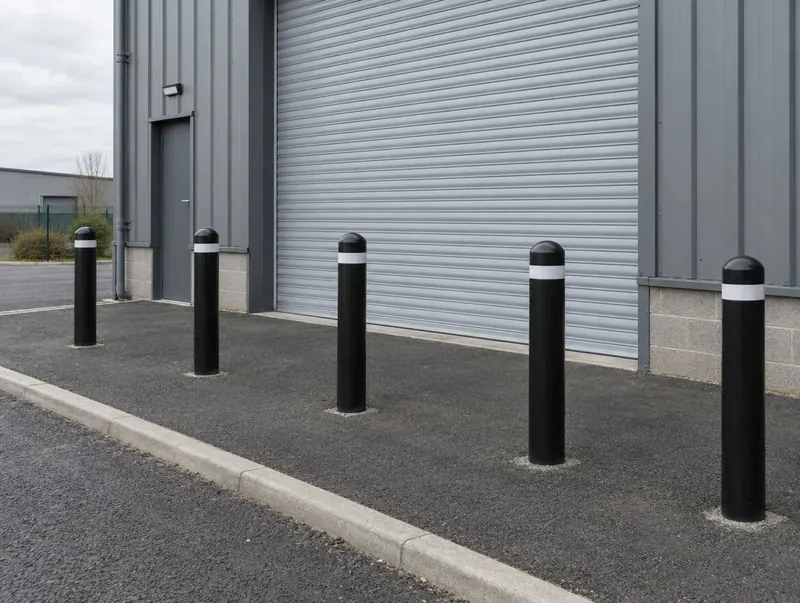 Computer-generated image
About steel security bollards in Hawick
In the town of Hawick, steel security bollards tend to go in at small industrial units, community car parks and high street shopfronts. Unrated steel bollards have not been crash-tested, so they deter vehicles and stop low-speed knocks and casual misuse rather than a determined attack.
Coverage in Hawick takes in the TD9 postcode district and nearby places like Denholm and Bonchester Bridge. Nearby, we also work in Galashiels (13.3 miles), measured as the crow flies. Hawick is about 40 miles from Edinburgh.
Local details
- Area
- Scottish Borders, Scotland
- Roads authority
- Scottish Borders Council (local roads)
- Planning authority
- Scottish Borders Council
- Postcodes
- TD9
- Guide price
- Typically £195–£895 per bollard + VAT (£225–£1,045 inc VAT for homes); minimum job £595
- Survey
- Free, with a fixed written quote
- Nearby
- Galashiels (13.3 mi)
Hawick: typical steel security bollard prices
| Specification | Guide price | Includes |
|---|---|---|
| Standard | £195–£485 + VAT · £225–£575 inc VAT | Standard post, foundation, reinstatement |
| Upgraded | £405–£695 + VAT · £485–£825 inc VAT | Upgraded finish or fittings, reflective band, matched keys |
| Premium | £615–£895 + VAT · £735–£1,045 inc VAT | Heavy-duty or architectural spec, premium finish |
Per bollard, supplied and installed; no regional adjustment. Guide only — the fixed price follows a survey.
Steel security bollards in Hawick: common uses
Around Hawick, steel security bollards usually solve one of these:
- Social housing estates with nuisance parking
- Car park perimeters, end-of-bay protection and walkway edges
- Lines between pedestrian routes and service yards
What we check first in Hawick
For anything on the public footway in Hawick we check with the roads authority first — Scottish Borders Council for local roads, Transport Scotland on trunk routes. Private ground such as a car park or forecourt only needs the owner's go-ahead.
Many private-land installations in Hawick need no planning application, but the rules don't clearly cover bollards, so listed buildings, conservation areas and prominent frontages are worth raising with the planning team at Scottish Borders Council before posts go in.
Verges are often softer than they look, and the edges of car parks may be thin tarmac over hardcore, so the foundation is sized to the ground found. Service runs commonly follow kerb lines and verges, which is exactly where steel posts tend to go, so positions are checked with records and scanning before digging.
- Fit contrasting or reflective bands near the top so posts are visible, as Inclusive Mobility guidance recommends.
- Check whether the land is public highway or adopted verge before installing; the roads authority's agreement is usually needed.
How the job runs
Break out and excavate
For root-fixed posts, the surface is cut neatly and each hole is dug to depth, by hand near known services. For base plates, the slab is checked for thickness and soundness.
Set the posts
Posts are set plumb and to a consistent height along the line, and concreted in. Base-plated posts are drilled, anchored with resin and torqued once cured.
Reinstate and finish
The surface around each post is made good to match, and reflective bands are fitted. Damaged galvanising from handling is touched up.
Options to consider
| Option | Detail |
|---|---|
| Caps and heads | Dome, flat, chamfered or ball tops, with welded caps to keep water out of hollow posts. |
| Base-plated | Bolted to a sound concrete slab with resin anchors. Quick to fit and easy to remove later, suited to light-duty and indoor use. |
| Concrete infill | Adds mass and stiffness and makes the post harder to cut or dent. Usually specified for security and impact positions. |
What affects the quote
Our Scotland guide prices are a starting point; the survey in Hawick firms them up. What tends to move them:
- Finish: galvanised only or powder-coated
- Tube diameter, wall thickness and concrete infill
- Surface reinstatement such as block paving or tarmac
After installation
Reflective bands fade and peel and are easy to renew. Powder coat chipped by vehicles should be touched up before the galvanising underneath starts to weather.
If posts in Hawick are later hit or damaged, we can repair or replace them — see bollard repairs.
Steel security bollards in Hawick: FAQs
Which parts of Hawick do you cover for steel security bollards?
We cover all of Hawick (TD9) and the rest of Scottish Borders. We also work in Galashiels.
Who gives permission for bollards on the pavement in Hawick?
For anything on the public footway in Hawick we check with the roads authority first — Scottish Borders Council for local roads, Transport Scotland on trunk routes. Private ground such as a car park or forecourt only needs the owner's go-ahead.
What's a typical price for steel security bollards in Hawick?
In Hawick, typically £195–£895 per bollard, supplied and installed, plus VAT (£225–£1,045 including VAT for homeowners), with a minimum job of £595 plus VAT, using our Scotland guide prices. The fixed figure comes in writing after we've seen the site.
Will galvanised posts rust?
Hot-dip galvanising protects steel for a long time in normal outdoor conditions. Powder coat over the galvanising adds colour and extra protection. Touch up chips promptly in coastal or heavily salted locations.
Can new posts match our existing ones?
Usually, if we can measure the existing diameter, height, cap and colour. Galvanised steel in standard sizes is easy to match; older or unusual sections may need a close equivalent.