Scottish Borders · Scotland
Automatic rising bollard installation in Hawick
Planning automatic bollards in Hawick? We check ownership, consents and buried services first, then quote a fixed price.
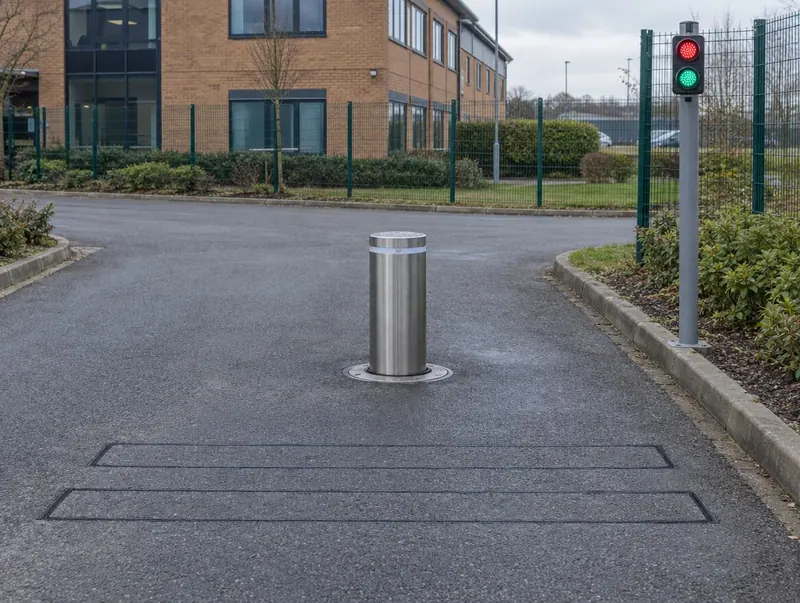 Computer-generated image
Hawick automatic bollards
Whether it's schools, community car parks and small industrial units, automatic bollards in Hawick are planned around who needs to get through and who doesn't. Automatic bollards are available unrated for traffic control or crash-tested for security entrances.
Coverage in Hawick takes in the TD9 postcode district and nearby places like Denholm and Bonchester Bridge. Jobs in Hawick can be combined with work in Galashiels (13.3 miles) (straight-line distances). Hawick is about 40 miles from Edinburgh.
Hawick at a glance
- Area
- Scottish Borders, Scotland
- Roads authority
- Scottish Borders Council (local roads)
- Planning authority
- Scottish Borders Council
- Postcodes
- TD9
- Guide price
- Typically £2,995–£14,995 per bollard + VAT
- Survey
- Free, with a fixed written quote
- Nearby
- Galashiels (13.3 mi)
Typical automatic bollards jobs in Hawick
Typical reasons Hawick sites choose automatic bollards:
- Pedestrianised streets with permitted delivery windows
- Private estates and gated developments without a full gate
- Entrances where a gate would block pedestrian desire lines
Hawick: typical automatic bollard prices
| Specification | Guide price | Includes |
|---|---|---|
| Standard | £2,995–£8,045 + VAT | Electro-mechanical or entry hydraulic, controls, loops and photocell |
| Upgraded | £6,595–£11,595 + VAT | Heavy-duty hydraulic, traffic light, signs and LED head |
| Premium | £10,195–£14,995 + VAT | High-cycle or crash-rated automatic bollard |
Per bollard, installed with controls, loops and commissioning; no regional adjustment. Guide only — the fixed price follows a survey.
Permissions and groundwork in Hawick
For anything on the public footway in Hawick we check with the roads authority first — Scottish Borders Council for local roads, Transport Scotland on trunk routes. Private ground such as a car park or forecourt only needs the owner's go-ahead.
Bollards on private land often need no planning application, but listed buildings and conservation areas are different; the planning service at Scottish Borders Council can confirm before anything is ordered.
The pit base is usually connected to a surface water drain or a soakaway, and on clay or high water table sites that connection needs particular attention. Reinstatement around each cassette is made flush so vehicles pass smoothly over the lowered head.
- On public highway, rising bollards normally need roads authority approval, with signs and signals to their requirements.
- Have the electrical installation carried out and certified by a qualified electrician to BS 7671.
What happens on site
Excavate and set cassettes
Each cassette pit is excavated to the manufacturer's depth, with the base prepared to drain. Cassettes are set to finished road level and fall, then concreted in.
Ducts, drainage and loops
Ducts are laid between the bollards, the controller cabinet and access devices, with draw pits where runs change direction. The drain is connected and the safety and exit loops are cut into the surface and sealed.
Commission and test
Rise and fall times, loop detection, photocells, lights and the manual release are tested with vehicles present. Safety settings are recorded against the risk assessment.
Choosing the right spec
| Option | Detail |
|---|---|
| Heights and diameters | Raised heights are commonly around 500–800 mm for traffic control and taller for security models, with diameters varying by drive and rating. |
| Electro-mechanical drive | Motor and gearbox inside the bollard with no hydraulic fluid. Often simpler to service, with duty cycles that suit moderate traffic. |
| Head lighting and finishes | LED rings or lights in the head, reflective bands, and powder-coated or stainless finishes. Lit heads help drivers see the post when it is raised. |
What moves the price in Hawick
When we price automatic bollards in Hawick, these make the biggest difference:
- Unrated or crash-rated model and its foundation size
- Access control devices, traffic lights and signage
- Hydraulic or electro-mechanical drive and the duty cycle needed
Keeping them working
Typical visits clean and inspect the cassette and drain, check hydraulic fluid or gearbox condition, test loops, photocells, lights and the manual release, and read the controller's fault log. Frequency depends on how often the bollard cycles; a busy entrance needs more visits than a rarely used one.
We can also service, repair or replace existing posts anywhere in Hawick.
Automatic bollards in Hawick: FAQs
Which parts of Hawick do you cover for automatic bollards?
We cover all of Hawick (TD9) and the rest of Scottish Borders. We also work in Galashiels.
Who gives permission for bollards on the pavement in Hawick?
In Scotland the council is the roads authority for local roads, which in Hawick means Scottish Borders Council. Automatic bollards on an adopted footway need its consent; trunk roads sit with Transport Scotland.
How much do automatic bollards cost in Hawick?
In Hawick, typically £2,995–£14,995 per bollard, installed with controls, loops and commissioning, plus VAT, using our Scotland guide prices. The fixed figure comes in writing after we've seen the site.
Should I choose hydraulic or electro-mechanical bollards?
Choose by how often the bollard will move and how you want it maintained. Hydraulic units suit busy entrances and heavier rated posts but need fluid and seal checks. Electro-mechanical units avoid fluid and are often simpler to look after at moderate traffic levels.
What happens in a power cut?
That depends on how the system is configured. Traffic bollards are often set to lower or can be lowered with a manual release, so vehicles are not trapped. Security bollards may be set to stay raised, with a procedure for staff to follow.