Cumbria · England
Shallow-mount security bollard installation in Barrow-in-Furness
Local installation of shallow-mount bollards in Barrow-in-Furness — free survey, fixed written price, and posts set to the right spacing for people and vehicles.
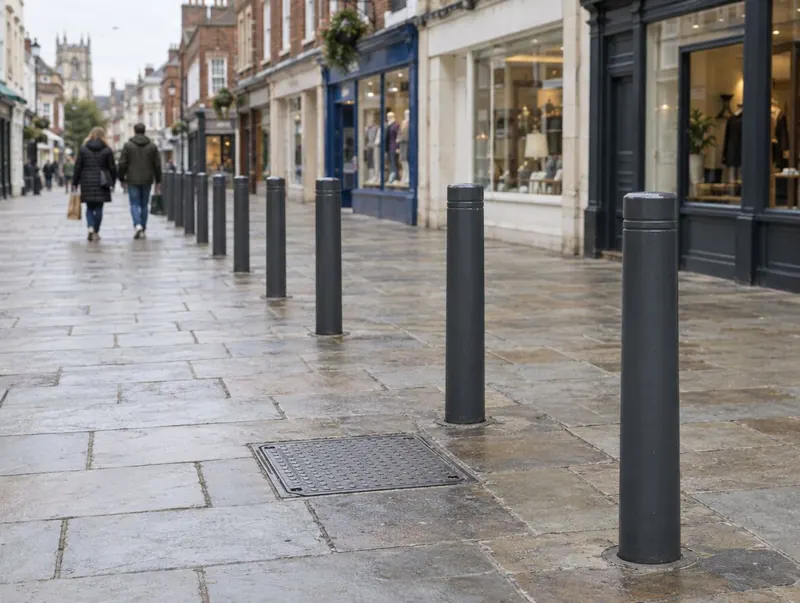 Computer-generated image
Barrow-in-Furness shallow-mount bollards
From filling-station forecourts, high street shopfronts and schools, Barrow-in-Furness has plenty of places where shallow-mount bollards earn their keep. Rated shallow-foundation bollard systems installed where buried services, basements or slabs rule out deep excavation.
Coverage in Barrow-in-Furness takes in the LA14, LA13, LA15 and LA16 postcode districts and nearby places like Rampside, Roa Island, Stank and Roosebeck. We also cover neighbouring Thornton-Cleveleys (18.4 miles) and Blackpool (21.6 miles) — distances are straight-line.
Key facts for this area
- Area
- Cumbria, England
- Highway authority
- Westmorland and Furness Council (local roads)
- Planning authority
- Westmorland and Furness Council
- Postcodes
- LA14, LA13, LA15 and LA16
- Guide price
- Typically £1,945–£8,795 per bollard + VAT; minimum job £4,895
- Survey
- Free, with a fixed written quote
- Nearby
- Thornton-Cleveleys (18.4 mi), Blackpool (21.6 mi)
Where shallow-mount bollards go in around Barrow-in-Furness
Typical reasons Barrow-in-Furness sites choose shallow-mount bollards:
- Lines that must cross over shallow drainage or ducts
- Sites where service diversions would be slow or impractical
- Listed or historic streets where deep digging is unwelcome
What shallow-mount bollards cost in Barrow-in-Furness
| Specification | Guide price | Includes |
|---|---|---|
| Standard | £1,945–£4,845 + VAT | Rated for a 7.5 t vehicle at 30 mph (48 km/h), tested foundation |
| Upgraded | £3,995–£6,895 + VAT | Rated for 7.5 t at 40 mph (64 km/h), tested foundation |
| Premium | £6,095–£8,795 + VAT | Rated for 7.5 t at 50 mph (80 km/h), or a specialist foundation |
Per bollard position, supplied and installed; -2% for North West. Guide only — the fixed price follows a survey.
Before we dig in Barrow-in-Furness
Westmorland and Furness Council is the highway authority covering Barrow-in-Furness's local roads. If any post would stand on adopted highway rather than your land, that consent is the first thing we sort out.
If your site in Barrow-in-Furness is listed or inside a conservation area, check with the local planning authority (Westmorland and Furness Council) before choosing a finish — heritage settings often favour cast iron or painted steel over stainless.
Shallow does not mean simple. Utility owners may set minimum separation distances or ask to be present when digging near their apparatus.
- Check gaps work for wheelchair users and buggies while still stopping vehicles, referring to Inclusive Mobility guidance.
- Record the frame's position on as-built drawings so future excavation near the line can be planned safely.
From survey to handover
Confirm the system with the manufacturer
The survey findings go back to the manufacturer and the client's adviser to confirm the system, its layout and any end details. A fixed written quote follows the free site survey.
Cut and excavate the trench
Paving is lifted and kept for reuse where possible, and a shallow trench is excavated by hand near known services. Where a service sits higher than expected, work stops and the detail is referred back.
Assemble and level the frame
Frame sections are placed, joined and set to line and level, with posts fixed as the drawing shows. Joints and fixings are photographed before any concrete goes in.
Specification choices
| Option | Detail |
|---|---|
| Linked-frame systems | Posts are welded or bolted to a continuous steel frame laid in a shallow trench and encased in concrete. Suited to straight or gently curved lines. |
| Modular cassette sections | Pre-made sections joined on site, allowing short runs and changes of direction within the manufacturer's tested limits. |
| Rated planters and street furniture | Benches, planters and cycle stands built around a tested shallow core, used where a line of posts would look out of place. |
What affects the quote
Our North West guide prices are a starting point; the survey in Barrow-in-Furness firms them up. What tends to move them:
- Lifting, storing and relaying natural stone paving
- Amount of hand digging needed around live services
- Length of run and the system needed to achieve the rating
After installation
Pay attention to the surface around the posts, because settlement or loose paving can indicate movement in the bearing layer. Any later utility work beside the line should be supervised so the frame is not undermined.
We can also service, repair or replace existing posts anywhere in Barrow-in-Furness.
Questions about shallow-mount bollards in Barrow-in-Furness
Which parts of Barrow-in-Furness do you cover for shallow-mount bollards?
We cover all of Barrow-in-Furness (LA14, LA13, LA15 and LA16) and the rest of Cumbria. We also work in Thornton-Cleveleys and Blackpool.
Who gives permission for bollards on the pavement in Barrow-in-Furness?
In Barrow-in-Furness, work on adopted pavements and verges needs consent from Westmorland and Furness Council, the local highway authority. Car parks, forecourts and other private land only need the owner's permission.
How much do shallow-mount bollards cost in Barrow-in-Furness?
In Barrow-in-Furness, typically £1,945–£8,795 per bollard position, supplied and installed, plus VAT, with a minimum job of £4,895 plus VAT, using our North West guide prices. The fixed figure comes in writing after we've seen the site.
How much shallower is a shallow-mount bollard foundation?
Often a fraction of the depth of a conventional rated foundation, commonly a few hundred millimetres. The exact depth depends on the system and rating chosen. What you gain in depth is usually traded for width, because the load is spread along a linked frame.
Will future roadworks damage the system?
They can if contractors dig beside it without knowing it is there. That is why we provide as-built drawings showing the frame position. Ask anyone excavating nearby to check those drawings first.