England · 5 towns
Shallow-mount security bollard installation in Cumbria
Shallow-mount bollards for sites across Cumbria: surveyed, quoted in writing and installed by our crews.
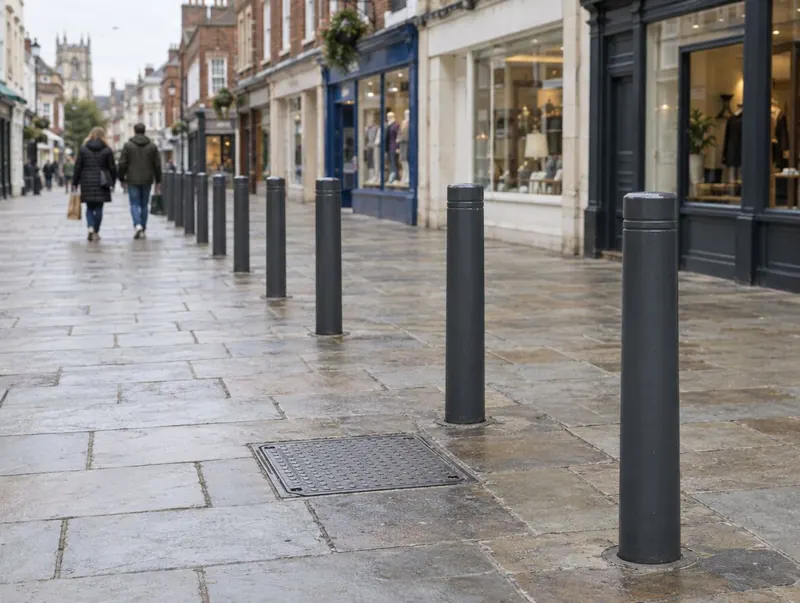 Computer-generated image
Shallow-mount bollards in Cumbria
Rated shallow-foundation bollard systems installed where buried services, basements or slabs rule out deep excavation. We cover Cumbria — Carlisle, Barrow-in-Furness, Kendal, Whitehaven and Workington.
Highway authorities for local roads in Cumbria: Cumberland Council and Westmorland and Furness Council.
Choose your town in Cumbria
Guide prices in Cumbria
| Specification | Guide price | Includes |
|---|---|---|
| Standard | £1,945–£4,845 + VAT | Rated for a 7.5 t vehicle at 30 mph (48 km/h), tested foundation |
| Upgraded | £3,995–£6,895 + VAT | Rated for 7.5 t at 40 mph (64 km/h), tested foundation |
| Premium | £6,095–£8,795 + VAT | Rated for 7.5 t at 50 mph (80 km/h), or a specialist foundation |
Per bollard position, supplied and installed; -2% for North West. Guide only — the fixed price follows a survey.
Highway and planning authorities in Cumbria
| Town | Highway / roads authority | Planning authority |
|---|---|---|
| Carlisle | Cumberland Council | Cumberland Council |
| Barrow-in-Furness | Westmorland and Furness Council | Westmorland and Furness Council |
| Kendal | Westmorland and Furness Council | Westmorland and Furness Council |
| Whitehaven | Cumberland Council | Cumberland Council |
| Workington | Cumberland Council | Cumberland Council |
Rules for shallow-mount bollards in England
Bollards on adopted highway are a matter for the highway authority under the Highways Act 1980, so they need its written agreement. On private land the owner's agreement is what matters; listed buildings and conservation areas need a word with the planning team first. Crash ratings (ISO 22343-1, or the superseded but still accepted PAS 68 and IWA 14-1) only hold when the product is installed to its tested foundation.
Details and sources: bollard rules in England.
How installation works
Map what is underground
Utility records, radar scanning and trial holes establish exactly how much depth is available along the line. This is the survey that decides whether a shallow system will fit at all.
Confirm the system with the manufacturer
The survey findings go back to the manufacturer and the client's adviser to confirm the system, its layout and any end details. A fixed written quote follows the free site survey.
Cut and excavate the trench
Paving is lifted and kept for reuse where possible, and a shallow trench is excavated by hand near known services. Where a service sits higher than expected, work stops and the detail is referred back.
Assemble and level the frame
Frame sections are placed, joined and set to line and level, with posts fixed as the drawing shows. Joints and fixings are photographed before any concrete goes in.
Shallow-mount bollards in Cumbria: FAQs
Do you cover all of Cumbria for shallow-mount bollards?
Yes — including Carlisle, Barrow-in-Furness, Kendal, Whitehaven and Workington. Enter your postcode in the price calculator to confirm.
How much do shallow-mount bollards cost in Cumbria?
In Cumbria, typically £1,945–£8,795 per bollard position, supplied and installed, plus VAT, with a minimum job of £4,895 plus VAT, using our North West guide prices. The fixed figure comes in writing after we've seen the site.
Who do I ask about bollards on public land in Cumbria?
For local roads, Cumberland Council and Westmorland and Furness Council; National Highways covers motorways and trunk roads. Bollards on adopted highway need the highway authority's written agreement.
Can shallow-mount bollards go on a car park deck?
Sometimes, if a structural engineer confirms the deck can take the impact loads and the waterproofing can be protected. Decks were not designed with vehicle attacks in mind, so this check comes before anything else. Some manufacturers offer details specifically for structures.
Does a shallow system protect as well as a deep one?
It can achieve the same rating, because both are tested to the same standards. What differs is how the load is resisted. Your security adviser should compare the specific ratings, not the foundation depths.