Cumbria · England
Shallow-mount security bollard installation in Carlisle
Shallow-mount bollards for sites across Carlisle and the rest of Cumbria, from the first measurement to the last relaid paving block.
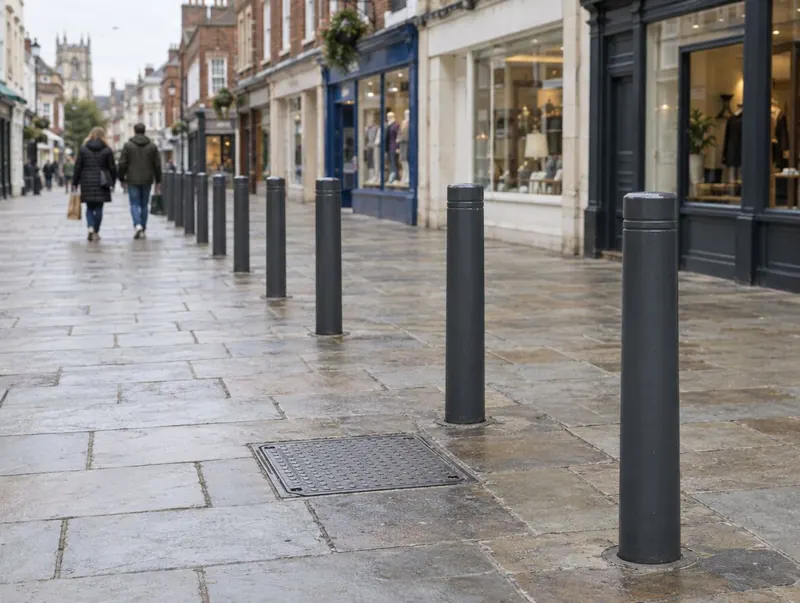 Computer-generated image
About shallow-mount bollards in Carlisle
From retail parks, college campuses and industrial estates, Carlisle has plenty of places where shallow-mount bollards earn their keep. Rated shallow-foundation bollard systems installed where buried services, basements or slabs rule out deep excavation.
Coverage in Carlisle takes in the CA2, CA3, CA1, CA5 and CA4 postcode districts and nearby places like Durdar, Cummersdale, Whiteclosegate and Rickerby. Carlisle is fairly self-contained, with no other large town within about 20 miles.
Local details
- Area
- Cumbria, England
- Highway authority
- Cumberland Council (local roads)
- Planning authority
- Cumberland Council
- Postcodes
- CA2, CA3, CA1, CA5 and CA4
- Guide price
- Typically £1,945–£8,795 per bollard + VAT; minimum job £4,895
- Survey
- Free, with a fixed written quote
Shallow-mount bollards in Carlisle: common uses
Around Carlisle, shallow-mount bollards usually solve one of these:
- Sites where service diversions would be slow or impractical
- Lines that must cross over shallow drainage or ducts
- Listed or historic streets where deep digging is unwelcome
Guide prices for Carlisle
| Specification | Guide price | Includes |
|---|---|---|
| Standard | £1,945–£4,845 + VAT | Rated for a 7.5 t vehicle at 30 mph (48 km/h), tested foundation |
| Upgraded | £3,995–£6,895 + VAT | Rated for 7.5 t at 40 mph (64 km/h), tested foundation |
| Premium | £6,095–£8,795 + VAT | Rated for 7.5 t at 50 mph (80 km/h), or a specialist foundation |
Per bollard position, supplied and installed; -2% for North West. Guide only — the fixed price follows a survey.
Consents, ground and services in Carlisle
Cumberland Council is the highway authority covering Carlisle's local roads. If any post would stand on adopted highway rather than your land, that consent is the first thing we sort out.
Many private-land installations in Carlisle need no planning application, but the rules don't clearly cover bollards, so listed buildings, conservation areas and prominent frontages are worth raising with the planning team at Cumberland Council before posts go in.
Utility owners may set minimum separation distances or ask to be present when digging near their apparatus. Paving is often natural stone in the streets where these systems are used, so careful lifting, storage and relaying is part of the job.
- Agree works and separation distances with utility owners, and with the highway authority where the line is on public highway.
- Keep the test certificate for the exact system and configuration, including the minimum run length and end details.
Installation, step by step
Map what is underground
Utility records, radar scanning and trial holes establish exactly how much depth is available along the line. This is the survey that decides whether a shallow system will fit at all.
Pour, cure and reinstate
Concrete is placed to the specified grade and finish depth, then the surface is rebuilt to match. The line is protected until the specified curing period has passed.
Record and hand over
As-built drawings show the frame position relative to services, which matters for anyone digging nearby later. Product certificates and photographs go to the client's adviser.
Choosing the right spec
| Option | Detail |
|---|---|
| Linked-frame systems | Posts are welded or bolted to a continuous steel frame laid in a shallow trench and encased in concrete. Suited to straight or gently curved lines. |
| Removable posts within a run | Some systems include removable or retractable positions for maintenance or emergency access. Check how these affect the rating. |
| Modular cassette sections | Pre-made sections joined on site, allowing short runs and changes of direction within the manufacturer's tested limits. |
What affects the quote
Our North West guide prices are a starting point; the survey in Carlisle firms them up. What tends to move them:
- Amount of hand digging needed around live services
- Lifting, storing and relaying natural stone paving
- Restricted working hours in busy streets or occupied sites
After installation
Pay attention to the surface around the posts, because settlement or loose paving can indicate movement in the bearing layer. If one post is struck, the frame may have transmitted load to its neighbours, so the whole run near the impact should be checked with the manufacturer rather than replacing a single post in isolation.
For damaged or loose posts in Carlisle, repairs and replacements are priced in writing first.
Questions about shallow-mount bollards in Carlisle
Do you install shallow-mount bollards in Carlisle?
We cover all of Carlisle (CA2, CA3, CA1, CA5 and CA4) and the rest of Cumbria.
Who gives permission for bollards on the pavement in Carlisle?
In Carlisle, work on adopted pavements and verges needs consent from Cumberland Council, the local highway authority. Car parks, forecourts and other private land only need the owner's permission.
What's a typical price for shallow-mount bollards in Carlisle?
In Carlisle, typically £1,945–£8,795 per bollard position, supplied and installed, plus VAT, with a minimum job of £4,895 plus VAT, using our North West guide prices. The fixed figure comes in writing after we've seen the site.
Will future roadworks damage the system?
They can if contractors dig beside it without knowing it is there. That is why we provide as-built drawings showing the frame position. Ask anyone excavating nearby to check those drawings first.
How much shallower is a shallow-mount bollard foundation?
Often a fraction of the depth of a conventional rated foundation, commonly a few hundred millimetres. The exact depth depends on the system and rating chosen. What you gain in depth is usually traded for width, because the load is spread along a linked frame.