Flintshire · Wales
Shallow-mount security bollard installation in Flint
Shallow-mount bollards supplied and fitted in Flint, Flintshire: surveyed, scanned for services, set in proper foundations and finished to match the ground.
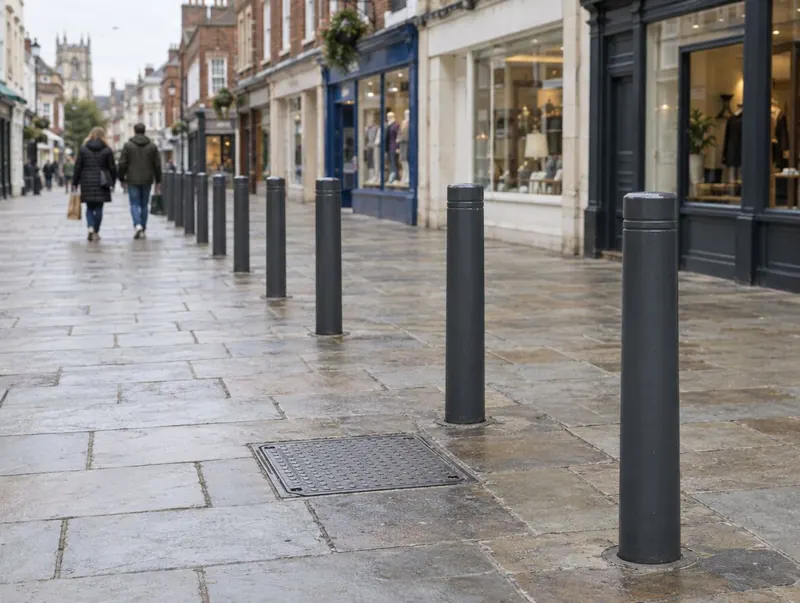 Computer-generated image
About shallow-mount bollards in Flint
Whether it's filling-station forecourts, schools and community car parks, shallow-mount bollards in Flint are planned around who needs to get through and who doesn't. Rated shallow-foundation bollard systems installed where buried services, basements or slabs rule out deep excavation.
Coverage in Flint takes in the CH6 and CH8 postcode districts and nearby places like Bagillt, Whelston, Walwen and Oakenholt. Jobs in Flint can be combined with work in Deeside (4.9 miles), Mold (5.4 miles), Prestatyn (13.1 miles) and Coedpoeth (13.5 miles) (straight-line distances).
Key facts for this area
- Area
- Flintshire, Wales
- Highway authority
- Flintshire County Council (local roads)
- Planning authority
- Flintshire County Council
- Postcodes
- CH6 and CH8
- Guide price
- Typically £1,945–£8,745 per bollard + VAT; minimum job £4,845
- Survey
- Free, with a fixed written quote
Typical shallow-mount bollards jobs in Flint
Around Flint, shallow-mount bollards usually solve one of these:
- Podium decks, car park roofs and basement slabs
- Retrofits outside occupied buildings with tight programmes
- Footways with dense utility runs just below the surface
Flint: typical shallow-mount bollard prices
| Specification | Guide price | Includes |
|---|---|---|
| Standard | £1,945–£4,795 + VAT | Rated for a 7.5 t vehicle at 30 mph (48 km/h), tested foundation |
| Upgraded | £3,995–£6,845 + VAT | Rated for 7.5 t at 40 mph (64 km/h), tested foundation |
| Premium | £5,995–£8,745 + VAT | Rated for 7.5 t at 50 mph (80 km/h), or a specialist foundation |
Per bollard position, supplied and installed; -3% for Wales. Guide only — the fixed price follows a survey.
What we check first in Flint
Before digging near the kerb in Flint we establish who owns the ground: adopted footways are Flintshire County Council's responsibility, trunk roads the Welsh Government's, and everything else belongs to the site owner.
Many private-land installations in Flint need no planning application, but the rules don't clearly cover bollards, so listed buildings, conservation areas and prominent frontages are worth raising with the planning team at Flintshire County Council before posts go in.
Utility owners may set minimum separation distances or ask to be present when digging near their apparatus. Paving is often natural stone in the streets where these systems are used, so careful lifting, storage and relaying is part of the job.
- Agree works and separation distances with utility owners, and with the highway authority where the line is on public highway.
- Keep the test certificate for the exact system and configuration, including the minimum run length and end details.
Installation, step by step
Map what is underground
Utility records, radar scanning and trial holes establish exactly how much depth is available along the line. This is the survey that decides whether a shallow system will fit at all.
Confirm the system with the manufacturer
The survey findings go back to the manufacturer and the client's adviser to confirm the system, its layout and any end details. A fixed written quote follows the free site survey.
Cut and excavate the trench
Paving is lifted and kept for reuse where possible, and a shallow trench is excavated by hand near known services. Where a service sits higher than expected, work stops and the detail is referred back.
Specification choices
| Option | Detail |
|---|---|
| Removable posts within a run | Some systems include removable or retractable positions for maintenance or emergency access. Check how these affect the rating. |
| Modular cassette sections | Pre-made sections joined on site, allowing short runs and changes of direction within the manufacturer's tested limits. |
| Linked-frame systems | Posts are welded or bolted to a continuous steel frame laid in a shallow trench and encased in concrete. Suited to straight or gently curved lines. |
What affects the quote
Our Wales guide prices are a starting point; the survey in Flint firms them up. What tends to move them:
- Restricted working hours in busy streets or occupied sites
- Length of run and the system needed to achieve the rating
- Changes of direction, end details and removable positions
After installation
Pay attention to the surface around the posts, because settlement or loose paving can indicate movement in the bearing layer. Once cured, a shallow-mount line needs much the same care as any static rated barrier: periodic visual checks, cleaning of covers and renewal of visibility bands.
For damaged or loose posts in Flint, repairs and replacements are priced in writing first.
Common questions
Which parts of Flint do you cover for shallow-mount bollards?
We cover all of Flint (CH6 and CH8) and the rest of Flintshire. We also work in Deeside, Mold and Prestatyn.
Who gives permission for bollards on the pavement in Flint?
Local roads and pavements in Flint are the responsibility of Flintshire County Council as highway authority, with the Welsh Government's trunk road agents handling trunk roads. Posts on the public highway need that authority's consent; private land does not.
How much do shallow-mount bollards cost in Flint?
In Flint, typically £1,945–£8,745 per bollard position, supplied and installed, plus VAT, with a minimum job of £4,845 plus VAT, using our Wales guide prices. The fixed figure comes in writing after we've seen the site.
Can shallow-mount bollards go on a car park deck?
Sometimes, if a structural engineer confirms the deck can take the impact loads and the waterproofing can be protected. Decks were not designed with vehicle attacks in mind, so this check comes before anything else. Some manufacturers offer details specifically for structures.
Does a shallow system protect as well as a deep one?
It can achieve the same rating, because both are tested to the same standards. What differs is how the load is resisted. Your security adviser should compare the specific ratings, not the foundation depths.