Flintshire · Wales
Semi-automatic bollard installation in Flint
Semi-automatic bollards supplied and fitted in Flint, Flintshire: surveyed, scanned for services, set in proper foundations and finished to match the ground.
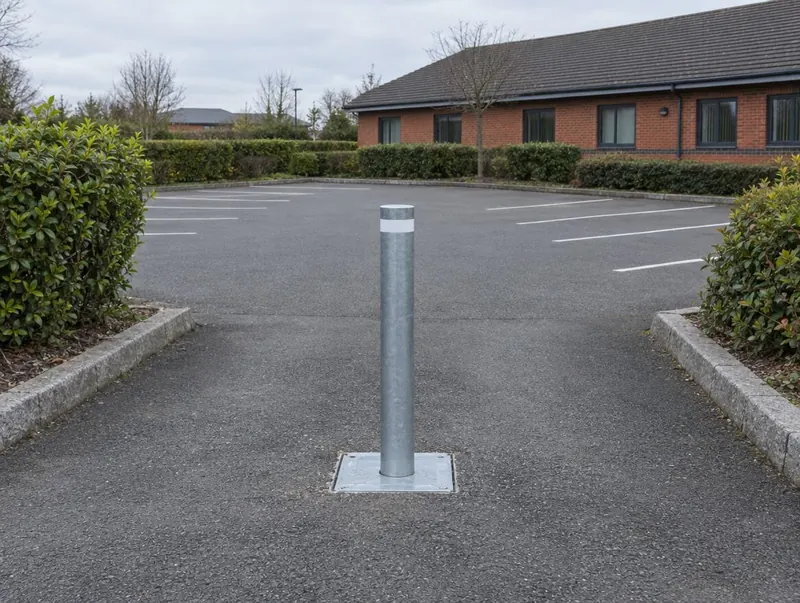 Computer-generated image
About semi-automatic bollards in Flint
Gas-strut assisted bollards that rise on their own when unlocked and lower by hand, with no mains power needed. In Flint, that tends to mean sites such as residential driveways, filling-station forecourts and small industrial units.
We work across CH6 and CH8 — Flint itself and places including Bagillt, Whelston, Walwen and Oakenholt. Nearby, we also work in Deeside (4.9 miles), Mold (5.4 miles), Prestatyn (13.1 miles) and Coedpoeth (13.5 miles), measured as the crow flies.
Local details
- Area
- Flintshire, Wales
- Highway authority
- Flintshire County Council (local roads)
- Planning authority
- Flintshire County Council
- Postcodes
- CH6 and CH8
- Guide price
- Typically £1,045–£3,395 per bollard + VAT (£1,245–£4,045 inc VAT for homes); minimum job £1,145
- Survey
- Free, with a fixed written quote
Typical semi-automatic bollards jobs in Flint
Typical reasons Flint sites choose semi-automatic bollards:
- Locations where automatic bollards are not justified
- Private roads and courtyards with a small number of key holders
- Delivery entrances without a power supply nearby
Semi-automatic bollard prices in Flint
| Specification | Guide price | Includes |
|---|---|---|
| Standard | £1,045–£2,045 + VAT · £1,245–£2,445 inc VAT | Standard post, foundation, reinstatement |
| Upgraded | £1,745–£2,745 + VAT · £2,095–£3,295 inc VAT | Upgraded finish or fittings, reflective band, matched keys |
| Premium | £2,445–£3,395 + VAT · £2,945–£4,045 inc VAT | Heavy-duty or architectural spec, premium finish |
Per bollard, supplied and installed; -3% for Wales. Guide only — the fixed price follows a survey.
Permissions and groundwork in Flint
In Flint the highway authority for local roads is Flintshire County Council. We confirm whether the ground is adopted highway before quoting, because semi-automatic bollards on a public footway need its agreement first.
Many private-land installations in Flint need no planning application, but the rules don't clearly cover bollards, so listed buildings, conservation areas and prominent frontages are worth raising with the planning team at Flintshire County Council before posts go in.
On sandy or gravel ground a soakaway beneath the cassette often drains it adequately; on clay, chalk with poor drainage or where groundwater rises, a pipe to a surface water drain or a dedicated soakaway is needed. Because the cassette houses both the post and its strut mechanism, the pit is deep and must stay dry.
- Keep clear gaps of typically at least 1,000–1,200 mm where pedestrians pass between posts, referring to Inclusive Mobility guidance.
- Warn users and passers-by that the post rises on its own; fit reflective bands and consider a sign at busy sites.
How the job runs
Excavate the pit
The surface is cut and the pit dug to the cassette depth plus a drainage layer, by hand near services.
Reinstate the surface
Paving or surfacing is made good tight to the cassette collar so there is no lip for tyres or feet to catch.
Test and show users
The post is cycled several times to check it rises fully, locks at both heights and lowers smoothly. Users are shown how to operate it and to keep clear of the head when it rises.
Finishes and options
| Option | Detail |
|---|---|
| Gas strut or spring assist | Most models use a gas strut; some use springs. Both store energy to raise the post when unlocked. |
| Finishes | Galvanised and powder-coated or stainless steel, with reflective bands for visibility. |
| Lock types | Keyed cylinder locks, typically operating at ground level, with keyed-alike options for multi-post sites. |
What moves the price in Flint
Two Flint jobs with the same number of posts can price quite differently. The usual reasons:
- Number of posts and keyed-alike locks
- Finish and any head lighting
- Excavation depth and services in the way
After installation
Watch the rising speed: when it slows or the post no longer reaches full height, the strut is losing pressure and should be replaced before it fails altogether. If several posts on one site were installed at the same time, their struts tend to wear at a similar rate, so it can make sense to replace them together.
For damaged or loose posts in Flint, repairs and replacements are priced in writing first.
Semi-automatic bollards in Flint: FAQs
Do you install semi-automatic bollards in Flint?
We cover all of Flint (CH6 and CH8) and the rest of Flintshire. We also work in Deeside, Mold and Prestatyn.
Who gives permission for bollards on the pavement in Flint?
Local roads and pavements in Flint are the responsibility of Flintshire County Council as highway authority, with the Welsh Government's trunk road agents handling trunk roads. Posts on the public highway need that authority's consent; private land does not.
What's a typical price for semi-automatic bollards in Flint?
In Flint, typically £1,045–£3,395 per bollard, supplied and installed, plus VAT (£1,245–£4,045 including VAT for homeowners), with a minimum job of £1,145 plus VAT, using our Wales guide prices. The fixed figure comes in writing after we've seen the site.
Do semi-automatic bollards suit domestic driveways?
Yes, if the owner wants less lifting than a telescopic post. The same depth and drainage checks apply. Domestic models are lighter duty than commercial ones.
Is it hard to push the bollard back down?
Not usually; most users press it down with a hand or foot. The strut resists, so it needs a steady push rather than a sharp kick. Heavier commercial models take more effort than domestic ones.