Flintshire · Wales
Semi-automatic bollard installation in Mold
Planning semi-automatic bollards in Mold? We check ownership, consents and buried services first, then quote a fixed price.
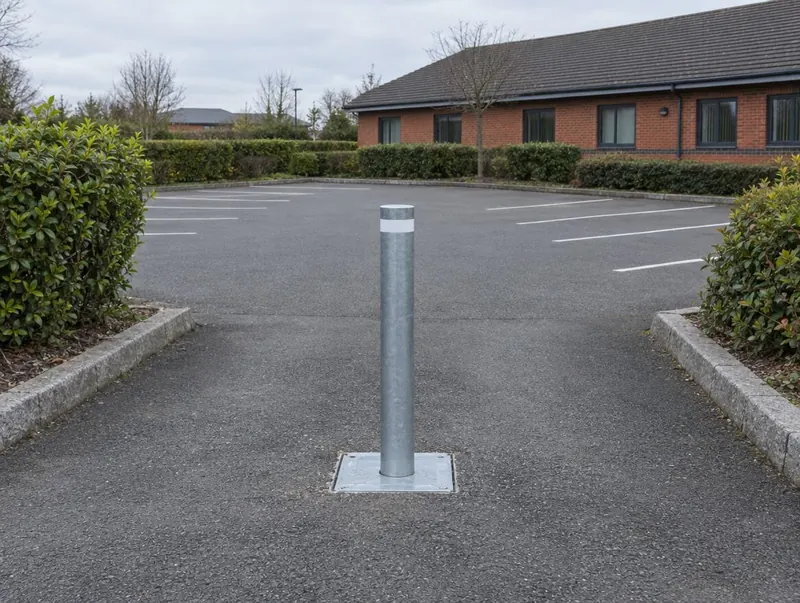 Computer-generated image
About semi-automatic bollards in Mold
In the town of Mold, semi-automatic bollards tend to go in at community buildings, residential driveways and community car parks. Gas-strut assisted bollards that rise on their own when unlocked and lower by hand, with no mains power needed.
Coverage in Mold takes in the CH7 postcode district and nearby places like Mynydd Isa, Northop Hall, Drury and Treuddyn. Nearby, we also work in Deeside (4.9 miles), Flint (5.4 miles), Coedpoeth (8.5 miles) and Wrexham (10.4 miles), measured as the crow flies.
Key facts for this area
- Area
- Flintshire, Wales
- Highway authority
- Flintshire County Council (local roads)
- Planning authority
- Flintshire County Council
- Postcodes
- CH7
- Guide price
- Typically £1,045–£3,395 per bollard + VAT (£1,245–£4,045 inc VAT for homes); minimum job £1,145
- Survey
- Free, with a fixed written quote
Semi-automatic bollard prices in Mold
| Specification | Guide price | Includes |
|---|---|---|
| Standard | £1,045–£2,045 + VAT · £1,245–£2,445 inc VAT | Standard post, foundation, reinstatement |
| Upgraded | £1,745–£2,745 + VAT · £2,095–£3,295 inc VAT | Upgraded finish or fittings, reflective band, matched keys |
| Premium | £2,445–£3,395 + VAT · £2,945–£4,045 inc VAT | Heavy-duty or architectural spec, premium finish |
Per bollard, supplied and installed; -3% for Wales. Guide only — the fixed price follows a survey.
Where semi-automatic bollards go in around Mold
Common uses in a place like Mold:
- Sites where telescopic posts are too heavy for regular users
- Staff car parks and reserved bays used several times a day
- Locations where automatic bollards are not justified
Permissions and groundwork in Mold
Local roads and pavements in Mold are the responsibility of Flintshire County Council as highway authority, with the Welsh Government's trunk road agents handling trunk roads. Posts on the public highway need that authority's consent; private land does not.
Bollards on private land often don't need planning permission, but it depends on the council's view, the height and the location; in a conservation area, next to a listed building or under an Article 4 direction, ask the local planning authority (Flintshire County Council) first — we flag this at survey.
Because the cassette houses both the post and its strut mechanism, the pit is deep and must stay dry. On sandy or gravel ground a soakaway beneath the cassette often drains it adequately; on clay, chalk with poor drainage or where groundwater rises, a pipe to a surface water drain or a dedicated soakaway is needed.
- Check land ownership; bollards on public highway need the highway authority's agreement.
- Warn users and passers-by that the post rises on its own; fit reflective bands and consider a sign at busy sites.
From survey to handover
Survey use and ground
At the free site survey we look at how often the post will be used, who will operate it and what is under the surface. A fixed written quote follows, including drainage.
Set the cassette
The cassette is set plumb and flush with the finished surface, connected to drainage and concreted in. The strut is fitted or released only as the manufacturer instructs.
Test and show users
The post is cycled several times to check it rises fully, locks at both heights and lowers smoothly. Users are shown how to operate it and to keep clear of the head when it rises.
Options to consider
| Option | Detail |
|---|---|
| Head lighting | Some models include battery or solar LEDs in the head to improve visibility on unlit sites. |
| Finishes | Galvanised and powder-coated or stainless steel, with reflective bands for visibility. |
| Gas strut or spring assist | Most models use a gas strut; some use springs. Both store energy to raise the post when unlocked. |
What affects the quote
When we price semi-automatic bollards in Mold, these make the biggest difference:
- Number of posts and keyed-alike locks
- Drainage method
- Finish and any head lighting
Keeping them working
Watch the rising speed: when it slows or the post no longer reaches full height, the strut is losing pressure and should be replaced before it fails altogether. Operate the bollard regularly and keep the head and lid clear of grit.
We can also service, repair or replace existing posts anywhere in Mold.
Semi-automatic bollards in Mold: FAQs
Can you install semi-automatic bollards anywhere in Mold?
We cover all of Mold (CH7) and the rest of Flintshire. We also work in Deeside, Flint and Coedpoeth.
Do I need consent for semi-automatic bollards on a public footway in Mold?
Before digging near the kerb in Mold we establish who owns the ground: adopted footways are Flintshire County Council's responsibility, trunk roads the Welsh Government's, and everything else belongs to the site owner.
How much do semi-automatic bollards cost in Mold?
In Mold, typically £1,045–£3,395 per bollard, supplied and installed, plus VAT (£1,245–£4,045 including VAT for homeowners), with a minimum job of £1,145 plus VAT, using our Wales guide prices. The fixed figure comes in writing after we've seen the site.
How is a semi-automatic bollard different from an automatic one?
An automatic bollard is powered and controlled by a panel, loops and access devices. A semi-automatic one rises on its own when unlocked but must be pushed down by hand. It needs no electrics, which keeps installation simpler.
Why has my semi-automatic bollard stopped rising fully?
Usually because the gas strut has lost pressure, or debris and water in the cassette are slowing it. Check and clean the cassette first. If it still stops short, the strut needs replacing.