Lancashire · England
Shallow-mount security bollard installation in Chorley
Planning shallow-mount bollards in Chorley? We check ownership, consents and buried services first, then quote a fixed price.
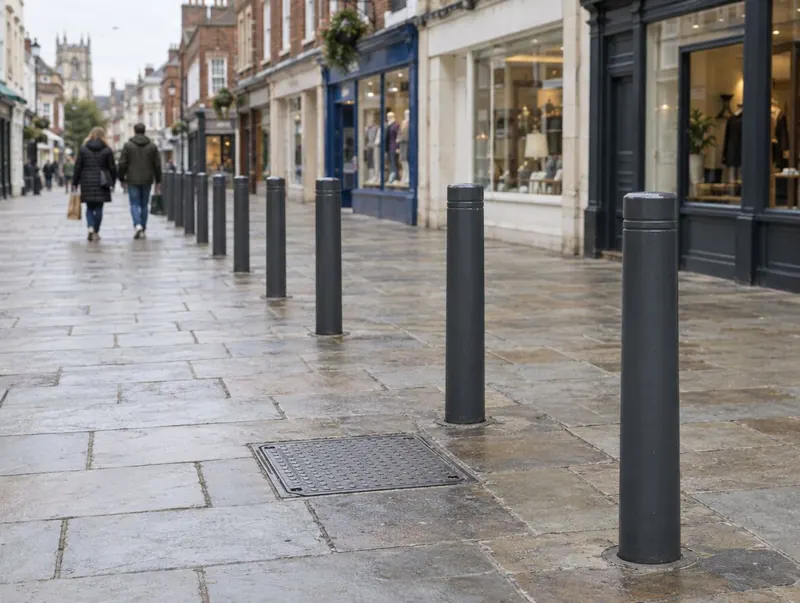 Computer-generated image
About shallow-mount bollards in Chorley
Like any rated product, its performance applies only to the configuration and foundation that were tested. In Chorley, that tends to mean sites such as filling-station forecourts, small industrial units and high street shopfronts.
We work across PR6 and PR7 — Chorley itself and places including Adlington, Whittle-le-Woods, Brinscall and Withnell. Jobs in Chorley can be combined with work in Leyland (4.4 miles), Darwen (7 miles), Wigan (7.4 miles) and Westhoughton (7.9 miles) (straight-line distances). Preston is around 9 miles away.
Key facts for this area
- Area
- Lancashire, England
- Highway authority
- Lancashire County Council (local roads)
- Planning authority
- the council for Chorley
- Postcodes
- PR6 and PR7
- Guide price
- Typically £1,945–£8,795 per bollard + VAT; minimum job £4,895
- Survey
- Free, with a fixed written quote
- Nearby
- Leyland (4.4 mi), Darwen (7 mi), Wigan (7.4 mi), Westhoughton (7.9 mi)
Where shallow-mount bollards go in around Chorley
Common uses in a place like Chorley:
- Bridges and structures where excavation depth is limited
- Lines that must cross over shallow drainage or ducts
- Podium decks, car park roofs and basement slabs
Guide prices for Chorley
| Specification | Guide price | Includes |
|---|---|---|
| Standard | £1,945–£4,845 + VAT | Rated for a 7.5 t vehicle at 30 mph (48 km/h), tested foundation |
| Upgraded | £3,995–£6,895 + VAT | Rated for 7.5 t at 40 mph (64 km/h), tested foundation |
| Premium | £6,095–£8,795 + VAT | Rated for 7.5 t at 50 mph (80 km/h), or a specialist foundation |
Per bollard position, supplied and installed; -2% for North West. Guide only — the fixed price follows a survey.
Consents, ground and services in Chorley
In Chorley, work on adopted pavements and verges needs consent from Lancashire County Council, the local highway authority. Car parks, forecourts and other private land only need the owner's permission.
If your site in Chorley is listed or inside a conservation area, check with the local planning authority (the council for Chorley) before choosing a finish — heritage settings often favour cast iron or painted steel over stainless.
On decks and roofs, the waterproofing and drainage layers must be protected or rebuilt, and fixings must not puncture membranes unless the structural and waterproofing designers have agreed a detail. Paving is often natural stone in the streets where these systems are used, so careful lifting, storage and relaying is part of the job.
- Keep the test certificate for the exact system and configuration, including the minimum run length and end details.
- Agree works and separation distances with utility owners, and with the highway authority where the line is on public highway.
Installation, step by step
Map what is underground
Utility records, radar scanning and trial holes establish exactly how much depth is available along the line. This is the survey that decides whether a shallow system will fit at all.
Cut and excavate the trench
Paving is lifted and kept for reuse where possible, and a shallow trench is excavated by hand near known services. Where a service sits higher than expected, work stops and the detail is referred back.
Record and hand over
As-built drawings show the frame position relative to services, which matters for anyone digging nearby later. Product certificates and photographs go to the client's adviser.
Options to consider
| Option | Detail |
|---|---|
| Covers and sleeves | Stainless, cast or powder-coated covers fitted over the cores to match surrounding street furniture, supplied or approved by the manufacturer. |
| Removable posts within a run | Some systems include removable or retractable positions for maintenance or emergency access. Check how these affect the rating. |
| Surface-mounted rated units | Some tested products sit on or very close to the surface with minimal digging. These are often used for temporary or semi-permanent protection and need careful checking of the surface they bear on. |
What affects the quote
Two Chorley jobs with the same number of posts can price quite differently. The usual reasons:
- Lifting, storing and relaying natural stone paving
- Changes of direction, end details and removable positions
- Length of run and the system needed to achieve the rating
Looking after them
Once cured, a shallow-mount line needs much the same care as any static rated barrier: periodic visual checks, cleaning of covers and renewal of visibility bands. Pay attention to the surface around the posts, because settlement or loose paving can indicate movement in the bearing layer.
If posts in Chorley are later hit or damaged, we can repair or replace them — see bollard repairs.
Shallow-mount bollards in Chorley: FAQs
Can you install shallow-mount bollards anywhere in Chorley?
We cover all of Chorley (PR6 and PR7) and the rest of Lancashire. We also work in Leyland, Darwen and Wigan.
Do I need consent for shallow-mount bollards on a public footway in Chorley?
The highway authority for local roads in Chorley is Lancashire County Council; motorways and trunk roads sit with National Highways. Shallow-mount bollards on the adopted footway are a matter for the highway authority, so we only install there with its written agreement.
What's a typical price for shallow-mount bollards in Chorley?
In Chorley, typically £1,945–£8,795 per bollard position, supplied and installed, plus VAT, with a minimum job of £4,895 plus VAT, using our North West guide prices. The fixed figure comes in writing after we've seen the site.
Can I install a single shallow-mount bollard on its own?
Usually not. Most shallow systems rely on several posts working together, and the rating applies to a tested run with a stated minimum number of posts. A single position generally needs a different solution.
Can shallow-mount bollards go on a car park deck?
Sometimes, if a structural engineer confirms the deck can take the impact loads and the waterproofing can be protected. Decks were not designed with vehicle attacks in mind, so this check comes before anything else. Some manufacturers offer details specifically for structures.