Hampshire · England
Stainless steel bollards and covers in Southampton
Stainless steel bollards supplied and fitted in Southampton, Hampshire: surveyed, scanned for services, set in proper foundations and finished to match the ground.
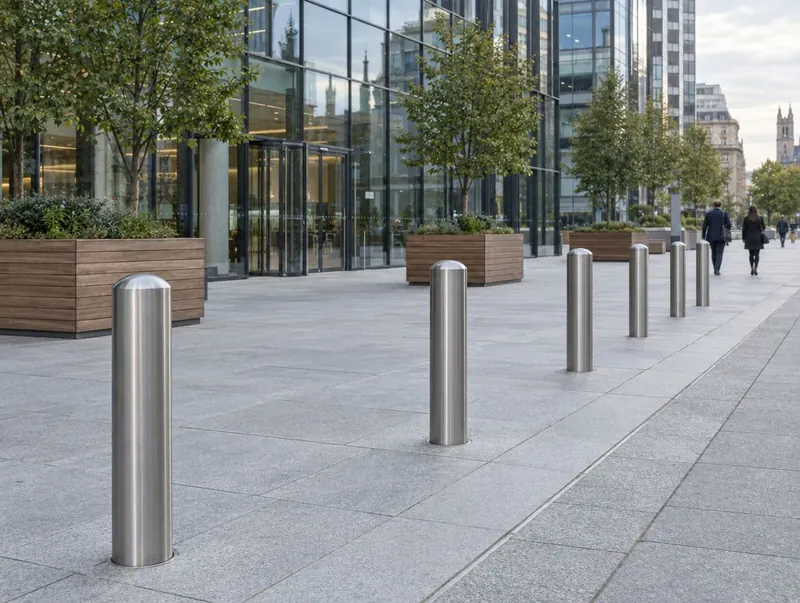 Computer-generated image
Stainless steel bollards in Southampton
Across Southampton, typical sites for stainless steel bollards include retail parks, university campuses and pedestrianised streets. Grade 304 suits most inland sites, while 316 is preferred near the coast, pools or heavy de-icing salt.
Coverage in Southampton takes in the SO14, SO15, SO17, SO19, SO18 and SO16 postcode districts. We also cover neighbouring Hythe (3 miles), Totton (3.9 miles), Eastleigh (4.9 miles) and Fareham (10.5 miles) — distances are straight-line. Portsmouth is around 15 miles away.
Southampton at a glance
- Area
- Hampshire, England
- Highway authority
- Southampton City Council (local roads)
- Planning authority
- Southampton City Council
- Postcodes
- SO14, SO15, SO17, SO19, SO18 and SO16
- Guide price
- Typically £315–£1,245 per bollard + VAT (£375–£1,495 inc VAT for homes); minimum job £735
- Survey
- Free, with a fixed written quote
Southampton: typical stainless steel bollard prices
| Specification | Guide price | Includes |
|---|---|---|
| Standard | £315–£715 + VAT · £375–£855 inc VAT | Standard post, foundation, reinstatement |
| Upgraded | £595–£995 + VAT · £705–£1,195 inc VAT | Upgraded finish or fittings, reflective band, matched keys |
| Premium | £885–£1,245 + VAT · £1,045–£1,495 inc VAT | Heavy-duty or architectural spec, premium finish |
Per bollard, supplied and installed; +6% for South East. Guide only — the fixed price follows a survey.
Stainless steel bollards in Southampton: common uses
Common uses in a place like Southampton:
- Disguising crash-rated cores as ordinary street furniture
- Retail parks and shopping centre frontages
- Sleeving existing painted steel posts that have become tatty
Permissions and groundwork in Southampton
In Southampton, work on adopted pavements and verges needs consent from Southampton City Council, the local highway authority. Car parks, forecourts and other private land only need the owner's permission.
Bollards on private land often don't need planning permission, but it depends on the council's view, the height and the location; in a conservation area, next to a listed building or under an Article 4 direction, ask the local planning authority (Southampton City Council) first — we flag this at survey.
The difference is in handling. Stainless can be stained by iron particles from cutting discs, drills and steel tools used nearby, and those particles rust on the surface within days.
- Add a contrasting band near the top, because bare stainless can blend into pale paving for partially sighted people.
- Check with the local planning authority before installing in conservation areas or beside listed buildings, where stainless may not be considered appropriate.
Installation, step by step
Prepare the cores
For covers, existing posts are checked for straightness, loose foundations and corrosion. Cores that lean or move are re-bedded first, because a cover will not hide a failing post for long.
Install new posts
New solid stainless posts are set in concrete, bolted down or fitted into sockets, with care taken not to scratch the finish or contaminate it with carbon steel tools.
Clean and protect
Fingerprints, grinding dust and adhesive residue are cleaned off with suitable stainless cleaners, and the protective film is removed only when surrounding work is finished.
Finishes and options
| Option | Detail |
|---|---|
| Grade 304 or 316 | 304 for most inland locations; 316 near the coast, swimming pools, or roads and car parks salted heavily in winter. |
| Heads and details | Domed, flat, angled or ball tops, grooved bands, engraved logos and inset reflective strips. |
| Covers for rated bollards | Manufacturer-supplied or approved covers for crash-tested cores so the security rating is not compromised. |
What moves the price in Southampton
Our South East guide prices are a starting point; the survey in Southampton firms them up. What tends to move them:
- Condition of existing cores and any re-bedding needed
- Grade 304 or 316 and the surface finish
- Diameter and height, and any custom heads or engraving
Looking after them
Check covers for loose fixings and rattles, and look at the base for trapped water or rust from an old core underneath. Stainless steel is low maintenance, not no maintenance.
For damaged or loose posts in Southampton, repairs and replacements are priced in writing first.
Stainless steel bollards in Southampton: FAQs
Can you install stainless steel bollards anywhere in Southampton?
We cover all of Southampton (SO14, SO15, SO17, SO19, SO18 and SO16) and the rest of Hampshire. We also work in Hythe, Totton and Eastleigh.
Do I need consent for stainless steel bollards on a public footway in Southampton?
In Southampton, work on adopted pavements and verges needs consent from Southampton City Council, the local highway authority. Car parks, forecourts and other private land only need the owner's permission.
What's a typical price for stainless steel bollards in Southampton?
In Southampton, typically £315–£1,245 per bollard, supplied and installed, plus VAT (£375–£1,495 including VAT for homeowners), with a minimum job of £735 plus VAT, using our South East guide prices. The fixed figure comes in writing after we've seen the site.
How should stainless bollards be cleaned?
With water and mild detergent, then rinsed and dried, more often in coastal or salty conditions. Use stainless cleaners and non-scratch pads for marks. Never use wire wool or steel brushes.
Should I choose 304 or 316 stainless for bollards?
Choose 316 if the bollards are near the sea, a swimming pool or a road that is salted heavily; choose 304 for most other locations. The extra resistance of 316 to chlorides is what stops brown staining in those settings.