Hampshire · England
Shallow-mount security bollard installation in Southampton
Local installation of shallow-mount bollards in Southampton — free survey, fixed written price, and posts set to the right spacing for people and vehicles.
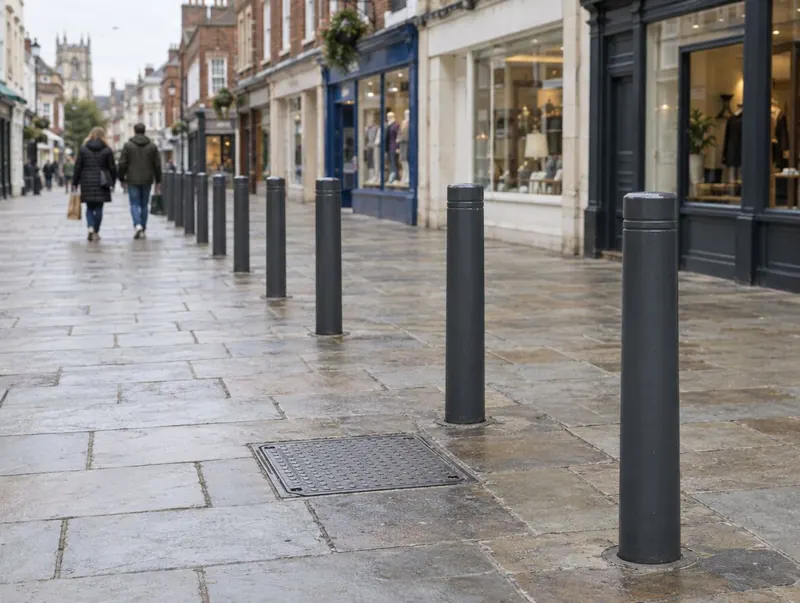 Computer-generated image
About shallow-mount bollards in Southampton
Across Southampton, typical sites for shallow-mount bollards include retail parks, office forecourts and pedestrianised streets. Rated shallow-foundation bollard systems installed where buried services, basements or slabs rule out deep excavation.
We cover every part of Southampton in the SO14, SO15, SO17, SO19, SO18 and SO16 postcode districts. Jobs in Southampton can be combined with work in Hythe (3 miles), Totton (3.9 miles), Eastleigh (4.9 miles) and Fareham (10.5 miles) (straight-line distances). Portsmouth is around 15 miles away.
Key facts for this area
- Area
- Hampshire, England
- Highway authority
- Southampton City Council (local roads)
- Planning authority
- Southampton City Council
- Postcodes
- SO14, SO15, SO17, SO19, SO18 and SO16
- Guide price
- Typically £2,095–£9,545 per bollard + VAT; minimum job £5,295
- Survey
- Free, with a fixed written quote
What shallow-mount bollards cost in Southampton
| Specification | Guide price | Includes |
|---|---|---|
| Standard | £2,095–£5,245 + VAT | Rated for a 7.5 t vehicle at 30 mph (48 km/h), tested foundation |
| Upgraded | £4,345–£7,445 + VAT | Rated for 7.5 t at 40 mph (64 km/h), tested foundation |
| Premium | £6,545–£9,545 + VAT | Rated for 7.5 t at 50 mph (80 km/h), or a specialist foundation |
Per bollard position, supplied and installed; +6% for South East. Guide only — the fixed price follows a survey.
Typical shallow-mount bollards jobs in Southampton
Common uses in a place like Southampton:
- Retrofits outside occupied buildings with tight programmes
- Podium decks, car park roofs and basement slabs
- Bridges and structures where excavation depth is limited
Consents, ground and services in Southampton
In Southampton, work on adopted pavements and verges needs consent from Southampton City Council, the local highway authority. Car parks, forecourts and other private land only need the owner's permission.
Bollards on private land often don't need planning permission, but it depends on the council's view, the height and the location; in a conservation area, next to a listed building or under an Article 4 direction, ask the local planning authority (Southampton City Council) first — we flag this at survey.
Utility owners may set minimum separation distances or ask to be present when digging near their apparatus. On decks and roofs, the waterproofing and drainage layers must be protected or rebuilt, and fixings must not puncture membranes unless the structural and waterproofing designers have agreed a detail.
- Record the frame's position on as-built drawings so future excavation near the line can be planned safely.
- Keep the test certificate for the exact system and configuration, including the minimum run length and end details.
How the job runs
Confirm the system with the manufacturer
The survey findings go back to the manufacturer and the client's adviser to confirm the system, its layout and any end details. A fixed written quote follows the free site survey.
Assemble and level the frame
Frame sections are placed, joined and set to line and level, with posts fixed as the drawing shows. Joints and fixings are photographed before any concrete goes in.
Pour, cure and reinstate
Concrete is placed to the specified grade and finish depth, then the surface is rebuilt to match. The line is protected until the specified curing period has passed.
Specification choices
| Option | Detail |
|---|---|
| Rated planters and street furniture | Benches, planters and cycle stands built around a tested shallow core, used where a line of posts would look out of place. |
| Covers and sleeves | Stainless, cast or powder-coated covers fitted over the cores to match surrounding street furniture, supplied or approved by the manufacturer. |
| Linked-frame systems | Posts are welded or bolted to a continuous steel frame laid in a shallow trench and encased in concrete. Suited to straight or gently curved lines. |
What affects the quote
Our South East guide prices are a starting point; the survey in Southampton firms them up. What tends to move them:
- Changes of direction, end details and removable positions
- Length of run and the system needed to achieve the rating
- Amount of hand digging needed around live services
Keeping them working
If one post is struck, the frame may have transmitted load to its neighbours, so the whole run near the impact should be checked with the manufacturer rather than replacing a single post in isolation. Any later utility work beside the line should be supervised so the frame is not undermined.
For damaged or loose posts in Southampton, repairs and replacements are priced in writing first.
Shallow-mount bollards in Southampton: FAQs
Can you install shallow-mount bollards anywhere in Southampton?
We cover all of Southampton (SO14, SO15, SO17, SO19, SO18 and SO16) and the rest of Hampshire. We also work in Hythe, Totton and Eastleigh.
Who gives permission for bollards on the pavement in Southampton?
The highway authority for local roads in Southampton is Southampton City Council; motorways and trunk roads sit with National Highways. Shallow-mount bollards on the adopted footway are a matter for the highway authority, so we only install there with its written agreement.
How much do shallow-mount bollards cost in Southampton?
In Southampton, typically £2,095–£9,545 per bollard position, supplied and installed, plus VAT, with a minimum job of £5,295 plus VAT, using our South East guide prices. The fixed figure comes in writing after we've seen the site.
Can I install a single shallow-mount bollard on its own?
Usually not. Most shallow systems rely on several posts working together, and the rating applies to a tested run with a stated minimum number of posts. A single position generally needs a different solution.
Does a shallow system protect as well as a deep one?
It can achieve the same rating, because both are tested to the same standards. What differs is how the load is resisted. Your security adviser should compare the specific ratings, not the foundation depths.