Herefordshire · England
Stainless steel bollards and covers in Leominster
Planning stainless steel bollards in Leominster? We check ownership, consents and buried services first, then quote a fixed price.
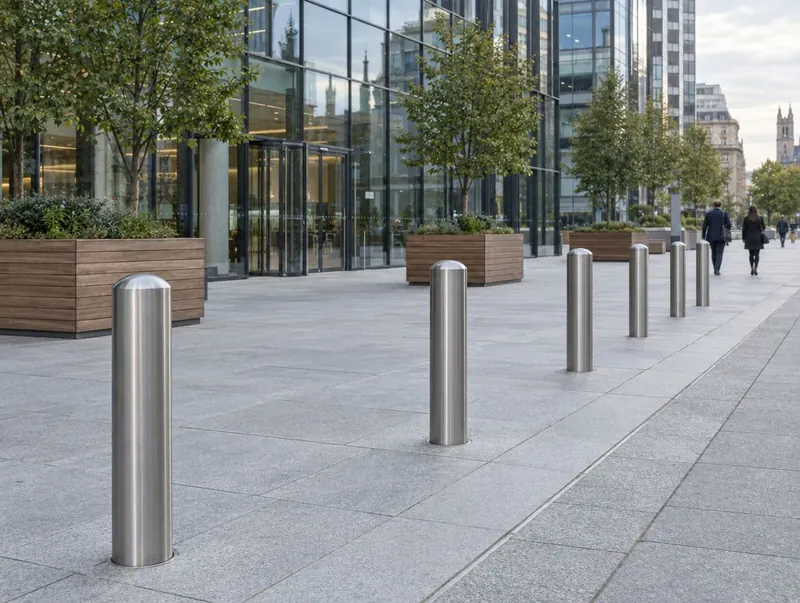 Computer-generated image
Stainless steel bollards in Leominster
Stainless steel bollards suit plenty of Leominster sites, community car parks, schools and small industrial units among them. Stainless steel bollards and sleeve covers in 304 or 316 grade, for building entrances, plazas and upgrading tired steel posts.
We work across HR6 — Leominster itself and places including Kingsland, Pembridge, Shobdon and Wigmore. Nearby, we also work in Hereford (11.7 miles), Great Malvern (19.5 miles) and Stourport-on-Severn (21.2 miles), measured as the crow flies. Wolverhampton is around 36 miles away.
Local details
- Area
- Herefordshire, England
- Highway authority
- Herefordshire Council (local roads)
- Planning authority
- Herefordshire Council
- Postcodes
- HR6
- Guide price
- Typically £295–£1,195 per bollard + VAT (£345–£1,445 inc VAT for homes); minimum job £695
- Survey
- Free, with a fixed written quote
- Nearby
- Hereford (11.7 mi), Great Malvern (19.5 mi), Stourport-on-Severn (21.2 mi)
Guide prices for Leominster
| Specification | Guide price | Includes |
|---|---|---|
| Standard | £295–£675 + VAT · £345–£805 inc VAT | Standard post, foundation, reinstatement |
| Upgraded | £565–£945 + VAT · £675–£1,145 inc VAT | Upgraded finish or fittings, reflective band, matched keys |
| Premium | £835–£1,195 + VAT · £995–£1,445 inc VAT | Heavy-duty or architectural spec, premium finish |
Per bollard, supplied and installed; no regional adjustment. Guide only — the fixed price follows a survey.
Where stainless steel bollards go in around Leominster
Common uses in a place like Leominster:
- Retail parks and shopping centre frontages
- Disguising crash-rated cores as ordinary street furniture
- Coastal and poolside sites where paint finishes fail
Consents, ground and services in Leominster
In Leominster, work on adopted pavements and verges needs consent from Herefordshire Council, the local highway authority. Car parks, forecourts and other private land only need the owner's permission.
If your site in Leominster is listed or inside a conservation area, check with the local planning authority (Herefordshire Council) before choosing a finish — heritage settings often favour cast iron or painted steel over stainless.
Where covers go over existing posts, there is usually no excavation at all, but the base of the old post often sits in broken surfacing that is worth making good at the same time so the cover finishes neatly against a clean edge. Stainless can be stained by iron particles from cutting discs, drills and steel tools used nearby, and those particles rust on the surface within days.
- Add a contrasting band near the top, because bare stainless can blend into pale paving for partially sighted people.
- On crash-rated bollards, confirm with the manufacturer that the cover is approved for the tested product.
From survey to handover
Survey and match
A free site survey records existing cores, diameters, heights and the setting, including any salt or coastal exposure that points to 316. You receive a fixed written quote covering grade, finish and fixing.
Install new posts
New solid stainless posts are set in concrete, bolted down or fitted into sockets, with care taken not to scratch the finish or contaminate it with carbon steel tools.
Clean and protect
Fingerprints, grinding dust and adhesive residue are cleaned off with suitable stainless cleaners, and the protective film is removed only when surrounding work is finished.
Choosing the right spec
| Option | Detail |
|---|---|
| Brushed or polished finish | Satin brushed finishes hide fingerprints and light scratches; mirror polish is striking but shows every mark. |
| Sleeve covers | Stainless sleeves over existing or new steel cores, sized to the core diameter, to refresh or upgrade appearance. |
| Grade 304 or 316 | 304 for most inland locations; 316 near the coast, swimming pools, or roads and car parks salted heavily in winter. |
Pricing stainless steel bollards in Leominster
Two Leominster jobs with the same number of posts can price quite differently. The usual reasons:
- Surface reinstatement and protection of the finish during works
- Condition of existing cores and any re-bedding needed
- Diameter and height, and any custom heads or engraving
Looking after them
Light tea staining can be removed with a stainless cleaner and a non-scratch pad, working with the grain of a brushed finish. Wash it periodically with water and a mild detergent, more often near the coast or busy roads, and rinse off road salt after winter.
If posts in Leominster are later hit or damaged, we can repair or replace them — see bollard repairs.
Common questions
Can you install stainless steel bollards anywhere in Leominster?
We cover all of Leominster (HR6) and the rest of Herefordshire. We also work in Hereford, Great Malvern and Stourport-on-Severn.
Who gives permission for bollards on the pavement in Leominster?
The highway authority for local roads in Leominster is Herefordshire Council; motorways and trunk roads sit with National Highways. Stainless steel bollards on the adopted footway are a matter for the highway authority, so we only install there with its written agreement.
What's a typical price for stainless steel bollards in Leominster?
In Leominster, typically £295–£1,195 per bollard, supplied and installed, plus VAT (£345–£1,445 including VAT for homeowners), with a minimum job of £695 plus VAT, using our West Midlands guide prices. The fixed figure comes in writing after we've seen the site.
Are stainless bollards stronger than steel ones?
Not necessarily. Stainless tube is often thinner-walled, so strength depends on wall thickness, infill and fixing. Many stainless posts get their strength from a concrete fill or a steel core inside.
How should stainless bollards be cleaned?
With water and mild detergent, then rinsed and dried, more often in coastal or salty conditions. Use stainless cleaners and non-scratch pads for marks. Never use wire wool or steel brushes.